Sign In
Upcoming Event
 Free Newsletter

Governor highlights economic growth, public safety in business address
Steve Lombard//August 30, 2024//

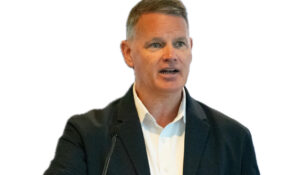
Gov. Brad Little greets the audience after being introduced at a luncheon held at The Grove Hotel in dowtown Boise. The event was organized by the Boise Metro Chamber of Commerce. (PHOTO: MARC LUTZ, IBR)
Governor highlights economic growth, public safety in business address
Steve Lombard//August 30, 2024//


Safety, economic growth and the guidance of a fiscally responsible state government are the keys to maintaining Idaho’s special place moving forward for today’s generation and the next, Gov. Brad Little told a group of state business leaders during his recent annual address to the business community.
During his brief presentation, the governor focused on these topics and shared his thoughts on where the Gem State has been and where he sees it going to more than 300 attendees at a luncheon organized by the Boise Metro Chamber of Commerce on Aug. 21 at The Grove Hotel in downtown Boise.
From the start, Gov. Little highlighted Idaho’s track record for managing state coffers and the importance of creating and sustaining economic prosperity for residents statewide.
“Idaho is ranked No. 1 in individual income growth, and this is very important to me as we have given more tax relief per capita than any state in the nation,” Little said. “And we are considered one of the most fiscally responsible states. We are number one for economic momentum, and we rank in the top 10 for best economy.”
All positive factors, he said, despite the brief economic downturn the state has experienced recently.
“Obviously the economy has cooled from the hyper-growth we had post pandemic but we did recover faster than any other state after being given a jump start to help our economy,” Little said.
However, the “biggest questions” faced by his administration the governor pointed out come from dealing with rapid growth and inflation.
“Growth is something that I consider us to be a victim of our own success,” he said. “But that relates to everything, from K-12 schools to post-K-12 schools, roads, water and housing. Those are the issues that growth and inflation present as the biggest challenges for our communities.”

As vice chairman of the board for the Idaho Housing and Finance Association, Mark Dunham said the governor has always been a “huge champion” when it comes to economic development and housing.
“At Idaho Housing, we appreciate his leadership and we came today because we wanted to know more about what the governor sees as the economic direction for the state.”
As part of that direction, the governor took a moment to acknowledge the vital role of small businesses and the collective leadership of the Idaho business community.
“Idaho is a great place to do business, and that does not happen automatically,” Little said. “We are one of the top three states when it comes to small businesses. And I know that business leaders in this room, those who have been in Idaho a long time, have been a part of our dynamic growth.”
For Steve Abiador, vice president of the Boise office of WSP USA, a global engineering firm, Idaho’s fast-paced growth remains a huge topic of interest for his outfit.
“I wanted to know more about the governor’s sense of priorities and how they will impact our business and infrastructure as the valley continues to grow rapidly,” Abiador said.
According to Little, a big factor in spurring growth has been the state’s willingness to remove what he called “impediments” that can impact existing businesses and allow new businesses to thrive.
“At the state level, my legislative partners and I have done the right thing by turning a significant amount of money back to the taxpayers,” he said. “We’ve done $4.6 billion dollars in tax relief and we’re not done yet.”
Unlike neighboring states that don’t collect either income or sales tax, Little said when it comes to taxes, Idaho is a “unique state given where we are.”
“We don’t have those advantages, so we have to be delicate about how we keep taxes fair, simple, predictable and competitive,” he said.
“And that looks different in different times and is something I remain very committed to.”
Caldwell Mayor Jarom Wagoner said based on the governor’s economic outlook, he feels quite good about the state’s strong support of local business communities.
“Overall, I think his message had a rather positive vibe,” Wagoner said. “We’ve seen some dips in sales tax, not just in Caldwell but across the state. We can see what is coming and we can prepare, but I think the governor stressed that the state is well-positioned to deal with this.”
Education was another key area the governor addressed, as he emphasized how the system can help steer young Idahoans into careers that will bolster what he called the state’s “vexing workforce problem.”
“My lens when it comes to making decisions is that our children when they graduate from high school or college will choose to stay here,” he said. “And that changes all the time depending upon the global and national economies.”
One way the governor hopes to help alleviate this issue is through the state’s LAUNCH program, which provides students $8,000 in tuition assistance for post-secondary educational and career technical opportunities.
“The robust job growth we have here in this community will require so many of these kids to be available, whether it’s construction, advanced manufacturing or food processing,” Little said. “Fill in the blank, these kids will be a huge part of the solution.”
And coming up with that solution, he said, will take investments and involvement from all sectors of the business community.
“To go from where we are in the skilled workforce to where we want to be we’re going to need the help of businesses, especially in the health care industry to create spots for students to have exposure to train them,” Little said.
Heading up the Boise Metro Chamber of Commerce, Bobbi-Jo Meuleman said she was encouraged by the governor’s vision to provide workforce training and educational opportunities to help keep Idaho’s younger population living and working in the Gem State.
“The opportunity for Idaho kids to be able to stay here or come back and prosper is huge because talent is the No. 1 resource businesses need,” Meuleman said. “It’s good for our business leaders to hear and for them to know the governor’s vision is to continue to fund education to help produce an educated society.”
Investments in transportation were also part of the discussion for Idaho’s roadmap into the future, as was a bit of humor on the governor’s part when it came to him assessing the condition of many of the state’s roadways.
“I read a recent survey that says Idaho has the best roads of any state in the nation,” Little said laughing. “And as I drive around, I think, ‘some of those other states must have really crummy roads.’”
Joking aside, the governor stressed how critical the need is to provide and maintain the roads and bridges that connect counties and cities across the state.
“One of the things we didn’t do before was help local city and county highway districts with their bridges,” he said. “With the help of my partners in the Legislature, we did one-third of the state’s bridges the year before last, a third of them last year, and we’re doing the last third this year.”
That message resonated well with Jay Gibbons, who serves as a commissioner of Highway District No. 4 in Canyon County.

“I came to hear the governor speak because I am very interested in the direction he is trying to lead the state, especially on where he is going in the area of transportation,” Gibbons said. “We’re always short on funding.”
Wagoner took the same path as his fellow county leader on the need for solid infrastructure statewide.
“Transportation is an issue for all of us and it doesn’t matter where the city or county boundaries are,” he said. “We all have to work together, from the state to the counties and the cities because we are growing so quickly statewide.”
Plus, with Idaho considered a dry state, and its water consumption per capita ranked second only to Nebraska, Little emphasized the need for all Idahoans to be “cognizant of the scarcity of water.”
“We’re a desert state with an average rainfall here in the valley at about 11 inches,” he said. “What happens if it doesn’t snow for a year? We have to be prepared for the fluctuations in meteorological events. We took $1 billion for our water infrastructure, some of it with federal dollars, to address the quality and quantity issue.”
Another problem the governor tackled, and one that flows like water and impacts not only the business community but the entire state, is the pervasive issue of fentanyl in communities and its widespread availability to young people.
“Fentanyl is everywhere, and Idaho is one of the first states to recognize the magnitude of this problem,” Little said. “I recently read it costs a cartel only a few cents to produce a fentanyl pill that they can sell for $60. Imagine the incentive for bad guys, the organized crime outfits to traffic in this.”
Keeping kids safe and creating awareness of the dangers of fentanyl remain priority measures for his administration Little firmly told the audience.
“The awareness for young people about the danger of this drug, how affordable it is, the overall magnitude of the problem, it’s still a problem,” he said. “But we’ve greatly raised that awareness. We need to address the awareness, the law enforcement and treatment issues regarding fentanyl.”
And the safety of all Idahoans is a pillar that Little believes will continue to spur growth statewide and provides incentive for others to move to what he proudly called “one of the safest states” in the nation.
“Those of you who have neighbors who have moved here, particularly from the West Coast, you likely know how much safety means to them and their quest to come here to Idaho,” Little said.
As well as the countless opportunities Idaho provides all residents to achieve economic prosperity.
“Whether its water, cybersecurity, broadband, transportation, deferred maintenance, Idaho is classified as one of the most resistant states to inflation going forward,” Little said.