Sign In
 Free Newsletter
Experts weigh in on how to make Vista Avenue ‘healthier’

Experts have created a recipe for spiffing up Vista Avenue, and now it’s up to local agencies to figure how to create a “healthy” corridor of the car-centric street.
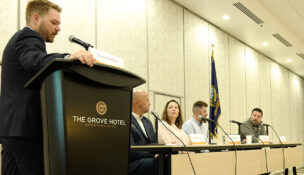
An Urban Land Institute national study team on Feb. 17 publicly presented suggestions to make Vista work better as gateway to the community and become a model for place-making. They also offered strategies on paying for changes to make the avenue more pedestrian-friendly.
“We studied 1.7 miles of Vista from the Boise Depot to the freeway,” said Jim Moore, the ULI team’s chairman. “There are only seven official crosswalks. We’re seeing people running across the street between cars.”
The national study team spent three days in Boise after a year-long evaluation of Vista Avenue by ULI Idaho, the city of Boise, Ada County Highway District, the Community Planning Association of Southwest Idaho or COMPASS, and neighborhood associations. The team toured Vista and interviewed Vista stakeholders before delivering its recommendations.
Boise worked with a $25,000 competitive “Healthy Corridors: A New Life for Urban and Suburban Arterials” grant given to four cities in December 2014 by ULI. Nashville, Los Angeles and Denver were the other recipients. The money comes from the Robert Wood Johnson Foundation and the Colorado Health Foundation.
Pedestrian amenities
Pedestrian matters are a major consideration. Right now, Vista’s narrow sidewalks run directly next to the roadway.
“You should devote a minimum of 12 feet on each side of the street to pedestrian and planting space,” said team member Danny Pleasant, transportation director in Charlotte, NC. Pleasant added that adding traffic signals will break up the blocks.
“Adding additional signals is a good thing,” he said. “The perception is traffic is slowed down. It’s seconds, not minutes. ”

The Vista Village shopping center was singled out as a model for changes that could happen elsewhere on Vista Street. The sidewalk there is separated from the curb by a strip of vegetation.
Pleasant suggested more prominent transit stops with shelters, benches and schedule displays.
Mixed use development
“Right now along Vista you have a mix of use but you don’t have mixed use,” said Patti Clare of Kentucky, a team member and most recently deputy director of Develop Louisville’s Office of Advanced Planning. “You need to make sure mixed use rules the day.”
Mixed use describes development where office, residential and retail uses share a building or are in close proximity. Proponents of mixed use say the dense development that results is healthier for users and the environment.
Clare suggested infield construction for narrow, shallot lots on Vista and shared parking, where one audience uses a parking lot by day and another at night. This is done now at The Flicks movie theater in downtown Boise.
Quick Wins
Quick wins are inexpensive improvements that make a big difference.
Team member Tracy Kane, a Nashville attorney, refers to “quick wins” as “tactical urbanism.”
She suggested the creation of wayfinding signs and recommended creating “parklets,” where parking spaces are converted for a day for group events.
“You can have weekend beautification projects: weeding or planting plants,” Kane said.
Kane encouraged Vista to embrace its role as a gateway or introduction into Boise. AnaMarie Guiles, manager of Boise’s Housing & Community Developer and a key player in the city’s Energize Our Neighborhoods program, embraced the gateway suggestion as an ideal quick win. Right now, there is only a thin, vertical “Welcome to Boise” sign in the median near the airport.
“We need an actualization of a gateway, a piece of art,” Guiles said.
Next Steps
Moore said the city needs a Vista Avenue executive steering committee, and a single person whose responsibility is Vista. The city in recent months has hired a Vista Neighborhood project coordinator with the Energize Our Neighborhoods program. The position focuses on improving “livability indicators” in the Vista Neighborhood. The ULI Health Corridors program falls within the Energize program.
Paying for the changes
A funding answer could come from the Capital City Development Corp., Boise’s urban renewal agency, which is taking part in the year-long Vista Avenue Healthy Corridor Project. CCDC’s executive director, John Brunelle, said CCDC would be open to discussing the creation of an urban renewal district in the area.
Designating the Vista corridor as a urban renewal district would generate tax increment financing potential for Vista projects such as sidewalks, bike lanes, and landscaping improvements.
Until now, all of CCDC’s redevelopment districts are contiguous and downtown, but they don’t have to be, Brunelle said. A Vista redevelopment district, if one is established, could come online just as CCDC’s first and oldest district, the Central District covering the downtown core, expires in September 2018.
A mirror image
Vista has a mirror image in a seven-lane road in Rochester, Minn. The area, called the uptown district, had a seven-lane street with two traffic lanes in each direction, a center median and parking on one side. Drivers routinely traveled at 45 to 50 m.p.h. in a 35 m.p.h zone, ULI team member and Rochester City Councilmember Michael Wojcik said.
The city converted the two-way turn median into a planted median, added bus shelters with custom tiler paved sidewalks, and installed five artistic light pillars at both ends of the district.
“Assessed values have increased 30 percent (on that street),” said Wojcik, adding that a 250-unit townhome complex that was valued at $25 million before the improvements sold for $56 million afterward. He said Vista is ready for a similar rejuvenation.
“There’s a billion dollars of economic development that‘s ready to happen on this corridor,” Wojcik said.

Teya Vitu is an Idaho Business Review reporter, covering commercial real estate, construction, transportation and whatever else may intrigue him in the moment. Join me on Twitter at @IBR_TeyaVitu.. Reach him at [email protected].