Sign In
Upcoming Event
 Free Newsletter

TRISO nuclear fuel arrives at INL for microreactor project
IBR STAFF//December 3, 2025//

The BWXT team prepares to ship the TRISO fuel for Project Pele to Idaho National Lab. BWXT’s experience with TRISO fuel fabrication stretches back to the early 2000s and work with INL and DOE to manufacture irradiation-tested uranium oxycarbide TRISO fuel for the Advanced Gas Reactor (AGR) Program. (PHOTO: BWXT)
TRISO nuclear fuel arrives at INL for microreactor project
IBR STAFF//December 3, 2025//


The fuel needed for a transportable energy production system arrived at Idaho National Laboratory this week, taking a “transformational leap” in nuclear power.
At a Glance:
- TRISO particle fuel delivered to Idaho National Laboratory
- Milestone advances Project Pele‘s Gen-IV microreactor
- Fuel produced and reactor built at BWXT in Lynchburg
- Testing of the transportable microreactor could begin in 2027
The tri-structural isotropic ― or TRISO ― particle fuel was delivered to INL for the Project Pele microreactor project, which is a Generation IV nuclear-powered system that is a high-temperature, gas-cooled reactor.
TRISO is made with uranium, carbon and oxygen combined into a small kernel, coated in several ceramic layers, making “it extremely durable under high heat, radiation and corrosive conditions. Thousands of these poppy seed-sized particles are combined into compact fuel forms used in advanced reactors like the one being developed under Project Pele,” stated BWXT, the company that manufactures the fuel at its facilities in Lynchburg, Tennessee.
Pele is also being built at BWXT’s facility in Lynchburg, and upon completion, will be delivered to INL in Idaho Falls. Testing on the microreactor could begin in 2027.
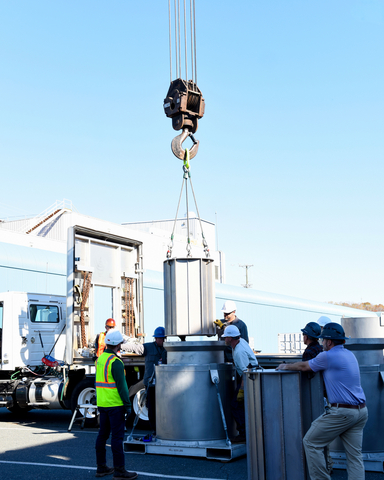
“The completion of the production and delivery of the TRISO fuel is an important milestone for Project Pele, and it further accelerates the Administration’s objectives to enable private sector investment, innovation, development, and use of advanced nuclear technologies,” said David Schurr, SCO’s Project Manager for Pele.
The delivery is enabling the project to move forward, said John Wagner, director of INL.
“This milestone reflects years of dedicated effort by the Office of Nuclear Energy’s Advanced Gas Reactor TRISO Fuel Qualification Program to fabricate and qualify TRISO fuel using world-class capabilities at INL’s Advanced Test Reactor and Materials and Fuels Complex, and Oak Ridge National Laboratory — capabilities that exist nowhere else in the world,” Wagner said. “That investment is now enabling Project Pele to move forward with the speed and confidence our national security demands to accelerate American innovation and demonstrate the leadership that will define this era of nuclear energy.”
Dr. Jeff Waksman, principal deputy assistant secretary of the U.S. Army for Installations, Energy and Environment, said the delivery is the realization of promise made to move Pele ahead.
“This is real nuclear microreactor fuel delivered at its final destination, rather than some letter or memorandum promising to make fuel at a later date,” Waksman said. “Project Pele is a transformational leap toward Gen-IV nuclear power, and the Army’s Janus Program will follow on to deliver affordable, reliable, commercial nuclear power to ensure that our critical infrastructure has the power they need, whenever they need it, even if the electric grid is disrupted.”






 Loading ...