Sign In
Upcoming Event
 Free Newsletter

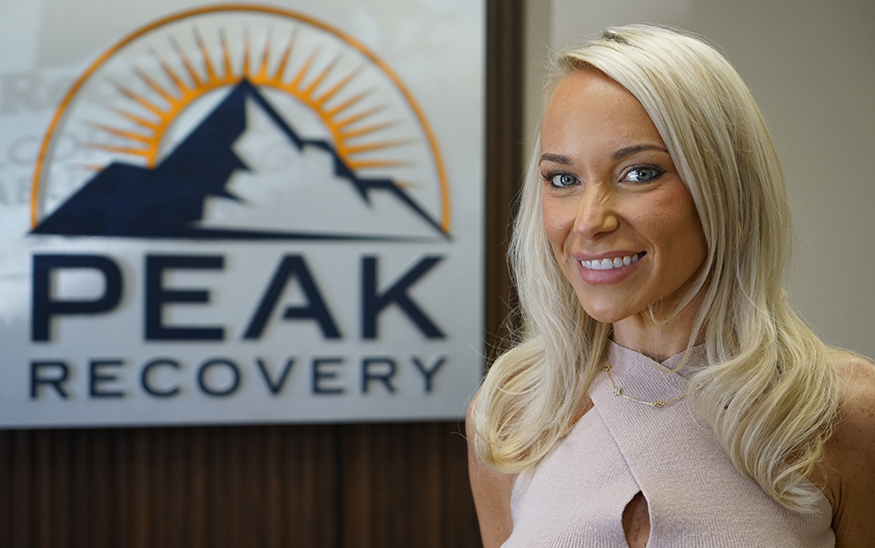
Paige Carson, the owner of Peak Recovery in Caldwell, has worked to help bring people to sobriety after finding recovery herself. (PHOTO: MARC LUTZ, IBR)
The IBR Interviews of Highly Effective People: Paige Carson
Marc Lutz//June 5, 2026//


At more than nine years clean and sober, Paige Carson has built a life revolving around the principles of recovery and is using her experience, strength and hope to reach others struggling with addiction.
At a Glance:
- Paige Carson owns Peak Recovery in Caldwell
- Peak Recovery employs six people
- Carson to be honored as IBR Accomplished Under 40
Carson, 32, is the owner of Peak Recovery in Caldwell, having purchased it after working at the business for a few years. Although she puts 100% into her work, she puts even more into being a mother.
It’s a vastly different life than the one she could be living had she not found a path to sobriety after about 10 years of drug use and trying to get sober. “I had burned every single bridge,” she said. But today, her business is thriving with six employees, she belongs to different industry associations, and she keeps moving forward. She is also being honored on June 9 as one of Idaho Business Review’s Accomplished Under 40.
For Carson, who grew up in Philadelphia, “any day that I stay sober is a successful day for me.”
The following interview has been edited for length and clarity.
Idaho Business Review: What inspired you to pursue the career you are in?
Paige Carson: I’m actually an ex-IV heroin addict, and I was using heroin and other substances for about 10 years. I’d gone to rehabs all over America. My poor parents would send me to all these different states to try to get help, and I finally got my act together nine years ago. I worked in treatment, and I realized that it was my calling and my purpose to help others and show them the way out. I got really lucky that before I owned [Peak Recovery] I was working here and just was doing a lot of ownership things, because the owner is not located in this area. It just felt really easy for me to show up for people who were still using and struggling, and I just had this connection. It felt good, so I was like, “You know what? This is what I want to do.” It felt easy to me. It didn’t feel like work. And I think that was a big thing for me was just the want to help others because I saw how good my life got when I got sober, and I wanted people to get a taste of what that was like.
IBR: What are some of the challenges you’ve experienced during your career and what have they taught you?
PC: I think a lot of it is not taking on other people’s stuff, feelings, emotions. I think that was the biggest thing, and prioritizing my own mental health and well-being, while still being able to show up not only for my team but for the clients because at the end of the day, none of this is about me, it’s for them. I think it’s sometimes really hard to go home and you’re almost so disassociated and not wanting to talk to anybody else, and you just sit there and you’re drained. I think I really had to set a lot of boundaries with myself, and what I’m willing to take on, and what I’m not willing to take on, what I leave at the door when I leave here. So I show up, and I can go and be a mom to my daughter, and not get crazy resentments for things people do. You can’t take things personal, and it took me a long time to kind of realize that, or when you’re dealing with people on addiction and with mental illness, it’s not about me, and I can only do so much.
IBR: When you encounter a roadblock on the path to reaching your goals, how do you circumvent it?
PC: I have a problem-solving mindset. I’m immediately looking at the problem and analyzing it and seeing how we’re going to adapt. I think that’s the biggest thing, is taking a step back. What is the purpose of this roadblock? How are we going to get from the problem to the solution the quickest way? Let’s get this done. And that’s just sort of how I’ve always been.
There are always going be roadblocks, right? If I wait around too long to do something, I’m going have 1,000 more roadblocks, and I’ll never get there.
IBR: Talk about a time when you felt less than highly effective and what you did to overcome that feeling.
PC: I think a time that probably sticks out the most is when I first took over [the business], and I had a very, very high workload. I was up here 16 hours a day, seven days a week, and I was also trying to be a mom. It felt like I couldn’t juggle everything, and if I showed up and put work before [my daughter], I was letting her down. So it took a long time for me to realize I have to have that work-life balance, and it’s not an easy thing to do when you’re trying to be successful and grow a company.
I now have not only the thought of I have to put food on my daughter’s table, I employ a bunch of people who also need to put food on their table. It’s like this can’t fail because now I have other people’s kids that I have to make sure that they’re fed too. Nobody works harder for your business than you, so it’s like I was just going until there was no gas left in my tank, then trying to show up and be a single mom to my daughter. and thank God she never was like, “I feel like you’re not giving me attention, you’re not showing up for me,” but I felt that the mom guilt. At the end of the day, nothing is more important to me than being a mom.
IBR: Talk about your most recent accomplishments, the significance of those accomplishments, and how you got there.
PC: I think a lot of things that people would assume would be accomplishments, like [Accomplished Under 40], some of the business awards I’ve won, none of them really. I mean, I’m proud of them, but it’s not anything where I’m like, “Oh, I’m so glad I accomplished that.” My daughter, for Mother’s Day at school, they do projects, and hers was about me. There was a part that was [write about] something your mom loves to do, and she wrote “helps people,” and that to me is my biggest accomplishment. She sees and understands what I’m doing. On the weekends when we have to be up here, and I’m doing stuff or I’m getting calls late at night to get people into other treatment centers, She sees that as just showing up for others. That’s accomplishment for me. I always get emotional when I talk about her because I love her. I’m proud that she knows … that I put my heart, my soul into this to help people.
IBR: How would you define your leadership style?
PC: Everybody who works for me is way older than me. I think it’s definitely probably more of a coaching style. I think that’s kind of where I do best at, where it’s more of a mentoring, listening, guiding, figuring out what your strengths are, and figuring out how are we going to help grow your strengths. They’re grown women who have had way more life experience and knowledge than I ever will, so for me it’s kind of like I’m [going to] cheer you on and walk side by side with you. I’m not a micromanager at all. I’m going cheer you on and give constructive criticism when needed, and I’m here for support. I trust my team so much. I couldn’t do it without them.
IBR: Do you mentor others? If so, what do you look for in a mentee?
PC: I do mentor others. What I look for in a mentee is someone who remains teachable. I look for people who are open-minded because you have to have that mindset when you own a business. I’m not afraid to try new things, and when I mentor someone, I want you to get comfortable with being uncomfortable and expand your horizon and look at things from different points of views. Someone who is ready to give feedback and receive it. I think nowadays a lot of people don’t want feedback. Feedback comes off as criticism to them. [I want] someone who takes action and has internal motivation because when you work with people who only have external motivation, as soon as you walk out that door, nothing gets done. I want somebody who’s a go-getter.
My No. 1 thing is, fail fast. Fail as fast as you can because the faster you fail, the faster we can fix things.
I’m very lucky, the people I do mentor are also a lot of women who are just starting their own businesses, and I think having that network of ladies and being able to mentor them has meant a lot to me, especially on the business aspect of things. Because I want everybody to succeed.
I also have great mentors in my life as well, and I think it just is kind of like a flowing state. When you’ve been in [Alcoholics Anonymous], and you’ve been in the rooms, a lot of things that you’re taught in AA are things that are applicable in everyday life. Having a sponsor it’s basically having a mentor. I’ve just taken a lot of those things and I’ve implemented it into like the business things.
IBR: How do you plan each day to be successful?
PC: Honestly, it depends on the day. Some days I wake up and I wing it. I have no plan in mind. I’m just going with the flow. Other days, I wake up and I prioritize what is the most important must top three things that have to be done today. And then from that list I go to things that maybe they get done or they don’t get done, that’s OK. And then things that I if I don’t get done today, I won’t care, and I kind of just work off of that. It is just planning a lot and scheduling and keeping myself on track. Then there are some days where I’m just glad to wake up and be alive, and whatever comes at me is going to come at me, but I mean any day that I stay sober is a successful day for me.
IBR: What will you accomplish this year?
PC: Help more people, continue to grow the business, foster my clinicians’ goals and wants. I would like to open up at least one sober living [facility] this year because there is a lack of sober living in this area. That is something I would love to do, but yeah, help more people stay connected in the community. And really reach out to my referral sources to make sure that we’re getting people the help they need instead of sending people to jail when they need treatment, [making sure] that’s an option for them.
IBR: If you had to retire tomorrow, how would you describe the entirety of your career, and what would you do in retirement?
PC: I don’t know how I would describe my career. This is a hard one. Dedicated to helping people, dedicated to seeing people and helping them to succeed. I hope that I leave a legacy behind where I’ve changed a couple people’s lives, or helped get a couple people sober, and … they will remember what I’ve done.
And as much as I would love to say I would move to Florida and lay on the beach and get a tan, I think I will always still be helping people. Whether that’s in mentorship or helping out in the community, there is always going to be some form of me helping people.
IBR: What makes Paige Carson so special?
PC: I have been so lucky to be surrounded by love and to come from incredible parents who have paved the way for me, put that seed in me to help people. What makes me so special is my family; just to be loved through the good, the bad, and for all the stupid things I’ve done to them, put them through. It’s my family. People tell me all the time how lucky and blessed I am to have my family. They’re still on the East Coast … and I could call them at any minute and they’d be on a plane.


 Loading ...