Sign In
Upcoming Event
 Free Newsletter

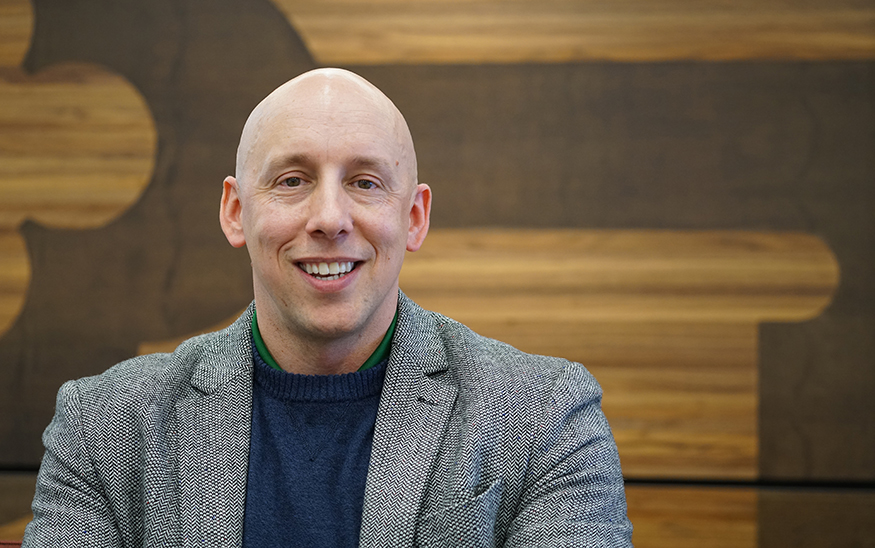
Scott Schlange, the KeyBank Idaho Market president, originally planned to be a school teacher before finding a career in the banking industry. (PHOTO: MARC LUTZ, IBR)
The IBR Interviews of Highly Effective People: Scott Schlange
Marc Lutz//March 27, 2026//


Whether he’s working or spending time with his family, Scott Schlange prioritizes the moment he’s in. As the Idaho market president of KeyBank, he has learned to create boundaries to achieve the goals he’s set before himself ― and that includes shutting off the work part of his brain when he goes home at the end of the day.
At a Glance:
- Scott Schlange is Idaho market president of KeyBank
- KeyBank growing staff and market share in Idaho
- Schlange emphasizes mentorship and leadership potential
Engaging, interested, personable and invested are just a few of the words one could use to describe Schlange, who believes in the power of mentorship and helping guide others in their careers to achieve their maximum potential.
Schlange was exposed to hard work early in life, growing up on a farm. He began his career in banking working for Wells Fargo for 12 years, then moving on to KeyBank in 2017. He took on the role of market president about four years ago, and has led his team in achieving bankable results.
Idaho Business Review sat down with Schlange recently to find out what makes him a highly effective person.
The following interview has been edited for length.
Idaho Business Review: What inspired you to pursue the career you are in?
Scott Schlange: In my particular case, I thought originally I was going to be a teacher. I went to school for that, and the way that I felt teaching would add purpose to my life was giving back to the community through students. I thought, “Hey, my purposing and my legacy will be through this one to one with the kid who, in 15 or 20 years or longer, will have this return where they make the world better.” And I still believe in that. I still do some teaching, but I found that when I worked in the bank that being able to lean into helping businesses … where, if you really could help a business grow, that impacted 10 families or 50 families or 200 families. I think I really have found my purpose in being able to lend and to be an advocate and a part of decisions with a business and a community, that there’s a real immediate [return on investment] on that. And edification; you it’s nice for me, personally, to go drive by an area and see that we had CRA dollars that went into that and made an LMI community able for a family to live there. Or we drove by a plant, and that now has 200 people that work in the plant, and that means that they have families, and those kids are at these schools. I almost now feel like I found my calling. And I don’t know that many look at it that way, but I really think it’s been serendipitous. … It’s a real blessing.
IBR: What are some of the challenges you’ve experienced during your career and what have they taught you?
SS: I think inherently, working at a bank means that you have to survive bank economics, and you have to survive economic cycles. And in my lifetime, there have been already some significant ones, whether it was the housing crisis of ’08, ’09, ’10, whether it was Covid or SVB and First Republic [failing], I think in most industries, to have been able to survive shocks like that is pretty notable. I think when I look at that question, to me, it’s a matter of how flexible is your business model? How fast can you pivot? What type of grit do you personally have? I don’t think this is an industry that you can always expect to be rainbows and butterflies. It’s an industry that really deals with life more so than others. We’re really on the forward, frontlines of just life happening and having a population that is really impacted by that.
IBR: When you encounter a roadblock on the path to reaching your goals, how do you circumvent it?
SS: I thought “circumvent” is an interesting word. I would say in our industry it’s how do you adapt? Because I don’t know that there’s a lot of getting around it. We’re too highly regulated to be able to just get around it. I often, when working with entrepreneurs, I’m really appreciative of the level of like ingenuity that they get to have. I think in a regulated financial system, it’s more a matter of, how do you adapt, how do you accept some of the challenges that you cannot [change]. I could not change that SVB, First Republic and some other institutions had capital issues, and although I could talk through those points in our community, or we could talk as a nation about that, it didn’t change what sentiment existed for financial institutions for a period. Or it doesn’t change how the Fed responds. Doesn’t change how investors respond. So those are just net inputs that you have to just deal with and be gritty. But I think you can adapt, you can be flexible. I think where [KeyBank] did that really well is we understood that it was going to be tough. We leaned into our existing client base, and made sure that we had the ability to support them.
IBR: Talk about your most recent accomplishments, the significance of those accomplishments, and how you got there.
SS: I think we’ve come on the other side now of what was a difficult, systemic shock to the industry, and we’ve come out swinging. We’re growing. We’re adding leaders, we’re adding bankers, and we’re looking to grow organically. I think again, we had to bite down for a few years when it was tough, and make sure that we had our house in order, but we’re in a really good place now to increase our market share, to add and increase our staff and our talent. We’re looking to do so actively and have, so I’m really grateful that we’ve had new leadership come into my retail channel. We’ve bolstered our business banking’s leadership. We’ve grown our team for the private bank. We’ve increased our investment officers, just net all the way around. We’re investing in Idaho. Personally, I have three happy kids, I have a happy marriage, and that’s enough. Those two things sound simple, but man, there’s a lot that goes into that formula, and I’m thankful for those two things.
IBR: How would you define your leadership style?
SS: I would describe it this way: I see potential in obstacles, opportunities and people, and I lean into people’s potential. I would like to think that I inspire the best out of people. I would like to think that I have a level of accountability on that standard that they agree to. It’s not imposed. And I think when you lean into people’s potential and look at life kind of entrepreneurially, that means you put a lot of trust into people, but you also have a high bar. I think that people want high bars. I have a high bar in my own life. But underneath that, there’s grace. “Hey, these external things happened.” What did we do as a result of that? Did we lean into the potential we had with what happened? And usually, I think that people are inspired by that. I’d like to think that my leadership style, therefore, is influential and inspirational. I think it’s hard to ask the person who’s the leader, though, what that [leadership style] is.
IBR: Do you mentor others? If so, what do you look for in a mentee?
SS: Mentorship, to me, is of paramount importance. KeyBank has an incredible internal system to pair mentorship. I think this is somewhat unique to Key as far as I know. We have the equivalent of Tinder for mentorship, where both parties, mentee and mentors submit their applications. It allows for people to go find somebody in a business line or a geography or stage in a career, etc., where they can reach out and appeal to the person and say, “I’d like to have a mentorship with you.” And conversely, I can do the same thing within my leadership, and I could have our CEO, theoretically, be a mentor. In addition to KeyBank for me, personally, this has been a huge part of my life. I’ve mentored people and kids since I was 23 years old, and still have a whole contingency of them that I still mentor. In fact, one of them is coming up for tree fort because she has a food truck business, you know, all of now 20-plus years later. I really get a lot out of that relationship. In KeyBank itself, I have three people I directly mentor, one of which just got promoted to be a leader for our Seattle market, which I’m very proud of; one of which left my institution and went to another institution, and is doing very well ― although that is hard, sometimes it’s part of mentorship and putting somebody first ― and another of which is kind of a newer-to-my system banker that I’m helping to develop.
I also have my own mentors in my life that I constantly am going to for advice and for inspiration and for accountability often. I would say it’s almost a central to my leadership is that it’s critical that we all are mentoring, and also are in mentorship with others. And that might even kind of go back to [when] I was going to be a teacher at one point in my life, and I think a part of that idea is being a continuous learner, always being open for constructive feedback, and that’s the way that we all grow.
I worry a little bit that it’s becoming disenfranchised and not as important in businesses. It’s something that I hope your readership, if they’re not doing, is inspired to do.
IBR: How do you plan each day to be successful?
SS: I would say I control my boundaries, and that’s how I try to be successful. I try to prioritize my work where I am completely dedicated to my work. I don’t let outside interactions and influences come into it, but I also end my day and dedicate myself back to my family and my kids. In my career, the boundaries are what allowed me to be 110% when I’m at work, but then also 110% when I’m at home. If there’s any controlling, that’s what I do. … Within that, I try to be malleable and … I prioritize what’s really important to somebody else, and then how do I block my time for things I have to get done? I would say I do prioritize early in the morning spending a little bit of time reading and then also working out. The older I get, that becomes less and less of that time. But I mean, 30 to 45, minutes a day, I have to those two things. Reading the news, journaling, meditative [practice] and then doing some workout. I think it’s been helpful for my mental health.
IBR: What will you accomplish this year?
SS: I think we’re going to have a lot of growth this year in our company. I think we’re going to see people continue to advance in their careers. I think that we’re going to have advancing in market share, which is critical. I think we’re well positioned for those things this year. I think this year is as opaque as it’s ever been as to what the future might be, just on a broad economic basis. It’s really hard right now to try to portend into two months into the future. But I think that benefits companies that are well prepared for any future. I think in some cases for us, sometimes we were poised for an event to happen, and hoped it did. I think right now we’re really poised for any event to happen and continue to be able to do be successful.
IBR: If you had to retire tomorrow, how would you describe the entirety of your career, and what would you do in retirement?
SS: I don’t know what I would do in retirement. I don’t think I can fantasize about that too much. I have 25 years left of work, so I try to keep that thought a little further away than some others. But when I retire, what I will be proud of, I think, is those that I have invested in the growth that they had in their careers. When I look back on my life, I will look at all the people who’ve been able to do well for their families and have grown that is still very important to me.




 Loading ...