Sign In
Upcoming Event
 Free Newsletter

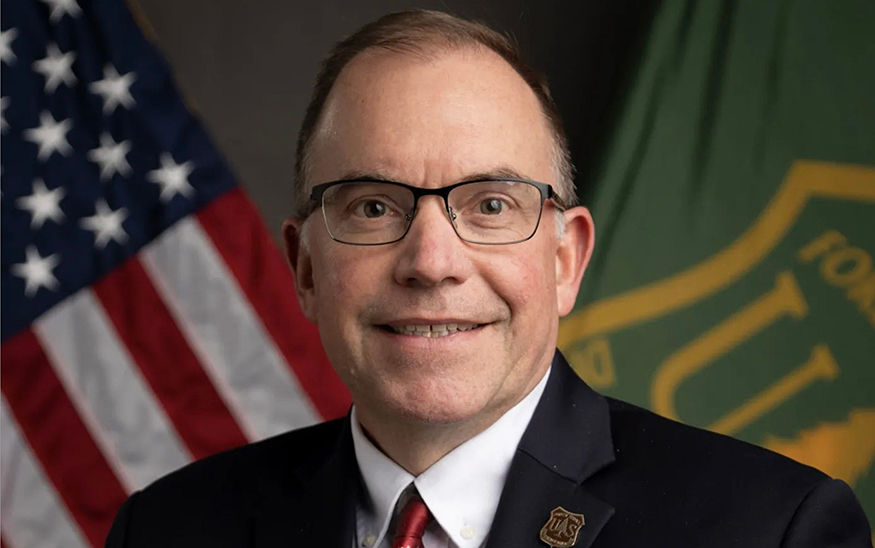
Tom Schultz is the chief of the U.S. Forest Service. (PHOTO: VIA REUTERS)
Forest service chief defends west reorganization plans amid criticism
reuters//April 16, 2026//


U.S. Forest Service Chief Tom Schultz is working to reassure employees and the public that the transformation of the century-old agency won’t lead to public lands being sold off, forests being exploited or rangers being laid off en masse.
He faces a skeptical audience.
At a Glance:
- U.S. Forest Service to close regional offices for state-based model
- Chief Tom Schultz denies plans to sell public lands
- Agency headquarters moving from Washington, D.C., to Salt Lake City
The federal agency announced in March it would close all regional offices in favor of a state-based system, close scores of research facilities and move the agency’s headquarters from Washington, D.C., to Salt Lake City.
The plan has faced criticism online and from outdoor apparel brands, including Patagonia and Black Diamond, that the move will gut the agency, remove staff and benefit extractive industries over public lands users.
U.S. Sen. Ron Wyden, D-Oregon, said the agency should focus on wildfires rather than “rearranging deck chairs on the Titanic.” U.S. Sen. Jeff Merkley, D-Oregon, said the Trump administration is “reducing the Forest Service’s stature as the world’s preeminent forestry research and conservation institution.”
The Forest Service manages 193 million acres nationwide, 20.5 million in Idaho and 16 million in Oregon.
In an interview with the Statesman Journal, Schultz pushed back on those claims and defended the reorganization as a necessary move to save money and move an overly bureaucratic agency closer to local forests. He noted that instead of one regional forester serving multiple states, there will be Forest Service directors in each state.

“We think a state-based model will afford much greater opportunity to develop meaningful relationships at the state level, tribal level, county level,” Schultz said. “And then ultimately, better programs on the ground.”
There will be big changes, he acknowledged. The Portland region 6 office, home to between 200 to 300 employees, will close and far smaller offices in Salem and Olympia, Washington will open. But Schultz said the agency isn’t planning layoffs and they’re working hard to find jobs or locations for impacted employees.
“(We’re) shifting staff capacity out from behind desks and into the forests and districts that are desperately understaffed,” the Forest Service said in a statement. In addition, the agency said, wildland firefighting won’t be impacted by the planned move, which is expected to take place across the coming year.
Schultz was sworn in as chief of the Forest Service on March 10, 2025, replacing retiring chief Randy Moore. Previously, Schultz was director of the Idaho Department of Lands and vice president of Idaho Forest Group, one of the nation’s largest lumber producers.
Below are experts from an April 9 interview with Schultz. They have been edited for brevity and clarity.
Zach Urness: Why is this reorganization needed? The Forest Service has used the regional model since its inception. Why is a state-based model superior?
Tom Schultz: One of the first things with reorganization is that we have budgetary constraints. We identified close to billion dollar shortfall last year. So there’s a looming budgetary issue that requires we do this. That’s one piece. But the piece that’s maybe more visionary, for lack of a better term, is the fact that we need to drive decision making to lower levels in the organization. We have become an organization that’s top heavy. We’ve created a bureaucratic state that is exemplified by probably about 3,500 directives. That’s in addition to statutes and regulations, manuals and handbooks. It’s unbelievable. We need to be more nimble. We need to drive decision making to the men and women on the ground. And we also need to be closer to the people that we serve where the lands are predominantly in the West.
Urness: It’s my understanding that you were at the Portland regional office when the reorganization was announced. How will that change from one big office to two smaller ones in the Northwest impact employees and the public?
Schultz: We’ve spent a lot of time internally trying to work with employees to find options for them. Part of my reason for being in Portland was that those offices that are going to be closed and trying to help them understand what options they have. We made it very clear that there are no risks assigned with this reorganization — that in offices we’re closing, we’re looking for opportunities for employees to do work in an area that would not force them to relocate. Some people will have to relocate, but we expect that there will still be job opportunities for them. They may be doing a different job. They may have a different reporting structure, but the expectation is that this structure will afford opportunities for employees to continue to work for the Forest Service but maybe in a different capacity.

Urness: How will the public notice these changes?
Schultz: Right now, we have a single regional forester that is basically maintaining and developing relationships across four different states ― Alaska, Oregon, Washington, and California. That’s a lot of country for one person to try to maintain those relationships. So we think a state-based model will afford much greater opportunity to develop those meaningful relationships at the state level, tribal level, county level. And then ultimately, we think better deliver programs on the ground.
Urness: You said there’s a lot of misinformation in the criticism of the reorganization and what it might mean. Where do you want to set the record straight?
Schultz: There is a narrative out there growing on social media that relocating to Salt Lake City is an effort to divest of federal public lands. That could not be further from the truth. This has nothing to do with divestiture of lands. Salt Lake City was identified because it’s at a center in the West where we’ve got 8 million acres of national forest lands in Utah. Salt Lake is family friendly. It’s got a tremendous airport. We looked at other locations and the airport situation is much more difficult. So that’s the biggest myth out there, that somehow this is about transferring federal lands. It has absolutely nothing to do with transfer of federal lands.
Urness: The biggest concerns I’ve heard are that you’re going to lose a ton of employees in the move ― similar to layoffs last year ― and that you’re going to lose more by closing something like 31 research stations.
Schultz: We’ve got approximately 30,000 employees in the Forest Service right now. And when you look at the impact, I think we’ve identified people that could have a different role, different responsibility, of probably 5,000 to 6,000 people. If we look at how many would have to relocate from where they’re currently at, it’s less than 500 people, mostly from the Washington, D.C., office. That is an impact to them and their families. Some probably will chose not to relocate. But overall, we think we’ve designed a structure that is compassionate to employees, providing them opportunities, at the same time, delivering better service to the public.
Urness: What about the closure of all the research stations?
Schultz: Our focus is on retaining scientists over facilities. I think we currently have approximately 130 facilities across the system. Many of those facilities have one, two, or three employees. We’ve identified 20 (research) facilities that we intend to keep around the country. We’ve identified Fort Collins as the central hub. We’re still evaluating other facilities, but the key takeaway is that we are not expecting the closure of a facility to mean we’re reducing that research program. Right now, we currently are underfunded in the budget provided by Congress by about $17 million for facilities. So the question that we’re dealing with is, ‘would you rather retain scientists and folks doing research or retain facility managers?’ We can’t maintain the facilities that we have. So those that have minimal or no staffing, we will identify those for closure, but the staff there, the folks doing the work, ideally they will find other locations.
Urness: You’ll have the mothership in Salt Lake City and then 15 state offices. Beyond that, it’s basically the same national forest and district offices. What do you think the biggest change people will see on the ground is? In Oregon, will more people come to Salem for business with the Forest Service? How do you think people will notice these changes?
Schultz: Most of the public doesn’t necessarily deal directly with their regional office. Many members of the public deal with a district office, a district ranger. So we don’t anticipate many changes there. The big difference I see is the responsiveness and attentiveness to the relationships on the local level.

Urness: So instead of a regional forester for the Pacific Northwest, there will be a state director for Oregon’s national forests?
Schultz: Yeah, there’s going to be a state director role.
Urness: What do you anticipate the state offices looking like compared to the regional offices? Are they just smaller?
Schultz: A regional office could have 200 to 300 people. We would expect a state office to probably have between five and eight people. The functions of the state office are going to be communications, legislative affairs. It’s going to be intergovernmental affairs. It’s going to be tribal relationships. This is a much slimmed down version and it’s really to improve the relationships and the ability to liaison better with those partners.
Urness: Wow. 200 to 300 people, down to five or eight? That is significantly slimmed down.
Schultz: It is. It’s going to have a totally different structure. I just going to need to emphasize this — this is not recreating regions at a state level. A lot of the functions that the regional offices had with support staff will go to our service centers.
Urness: On the ‘operations service centers,’ I’d seen them located in Montana and California but none in Oregon or Washington?
Schultz: We’re actually going to put one in Central Oregon as well ― that’s in the plans. So those service centers are there to support forests. A lot of the functions that regional offices perform right now are, let’s say, engineering functions. Not every forest is going to have all of the engineering resources they need for road building and those kind of things, so that’s what the service centers will be for. The centers are really there to support forests. They’ll have that technical expertise. It could be, engineering, it could be archeology resources, it could be wildlife resources, or permitting for ski areas.
Urness: It sounds like the goal is to streamline a lot of the technical operations? The state, forest and district office focus on the work on the ground. The operations centers support more technical work?
Schultz: Twenty years ago we centralized our business operations in Albuquerque. So this is not new for the Forest Service to be doing this. We’ve been reorganizing many times over and a lot of those functions are still there. There will be dedicated resources to a state director from the business operations functions, whether it’s HR, it could be procurement, it could be accounting, but those functions will have a team that will be supporting a state directly. And that’s one of the things that we think will make it much more effective and efficient in terms of getting the work done is having those dedicated resources for those state directors.
Urness: Do you see the state directors as being fairly out front ― more of a public facing role in a given state?
Schultz: I personally do. I think that role is going to have an external role that’s going to be critical in communicating with state partners, tribal partners, NGO partners. Absolutely. The other role that it’s going to have is an internal facing role though. Think about it. Now, if I’m a regional forester, my focus is within my region. And I typically have been staffed to have the resources within my region. If you’re going to have these service centers, those state directors are going to have to be facing and advocating for resources for their state. It’s going to give them a much better perspective on what the overall national priorities are and how we set expectations and priorities across all those programs.
Urness: There’s two things that seem to be happening here at once. You’re pushing for streamlining the agency and at the same time, President Trump has pushed for increasing timber production and forest management on national forests and public lands in general. Are these part of the same effort?
Schultz: My goal, just so we’re really clear on this, is to implement forest plans. Every forest has a plan. Forest management is a tool to achieve so many things, whether it’s forest health, watershed health, wildlife habitat creation, fish passage, for road maintenance and management. Forest management enables those things to happen. It also creates wood products, jobs, all of those things. We are already doing that. So we have targets that have been set. This administration has set an increase over the next four years of 25%. So every year we’re marching toward that. We have set national targets, Congress has set targets for us. In the reconciliation bill that was passed six months ago, Congress basically said over the next 10 years, we expect your harvest levels to increase by 250 million (board) feet a year every year for the next 10 years.
When we achieve that, it’s still going to be less than if we implemented every forest plan to its fullest extent. So everything that we’re doing in my mind is consistent with our forest plans. It’s sustainable. It’s the right thing to do on the ground and we’re moving in a direction to be more actively managing our forest, reducing wildfire risk, protecting communities, creating jobs, and improving the overall health of the forest.
This article originally appeared on Salem Statesman Journal: “In Q&A, U.S. Forest Service chief defends reorganization plans in West.” Reporting by Zach Urness, Salem Statesman Journal, USA TODAY Network via Reuters Connect.






 Loading ...