Sign In
Upcoming Event
 Free Newsletter

University of Idaho launches new AI degree programs amid surging workforce demand
IBR Staff//June 30, 2026//
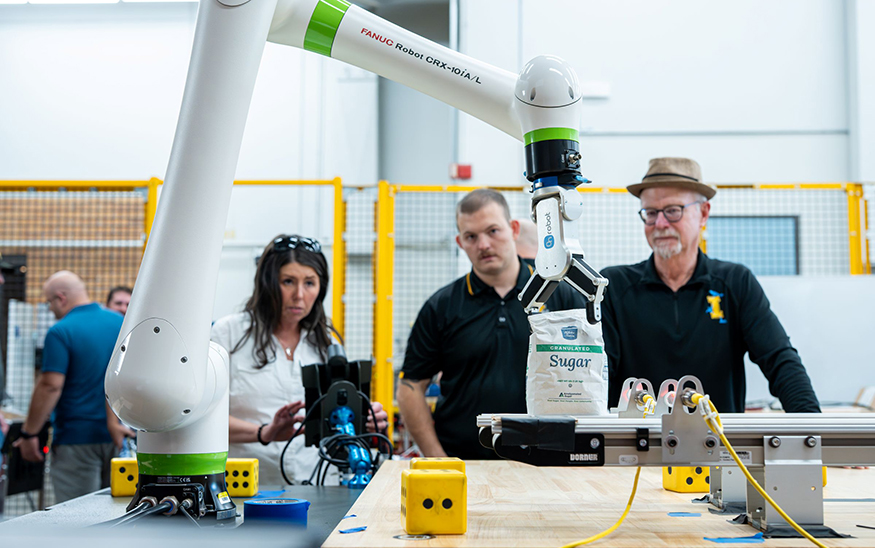
Graduate researchers Sarah Davis (left) and Hunter Hawkins (center) work with research faculty John Shovic to find AI solutions for a safety and productivity issue at Amalgamated Sugar. (PHOTO: U OF I)
University of Idaho launches new AI degree programs amid surging workforce demand
IBR Staff//June 30, 2026//


University of Idaho is launching three new artificial intelligence degree programs this fall, building on nearly 40 years of computing education as the university expands its role in AI research and workforce development.
At a Glance:
- University of Idaho launches bachelor’s and master’s AI degrees
- Programs available at Moscow and Coeur d’Alene campuses
- AI employment in Mountain West projected to grow 25.5%
Beginning in fall 2026, students can pursue a bachelor’s degree, a Master of Science or a Master of Engineering in artificial intelligence. All three are available at the Moscow and Coeur d’Alene campuses, with graduate programs also offered fully online. The programs combine classroom instruction with hands-on research and industry partnerships.
“The U of I helped build the applied engineering, computational and interdisciplinary foundations that became important as AI matured into a real-world industrial technology,” said U of I President C. Scott Green. “Our students don’t just learn how to use AI, they learn how to build AI tools and systems.”
The new degrees build on coursework dating to 1986, when U of I introduced its first artificial intelligence course covering inductive and deductive reasoning and natural language processing. The university now offers 14 AI-related courses spanning machine learning, deep learning, natural language processing, data science and computer vision, along with existing certificate programs in AI, machine learning and robotics automation.
The expansion comes amid strong projected job growth in the field. According to the U.S. Department of Education, AI employment opportunities are expected to grow 17.3% nationwide by 2034, with growth in the Mountain West projected even higher at 25.5%.
“U of I continues to shape the future of AI by preparing graduates to address complex industrial challenges and advance innovation through hands-on research, industry partnerships and nationally recognized AI initiatives,” said Steve Wang, professor and chair of the Department of Computer Science.
The university is already applying AI research to industry problems. In U of I’s Center for Intelligent Industrial Robotics, doctoral student Hunter Hawkins and professor John Shovic partnered with Amalgamated Sugar to develop an AI-powered predictive system that analyzes data from steam dryer equipment to prevent failures and improve worker safety. Researchers are also collaborating with Washington University School of Medicine on an AI-driven study of ALS through a Longitude Prize on ALS Discovery award.
U of I is the only institution in Idaho conducting research through the National Artificial Intelligence Research Resource Pilot program, operated through the National Science Foundation. Engineering professor Xiaogang “Marshall” Ma is using the resource to advance Mindat, the world’s largest open data interface of mineral species and distributions.
The university’s 2026-30 strategic plan incorporates artificial intelligence across student learning, research, community engagement and operations. U of I also earned national recognition for its early adoption of AI in research administration through a $4.5 million National Science Foundation-supported initiative, and the university is participating in Google’s AI for Education Accelerator, giving students free access to AI tools and Google Career Certificates.
This story was written using artificial intelligence with human oversight.





 Loading ...