Sign In
Upcoming Event
 Free Newsletter


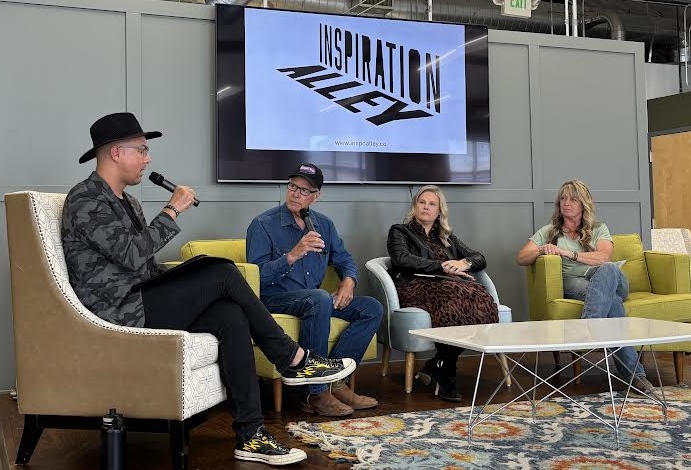
Panelists Tim Sommer, Purple Sage Farms, and Angela Reed, Grasmick Produce, discuss the vital role local farms play in protecting food sources. (PHOTO: STEVE LOMBARD, IBR)
Panel discusses efforts to keep farms from becoming fables in Idaho
Steve Lombard//May 23, 2025//


In Brief:
- Panelists raise alarm over rapid farmland loss in Idaho
- Urban development threatens local food supply chains
- Organic and small farm advocates call for smarter land use
- Forum stresses need for public awareness and policy change
Preserving dwindling farmland to help protect local food sources has been a key strategy in the process known as farm to table. But with development and growth spreading rapidly throughout the Treasure Valley, some who want to slow the pace of urbanization believe the process is now becoming more “farm to fable.”
To highlight the changes that accompany economic development and the competing interests for area land use, HMK Impact, a local sustainability boutique, in partnership with Idaho for Good, hosted a recent community forum, “Farm to Fable: The Future of our Food is at Stake,” as part of its “Do Good Conversation” series May 6 at the Inspiration Alley meeting facility in downtown Boise.
Event organizer Hannah Mae Schaeffer described the panel discussion to help promote “intentional growth,” and to bring “more needed attention” to preserving the future of local farming in the Gem State.
“Urban development and growth are putting our food systems at risk by moving out a lot of agricultural land,” Schaeffer said. “A lot of this has to do with the rate of or growth, how fast, the monopolization of farms, especially in our urban areas.”
As the fourth-generation owner of Grasmick Produce, a well-known name in the local produce industry for the past 70 years, Angela Reed described the difficulties of distributing produce, calling it the “invisible step” in the food process.
“Our food system is an interwoven system of national and local producers that come together through companies like Grasmick and others who work to supply healthy food,” Reed said.

However, she stressed that relationships between farmers and businesses such as Grasmick have shifted greatly during the past decade.
“A lot of those partnerships my grandfather fostered early on have gone away because the farms have been sold for developments,” she said. “I’ve watched that over time shift during these past 10 years.”
Panel moderator Crispin Gravatt, executive director of Idaho Smart Growth, a local coalition that works to help build communities that are “healthy, safe and resilient,” engaged panelists on the “tension” that exists between the need for housing and preserving local land needed to produce healthy, fresh food.
“Having grown up in the business I can say that Grasmick really grew with the support of the local farmers,” Reed said. “In early times there were more farmers to partner with and it made it easier to do.”
Fellow panelist Tim Sommer is one such local farmer. Now in his 37th year as an organic grower in Idaho, he is the co-founder of Purple Sage Farms, a “pioneering organic farm.” He also established the Idaho Organic Certification program which includes more than 330 farms statewide certified as organic.
“I represent small and medium farms in the state of Idaho,” said Sommer, who grew up on his family farm in Middleton, and raised his own children on a farm. “Part of that is building coalitions with other farmers, creating farmers markets. We’re excluded from the conventional and dominant food system, meaning grocery stores.”
With decades of farming experience, an “innovative bunch” is how he poignantly describes those who continue to operate small- and medium-sized farms.
“These farmers are better stewards. They have a better ratio of eyes to acres,” Sommer said. “They have fewer acres to take care of more intensely. Putting a more intensive effort on smaller acres helps farmers do better.”
Asked to classify farms by scale, he referred to medium-sized farms as those producing $500,00 in product annually, and small farms as those generating $150,000 or less.
“They’re up against expectations that price is the only value that matters, without considering the impact on human health, the environment, animal health and soil,” he told the audience. “Those things get skipped a lot in that evaluation when you go to a large grocery chain to do your shopping.”
But these days, many farmers are being tempted or persuaded to trade their land for big payouts from developers, a situation Debbie Davis, an agent with Silvercreek Realty Group, knows all too well.
Residing in the tiny farm town of Melba, and representing the real estate sector while also serving as a board member for Fare Idaho, a group that advocates on behalf of independent ag producers, Davis called it a “balancing act” being on both sides of the fence.
“It’s hard to be a Realtor and to advocate for agricultural land at the same time,” said Davis, who helped establish the Melba Chamber of Commerce. “People think being in realty makes me part of the problem. I’m proud to help people to own a home, but we have to be smart in our communities about where we put things.”
With a passion for agriculture, part of her dual role, she stressed, is not just “making people aware” of any development that may be coming to a community, but seeing it placed in the “right spot.”
“I’m not a farmer or rancher, but have always been within that sphere,” she said. “But we need to be more aware of what is in our food. It’s just an awareness we should have for protecting agriculture.”
An advocate for rural communities and agricultural preservation, Davis is also the co-founder of Rural Community Advocates, a nonprofit group working to protect Idaho’s local agricultural economy from incompatible or large-scale developments.
“No matter what is being placed on the ground, or what we are losing our agricultural land for, we have to be careful, and we especially have to plan,” she said. “If things are going in, we have to ask where the smart place is to put them to help benefit the entire community.”
Smart planning and taking the initiative to get involved led Meridian resident Kristen Pooley to attend the session. A social worker by trade, she shared her strong feelings about the important role community discussions play when it comes to the topic of developing local farmland.
“These kinds of conversations are how we become better through coalition building, Pooley said. “We all have to try to connect to the community builders. HMK is doing that. It all resonated with me tonight.”
According to statistics provided by Davis, in the 40-year period from 1982 to 2022, more than 5.14 million acres of farmland have been developed statewide in Idaho. Additionally, she noted Ada County has lost 75% of its farm ground since 1945.
“We have to be careful with what we are doing with our ground,” she said. “Ignorance is no longer bliss. We need to be involved, to ask questions about land use.”
In her introductory remarks, Shaeffer cited how the United States has “imported more food than it has exported” during the past four years, especially foods of high nutritional value such as fruits and vegetables.
“We need to look for immediate actionable ways to help provide solutions,” she said. “How do we cultivate land within all the growth and urbanization?”
“Part of my responsibility in the community is to help get people involved and invested,” said Reed, now in her 10th year managing her family’s produce distribution operation. “It’s not easy. We’re talking about a product that has to be grown and planned for and picked at the right time.”
Especially, when the definition of “local” produce varies greatly across the industry.
In Sommer’s perspective, he called it “unfortunate” that the process of selling and getting a product harvested, packaged and delivered has surpassed the actual growing process.
“We’re still growing but doing more that is oriented to delivering, providing, convincing people to buy,” he said. “Our longest standing customer is the Boise Co-Op. They’re a great ally when it comes to organic food.”
Working steadfast to maintain her family’s rich legacy delivering produce, Reed believes “deeply personal relationships” still matter greatly moving food from farm to table.
“It means a local farmer like Tim can walk into my facility and ask for help to move his product,” she said. “And I can say ‘yes, I’d love to support you.’ Then I can shake his hand and put his product in my local warehouse and get it to a customer.”



 Loading ...