Sign In
Upcoming Event
 Free Newsletter

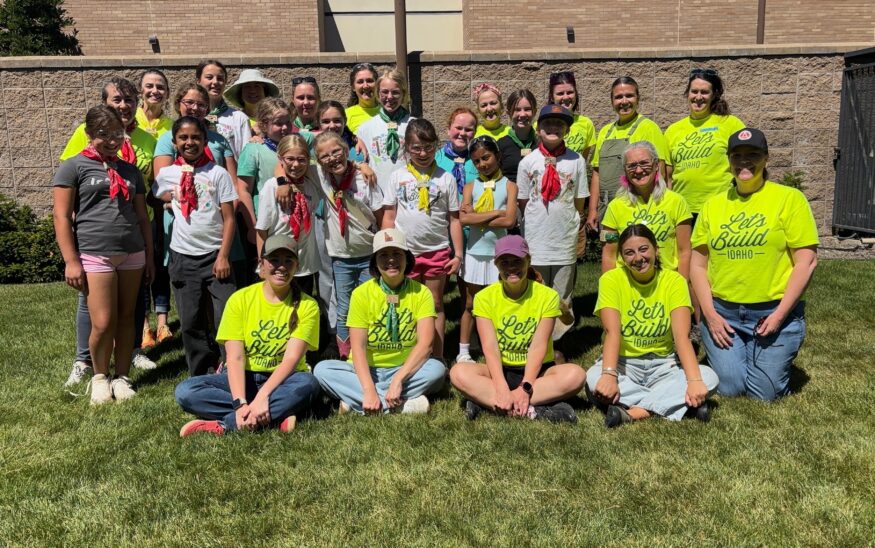
Let’s Build Idaho held its inaugural girls’ camp in June to help girls learn how to build, use the proper tools, and hopefully gain an interest in construction. (PHOTO: LET’S BUILD IDAHO)
Camp for girls puts emphasis on learning lifelong skills in construction
Marc Lutz//July 2, 2026//


Summer camp used to be a place where parents sent their kids to swim in mountain lakes, go horseback riding, do arts and crafts, and return home with fond memories and not too many useful life skills.
At a Glance:
- Let’s Build Idaho camp offers weeklong construction workshop
- Andersen Construction and 14 firms sponsor camp in Boise
- Girls build benches for Habitat for Humanity project
But there is a summer camp that is turning that traditional model on its head.
Let’s Build Idaho girls camp is a weeklong workshop that gives girls ages 8 to 14 practical building skills that they can use for a lifetime. It’s even possible the camp will lead to a career in the trades, an area that is traditionally male dominated.
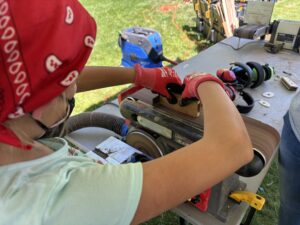
If girls aren’t introduced to the construction industry by the time they’re in high school, odds are they won’t pursue a career in building, welding, electrical or other related trades, said Laura Williams, the internal communications strategist with Andersen Construction, one of the many firms that work together to sponsor and run the camp.
“It’s too late for girls if they haven’t already been introduced and told that this is something they can do,” she said. “They won’t be interested because it’s so traditionally a male world. By starting younger, they get the skills and the empowerment to be like, ‘I can do that. I can operate a drill. I can operate a chop saw. Maybe construction is a [career path] I want to go down.”
In a report published last year, the National Association of Home Builders noted that in 2024, 1.34 million women worked in construction fields in the U.S., or 11.2%. Of that, 521,000 held office and administrative roles. Just 4% worked in building or maintenance jobs.
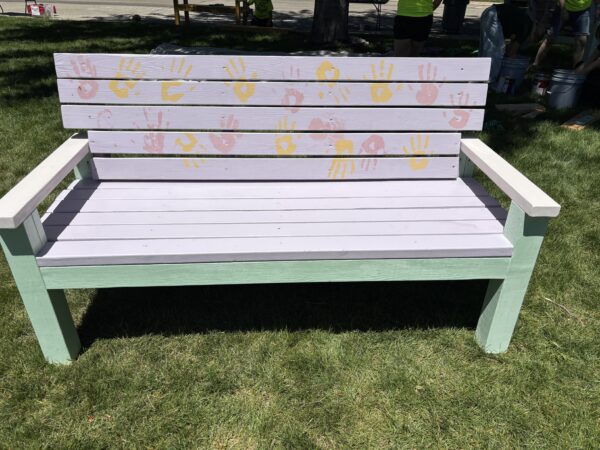
The Let’s Build Idaho girls camp, which runs for a week, is open to girls only and gives participants five projects to work on, from working electrical boxes shaped like a cat to benches that will be used in a community development project by Habitat for Humanity.
While construction companies typically compete against one another for various projects, this is one project many worked together on, investing in the future workforce. The participating companies and organizations who supported Let’s Build Idaho girls camp with financial donations, supply donations and/or volunteering were:
• Andersen Construction
• Cator Ruma & Associates
• Desert Sage Wall Systems, LLC
• DeWalt
• ESI
• Habitat for Humanity
• Idaho AGC and the Idaho AGC Education Foundation
• Idaho Chapter NECA
• McAlvain Companies
• Platt
• Quality Electric, Inc.
• RedBuilt, LLC
• Sherwin-Williams Co.
• Sunbelt Rentals
• YMC, Inc.
Each day of the camp is a full eight hours with breaks that mirror those of a typical work shift, and everyone is taught how to properly handle tools and to follow safety protocols. Participants are also provided with breakfast and lunch.
The days can be hot and filled with hard work, but that’s part of the learning process, said Monteen-alyse Ebert, a project engineer with Sletten. She pointed out that sometimes the girls might express how hard it is to use some of the tools or learn the skills. She takes that as an opportunity to impart a lesson.
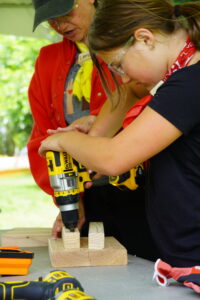
“There’s a certain level of empowerment from doing hard things,” she said. “But you can do hard things. … It’s OK if most of the these girls don’t end up working in the industry in trades or anything. They’ve all had the chance to do something hard and to learn something new and to see they can do it, and it’s not so scary.”
For its inaugural year, Let’s Build Idaho had 24 girls attend the camp from various backgrounds. Ten to 12 instructors, who are all women, teach the girls proper techniques. The girls tend to feel more secure when they have a female instructor, and it shows them that women can and do work in the industry.
“Once you’re in college, you’ve already missed a lot of valuable time in learning [in the trades],” said Katrina Anderson, a senior project manager with Quality Electric, Inc., (QEI) in Boise. She was teaching the girls how to work with electrical materials. She detailed her own career path in the industry, recounting how she attended Boise State University but missed out on hands-on training she would have received had she entered directly into the trades.
“You can go straight from high school, join the union, go to school, and start working,” Anderson said. “So, you’ve got money coming in, and you also have pension building up. But more importantly, we need a lot of skilled labor, especially with the boom at Micron. The more we can get girls interested in that, the sooner the better for the whole industry.”
Though this is the first year that LBI has operated, it’s not the first year the construction camp was offered. Previously, the organization operated under Girls Build, a trades education nonprofit based in Portland that runs workshops throughout Oregon. LBI has used its connection with Girls Build to structure their own camp, following established organization to guide their own approach and growth.
Williams said even though the program is still new, they are looking at how Let’s Build Idaho can open up other camps in the state and possibly offer more than one workshop per year.
Some of the girls who have participated in past Girls Build workshops have returned to continue learning. One of whom is Tessa Johnson, 11, daughter of Molly Johnson, director of workforce development at Idaho AGC, and a board member for LBI.
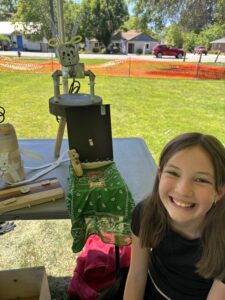
“She asked for a toolkit for Christmas,” Johnson said about her daughter’s interest after attending a previous camp. “She wants to put together the IKEA furniture when it shows up.”
Tessa is one of about six girls who are veteran attendees. As they build their experience, they share what they’ve learned with the other girls, sometimes helping guide them. When asked what she’s learned about building and construction, she simply replies, “everything.”
“I feel like that’s the biggest change you see in the girls,” Williams said. “It’s great they can do these things, they have these skills, but they have this confidence in themselves that they can do it.”
That confidence, said Ashley Wiedemer, a program director at Sletten Construction and the logistics coordinator with LBI, is evident even within the first few days of the camp, as girls become more comfortable with the tools and what they’re learning.
“Day one, they’re kind of anxious, nervous, they don’t really want to touch, don’t want to help,” she said. “But by day three or four, they’re like, ‘What do you need? Oh, I can go get that. I can help you with that.’ There’s that camaraderie.”
By the final Friday of the camp, girls will have worked on five projects that have required measuring, sawing, wood burning, nailing, metal bending, drilling, sanding and a whole host of other skills. At a wrap-up event that evening, the girls get to show off their handywork to their families.
The work may be done, but the skills and confidence gained will help the girls build on their future goals. And it’s not just the participants who get something from the program.
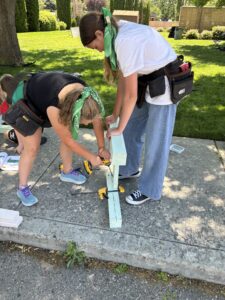
“I get satisfaction that I am helping the youth,” Wiedemer said. “I grew up in the industry. My dad worked for Sletten my whole life, so if you’re not exposed to it, chances are you’re not going to even think, ‘Oh, this is the path I should take.’ I think it’s very important that we start well below the high school level at getting girls in the trades.”
She emphasized that both girls and boys need to know the career paths that are available to them, but girls especially need to know that construction isn’t just “men’s work.”
“To get a girl involved right from the get go, my only hope would be that she — whether it’s a project manager, a superintendent, an engineer — embraces it and knows that she is welcome in this industry.”




 Loading ...