Sign In
Upcoming Event
 Free Newsletter

Up, Up and Away!
100-year celebration highlights soaring growth of Boise Airport
Steve Lombard//May 8, 2026//
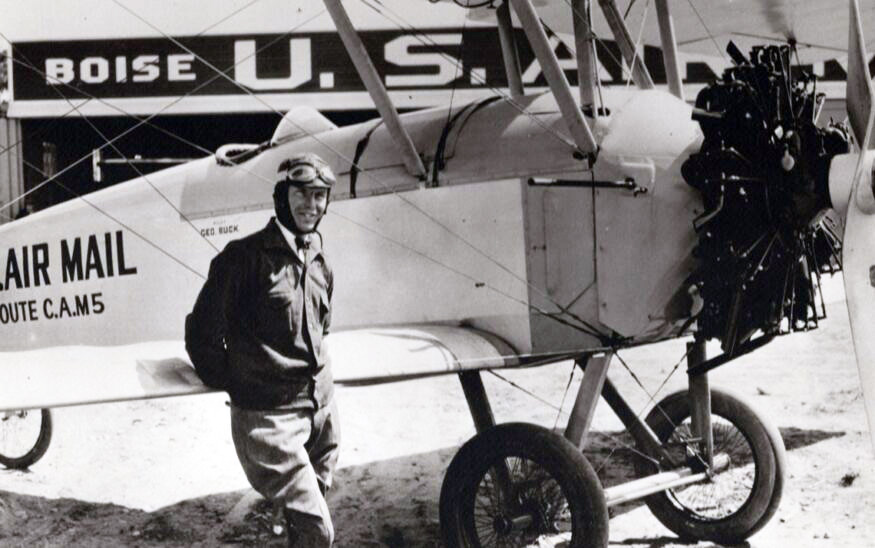
Airmail pilot for Varney Air Lines, George Buck, stands next to an airmail plane at the Boise Airport at College Field in 1927. (PHOTO: BOISE CITY ARCHIVES)
Up, Up and Away!
100-year celebration highlights soaring growth of Boise Airport
Steve Lombard//May 8, 2026//


Celebrating a full century of flight service in and out of the Treasure Valley, Boise Airport (BOI) remains one of the nation’s most uniquely positioned and important “origin and destination” airstrips where passenger travel numbers continue to soar yearly.
At a Glance:
- Boise Airport records 5.2 million passengers in 2025
- 76% increase in passenger travel over the past decade
- Plans for new concourse with 10 additional gates
Flight logs indicate it was a mere 100 years ago, April 6 to be exact, that the first commercial contract airmail flight landed in Boise from Pasco, Washington, carrying two potatoes to be delivered to then-President Calvin Coolidge, before continuing on to Elko, Nevada.
“This airport is a vital hub that has connected our community to the world for a century,” said Mike Vigil, a representative of the U.S. Postal Service. “Our partnership with local airports like Boise is essential.”
And now equally, if not more vital to area passengers.
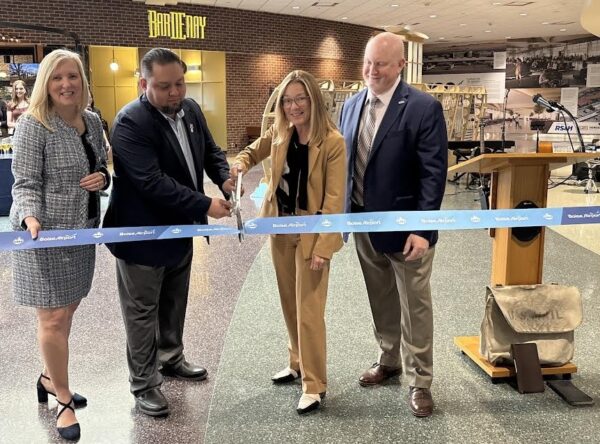
A ribbon-cutting ceremony held on the anniversary date to commemorate that historic airmail flight also served to highlight the airport’s whopping 76% increase in passenger air travel the past decade, including a record-setting 5.2 million passengers in 2025.
“The Boise airport is considered the most geographically isolated airport in the lower 48,” said Shawna Samuelson, air service and marketing manager for the airport.
“We have a very large area from which our passengers are coming. What makes us unique is we are serving so many cities in the region.”
As the Treasure Valley continues to spread its wings, so does BOI.
“You think about the airport 10 years ago, and you think about it now, and it’s just a mirror of the valley,” said Jennifer Kronberg, who has managed communications at the air terminal the past two years.
In addition to last year’s record number of passengers, the airfield has recorded four consecutive record-breaking years (2022-2025) for total annual travelers landing and departing the City of Trees.
The record pace of yearly passenger totals shows an upward climb from 4.4 million in 2022, to 4.7 million the following year, reaching 4.9 million in 2024, before hitting last year’s all-time high of 5.2 million, a 5% increase year-over-year during that time period.
Not since 2021 has the annual total of passengers dipped below 4 million, when a mere 3.6 million travelers closed out the books for that calendar year.
And 2026 is already off to a high-flying start. In January, 382,191 travelers made their way through BOI gates, just slightly ahead of the same month last year (380,739).
“So far in ’26, we are trending ahead of last year’s pace,” Kronberg said. “We’re only a few months in, but so far we’re on target considering all that is going on globally.”
Also, for this year’s spring break session (March 12-22), the facility expected at least 165,000 passengers to pass through the facility.
“We don’t have a lot of layover type traffic of people who leave or continue on, what you’d find typically in many of the larger airports,” Kronberg said. “Most people who leave or fly out of here live in the area. And the people who arrive in Boise, they are staying.”
A deeper look inside the official yearly travel numbers reveals some sky-high flight figures for an airport not classified as a major hub.
From March through December last year, 4.48 million travelers came through BOI gates (448,607 monthly average), a 10-month stretch total that landed just shy of the collective number of passengers for all 12 months in 2024. Plus, the single largest month of travel ever recorded in Boise happened in July 2025 with 487,225 passengers.
Last year’s minor increase in yearly passenger totals (238,514), compared to 2024, was nearly equivalent to Boise’s current population.
“People here are traveling, which is not necessarily happening at all airports nationally,” Kronberg said. “Others may be experiencing some leveling off or a slight downturn. But we are continuing to grow. We are a little bit of an outlier among airports in our country.”
Beyond the statistics that help elevate the airport’s historic 100-year milestone even higher, it should be noted that the airport’s original location and humble beginnings began where the Boise State University Broncos now play their home football games on the blue turf at Albertsons Stadium.
During last month’s ribbon-cutting celebration marking the monumental anniversary, Chris Greene, whose RS&H architectural, engineering and consulting firm has executed more than 125 airfield projects since 2007 to help the site keep pace with area growth, told those gathered that “focusing on the future” is what keeps the airport moving forward.
“The 100-year anniversary represents more than just longevity,” Greene said. “It reflects leadership, vision and resilience in serving this region and everyone who travels through this airport.”
A “collaborative spirit” between the airport and the community, he added, reflects a “thoughtful and forward-looking approach to stewardship and service” for all those the airport serves.
And as passenger flight numbers continue to grow, so does the airport itself. The facility is now serviced by eight airlines utilizing 21 gates, while collectively offering 26 nonstop flights.
Plans for the site to spread its wings further include a future concourse that will feature 10 additional gates and a consolidated rental car lobby and garage.
“This will allow more service and flights and passengers to move through here smoothly and easily,” Kronberg said. “And that is what people love about this airport; it feels like home. The airport feels very familiar, so you can get where you need to go from here.”
A sentiment shared by Boise Mayor Lauren McLean, who led April’s ribbon-cutting ceremony.
“It’s so exciting to dream and think about what this place will look like in another 100 years for the next group of people celebrating as we begin the process of building a new concourse,” McLean said.
Even with the growth, there is still the added benefit of the airport providing what is thought of as the “local” feel with many of the terminal’s food, beverage and retail outlets receiving upgrades during last year’s construction phase.
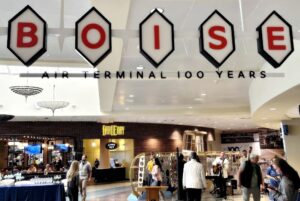
“With the work we’ve been doing the past couple of years, the airport really feels like Boise,” Kronberg said. “We have a lot of local restaurants and a lot of locally sourced small business products. Coming here, even for the first time, you quickly get the sense and feel of Boise once you land.”
McLean also stressed that Idahoans should never “take for granted” how good we have it with access to one of the “finest” and “best run” airports in the country.
“The airport will always have a key part in the city, from an economic development perspective, in terms of bringing businesses in and allowing businesses to thrive here,” she said. “The growth of our airport reflects the history and growth of our city.”
And the increasing high volume of travelers serviced by the airport, the mayor believes, speaks volumes about BOI. “From a smaller city in the West that was relatively isolated, to now being one of the fastest growing cities in our country, we are seeing this with the airport as well.”
Even with recent expansion, Samuelson still consider the facility to have a “relaxed” environment. “People are friendly and happy to see you traveling through. We’re still small enough that it makes it convenient and easy for travelers.”
Putting the past 10 years of travel numbers into perspective, 2015 notched a total of 2.9 million travelers, with a single high month of 289,215 in July of that year. By comparison, February marked the lowest total of monthly travelers last year but was still about 73,000 more than the single highest monthly total in all of 2015.
“That 5 million total last year felt like a milestone to us,” Kronberg said. “I’ve traveled in and out of this airport countless times the past 25 years, and I do believe this airport has grown in pace with the community.”
As Idaho’s population continues to move upward, most especially within the Treasure Valley, some may worry about BOI eventually growing too large, maybe reaching the levels of neighboring regional airports servicing Seattle, Portland, Reno or even Salt Lake City.
Regardless of any growth spurts here, Samuelson remains confident that it will be “quite a while” before the Boise airfield ever becomes a major hub.
“Those other large regional airports are so much larger than Boise when compared to the number of passengers we are serving,” she said. “We may be considered as a medium-hub airport, but we are still definitely one of the smallest.”
As well as historically, with the state’s largest airfield now having now reached the prestigious century mark.
“This celebration honors the people, decisions and partnerships that have shaped the airport over the past century,” Greene said. “Boise Airport should be incredibly proud of this centennial achievement.”





 Loading ...