Sign In
Upcoming Event
 Free Newsletter

Idaho State University develops VR game to teach 17th century literature
Steve Lombard//May 8, 2026//
(PHOTO: DEPOSITPHOTOS.COM)
Idaho State University develops VR game to teach 17th century literature
Steve Lombard//May 8, 2026//


A myriad of lasting and popular literary lines and phrases are regularly attributed to the world’s most famous playwright, William Shakespeare.
At a Glance:
- Idaho State University creates Lit-VR virtual reality game
- Curtis Whitaker and Farjana Eishita lead interdisciplinary project
- Graduate student Shojibur Rahman develops Tudor London environment
But his “All the world’s a stage, and all the men and women merely players,” from the comedy “As You Like It,” may best describe a merging of a variety of 17th century literature and 21st century technology taking place on the campus of Idaho State University (ISU) to help students in their quest to learn more about English literature.
Through a co-mingling of the ISU English and Computer Science departments, campus researchers are in the process of building a new virtual reality game, Lit-VR, that aims to help illuminate life in Renaissance-era London.
“My area of specialization is 17th century England, and this is the area we are using for the creation of this serious game,” said Curtis Whitaker, professor of English. “I had read about it and developed an interest in VR technology, so I started calling some of our tech people to see if we had any VR equipment on campus.”

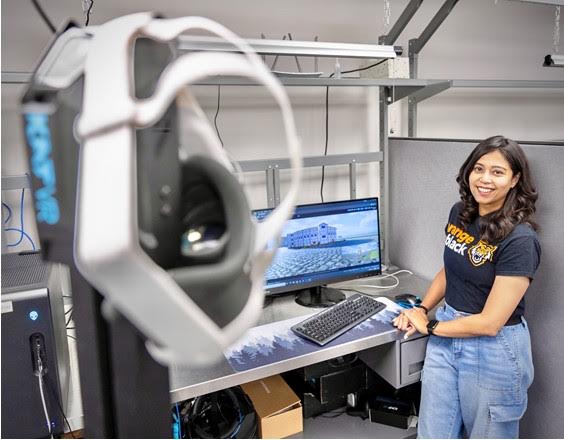
What Whitaker soon discovered was an ally in fellow assistant professor Farjana Eishita, who runs a campus lab that specializes in the visually immersive technology.
“Some of my students went to Farjana’s lab and it was a terrific experience for them,” he said. “She then had the idea of producing one of the games she works on.”
“We’re just hoping the VR technology can help these students improve their learning,” Eishita said.
Especially for those who learn better visually, said Whitaker, who describes himself as an old-school, “’80s undergrad” prior to obtaining his master’s degree at the University of California Los Angeles.
“I am more of a visual learner myself,” he said. “So when I am reading a novel or a play, seeing more than pictures with this VR element and being able to set yourself in it and look around it feels much different than just looking at pictures.”
For Whitaker, the learning experience he underwent four decades earlier was primarily text-based. “As a humanities major back then, I could see how such visuals could have been so beneficial to make the learning experience so much more engaging.”
In this case, and with the advancements in technology, some of London’s most famous landmarks, including Westminster Abbey, the Houe of Commons, Shakespeare’s Globe and even the London Bridge will soon be visually available to those studying the literary genre.
“We are setting up the city exactly the way it was and working to portray it as it was during that time so that students will enjoy a proper experience,” Eishita said. “For this college level of study, I have not found any other program focused on this genre of literature.”
Much needed university funding has helped spur the program along, though Eishita referred to it as being still in the “developmental stage,” as she and her team work to bring the game to life.
However, the pesky annual rite of passage, also known as graduation, serves as a double-edge sword in the development process. Lab workers under her guidance eventually move on from their university life and into the real world.
“Recruiting new students to work in the lab can cause some delays,” she said. “But I am confident that come this fall semester, we will be ready and prepared to do some play testing.”
Graduate student and primary researcher, Shojibur Rahman plays a key role in helping her with the project’s technical development.
“I’ve been specifically designing and building the VR environment that recreates Tudor London,” Rahman said. “That includes implementing the interactive elements, structuring the gameplay flow, and integrating learning components into the experience.”
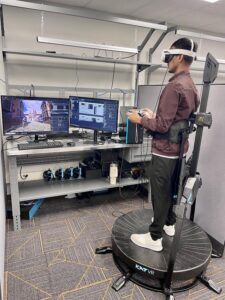
Rahman’s vital participation also involves shaping how the system is evaluated, as well as planning user studies to help develop an understanding of how students interact with and learn from the designated environment.
“It’s definitely challenging because you’re not just building a system, you’re designing an experience,” he said. “You have to think about usability, interaction design, performance and how to make the environment meaningful for learning.
“For me, one of the biggest challenges was starting without prior experience in VR development and quickly getting to a working prototype. But that process also made it really rewarding.”
The ultimate reward is producing a product that brings together human-computer interaction and immersive technologies to reinforce learning.
And this is not just a game.
Rather, in this instance, the technology is classified as a “serious” game for those who will engage in its use, with learning the key outcome.
“When we talk about games, it is quite often understood that many are simply produced for leisure time activities,” Eishita said. “For games of this nature, the primary goal is to be entertained, to experience the feeling of enjoyment.
“But for what we call a serious game, while it is still absolutely a game, this type of game also has a purpose beyond entertainment. That is still an important element for cognitive understanding.”
When finalized, Lit-VR will encompass five total games that students will have to complete over the course of a full semester in an attempt to gain greater understanding of the geographical and historical context of 17th century literature.
“These games blend engaging gameplay mechanics with meaningful content to achieve specific outcomes, such as teaching skills, promoting behavioral change or solving real-world problems,” Eishita said.
Although, the gaming format, Whitaker acknowledges, is not universally applicable to all literary works, particularly those written to specifically delve more deeply into the internal states of the mind through conversation.
“There are some literary experiences that rely heavily on immersion into the text, such as a Virginia Woolf novel or a Henry James novel,” he said. “I can see in some cases how too much visualization in these situations can actually be a disadvantage.”
But based on his own educational background and subsequent teaching experience, he does strongly feel that VR technology could aid those in specific industries such as farming, mining and even energy development.
“The opportunity to learn about the geography of the subject in a particular industry, I would think this would be a huge plus,” Whitaker said. “It’s a learning technology with so many different applications, and with the serious game application, it has so much potential for so many people.”
And for an experienced educator who, during the course of his lengthy teaching career, has walked many students through London and other prominent locations, being present in a specific setting is always the best way to fully experience the learning environment.
“Imagine how useful the VR technology can be to a person who already knows a bit about a subject,” he said. “Using this can only help deepen one’s understanding of a particular place.”
(PHOTO: LOGAN MCDOUGALL, ISU)
Technology he sees benefiting those on both ends of the spectrum. “VR technology is quite helpful to so many at so many levels of the learning process. Beginners can be enticed by the gaming element, while those already familiar can deepen their knowledge.”
A learning concept that similarly applies to those charged with developing and enhancing such technology for others, an experience Rahman has enjoyed from working with both instructors.
“Professor Eishita has really shaped how I approach research,” Rahman said. “She’s helped me think more systematically about problem-solving, structuring my work, and making sure what I build is grounded in clear research goals, not just technical implementation. Since I’m still early in my master’s, her guidance has been important in helping me transition into doing research more seriously.”
He also shares high praise for Whitaker, whom he attributes as the key factor for the opportunity to obtain a “completely different” learning perspective derived from the classroom side of the venture.
“As someone who comes from the English Department, Professor Whitaker brings the vision for how literature should be experienced by students, and we’re essentially translating that into a VR system,” he said. “That collaboration has helped me to understand how to design technology that actually serves a domain outside of computer science, especially in terms of storytelling, context and student engagement.”
One can only imagine what Shakespeare or Charles Dickens would have thought about integrating their famous works with today’s technological advancements.
“I don’t know if I want to presume getting into the head of Shakespeare, but I have to think some of these famous writers would be delighted by the prospect of this technology,” Whitaker said with a laugh. “Sometimes it is actually fun to speculate what genre a writer from an earlier time would be working on today.”
All in the name of learning.
“By exploring themes, settings and narratives from historical texts, students gain insights into the cultural, social and philosophical underpinnings of the era,” Eishita said. “The future of VR learning is promising, with the potential to become a mainstream educational tool.”