Sign In
Upcoming Event
 Free Newsletter

Fulbright Scholar from Poland studies actinide physics at Idaho National Laboratory
By Paul Menser, INL Communications//May 6, 2026//
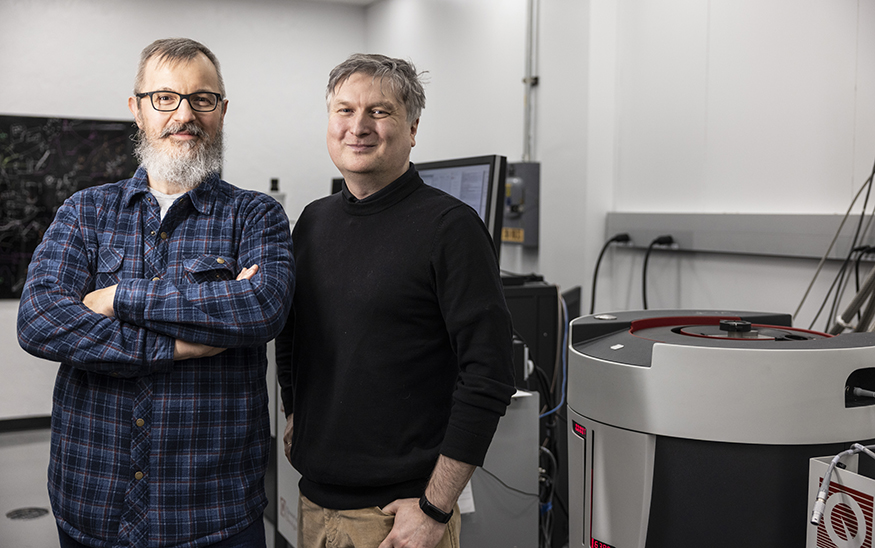
Adam Pikul and C-QAST Director Krzysztof Gofryk. (PHOTO: INL)
Fulbright Scholar from Poland studies actinide physics at Idaho National Laboratory
By Paul Menser, INL Communications//May 6, 2026//


For Adam Piotr Pikul of the Polish Academy of Sciences, there is always more to understand about the basic physics of uranium atoms. That’s why Pikul, a professor at the Institute of Low Temperature and Structure Research in Wrocław, is studying actinide quantum materials at the Idaho National Laboratory (INL) on a Fulbright Senior Award. Actinides are a group of 15 radioactive elements, including uranium.
At a Glance:
- Adam Piotr Pikul awarded Fulbright Senior Award for research
- Collaboration with Krzysztof Gofryk at Idaho National Laboratory
- Research supported by U.S. Department of Energy Basic Energy Sciences
At INL, Pikul is collaborating with Krzysztof Gofryk, director of C-QAST. They are studying how electrons behave in uranium-based compounds and evaluating their potential as quantum materials to advance energy and information technologies. Pikul hopes to deepen the scientific community’s understanding of advanced magnetic quantum phenomena, potentially influencing future quantum technologies. Gofryk’s research on actinide quantum materials is primarily supported by the U.S. Department of Energy’s Office of Science, specifically within the Basic Energy Sciences program.
Pikul is visiting from Wroclaw, a city of about 630,000 residents and upwards of 100,000 college students in southwest Poland. His research project, “Emergent Electronic States in Uranium Based Quantum Materials,” is supported by a one-year scholarship.
Highly selective and prestigious, the Fulbright Senior lets Polish scholars employed at Polish higher education or research institutions conduct independent research or teaching projects at host institutions in the U.S. Pikul’s time at INL is hosted through the Center for Quantum Actinide Science and Technology (C-QAST) and the Glenn T. Seaborg Institute.
Focused on the ‘whys’
Heavy actinide elements like uranium and thorium, found at the bottom of the periodic table (atomic numbers 89-103), have a lot of nucleons and electrons in motion at the subatomic level. That movement looks like random activity at room temperature. But at super-cold temperatures, the atoms slow down and their interactions become easier to observe.
“INL has special capabilities to study actinide quantum materials, including the lowest temperatures and highest magnetic fields in Idaho,” Gofryk said.
The discoveries they make and the data they collect contribute to the simulation tools that researchers use to predict the behavior of advanced nuclear fuels .“This is pure physics,” Pikul said. “We use magnetism as a tool to probe basic properties of various materials, including nuclear materials.”
Pikul said basic understanding of materials leads to better modeling. “Examining the crystal structure, whether it’s metal or not, it’s heat conduction properties … these are the most complex elements. We’re focused on the ‘whys.’”
Before he returns home, Pikul plans to visit Lawrence Berkeley National Laboratory, where he intends to use the Advanced Light Source synchrotron facility; and Los Alamos National Laboratory, home of the Magnetic Field Laboratory Pulsed Field Facility.
Many collaborations
Specializing in magnetism and low-temperature physics, Pikul has collaborated with scientists from over a dozen countries. He took part in a 20-month postdoctoral fellowship at the Max Planck Institute for Chemical Physics of Solids in Dresden, Germany, courtesy of a Humboldt Foundation fellowship. He has studied at the University of Rennes in France several times.
Pikul enjoyed at three-month residency at INL in 2021, funded by the Kosciuszko Foundation, which promotes closer ties between Poland and the U.S. through educational and cultural exchanges. The choice to apply for a Fulbright grant was strategic but simple: He wanted more access to the specialized research infrastructure available at INL’s Quantum Actinide Science Lab. The U.S. Department of State’s Fulbright Program, with its strong ties to U.S. institutions, international prestige and exceptional support for scholars, was a natural fit.
Pikul said he recognized INL’s equipment and expertise could help him get further into the “whys” that have always interested him. His earlier work at INL resulted in a 2022 paper published in Physical Review Materials titled, “Competition of Magnetocrystalline Anisotropy of Uranium Layers and Zigzag Chains in UNi0.34 Ge2 Single Crystals.”
After returning to Poland, he said he wanted to do something bigger. He applied for the Fulbright and learned in January 2025 that his proposal had been accepted.
Uranium was the first actinide discovered, in 1789, followed by thorium approximately 40 years later. But it wasn’t until the mid-20th century that Glenn Seaborg formulated his actinide hypothesis, opening the door to synthesizing transuranic elements such as neptunium, plutonium, americium and curium.
“In the 1950s, they could describe properties, but that was about all they could do,” Pikul said. “Now we are much deeper. We can delve into various subtle microscopic effects, see how the atoms vibrate and determine the first principles of fuels and compounds.”
One of the goals of the Department of Energy’s Genesis Mission, announced in February, is “building the quantum ecosystem that will power discoveries — and industries — for decades to come.”
With high-powered computing and artificial intelligence, the possibilities for unlocking atomic secrets have grown dramatically. Gofryk and Pikul are at the front end of the process, providing the detailed subatomic data that will allow researchers to use AI to discover new patterns and analyze new insights.
This story was provided by Idaho National Laboratory.






 Loading ...