Sign In
Upcoming Event
 Free Newsletter

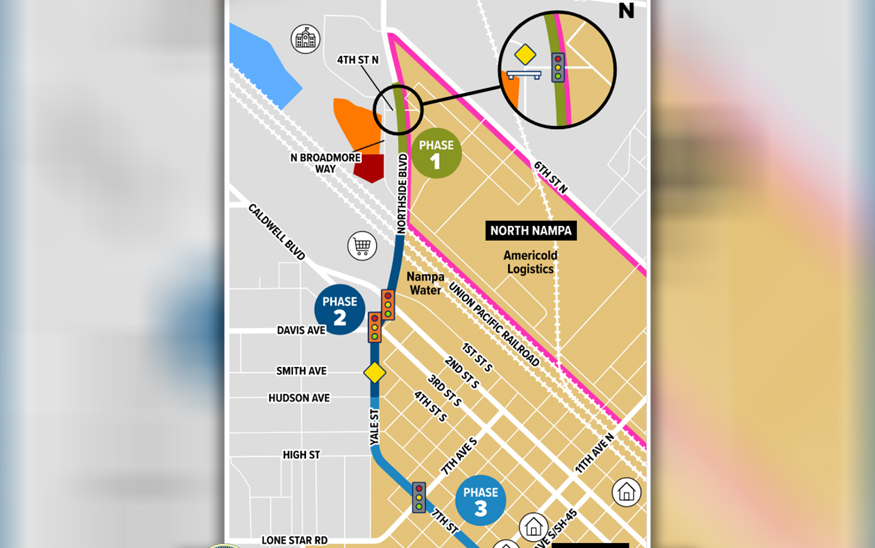
This map shows the three areas that will benefit from a BUILD grant awarded to Nampa for infrastructure improvements. (CITY OF NAMPA)
Nampa, Boise land $28.6M in federal transportation grants
IBR Staff//July 9, 2026//


The cities of Nampa and Boise have been awarded a combined $28.6 million in federal BUILD grants for transportation projects in the Treasure Valley, the Community Planning Association of Southwest Idaho announced July 9.
At a Glance:
- Nampa awarded $22.99 million for Northside Corridor improvements
- Boise granted $5.6 million for Lake Hazel Road extension planning
- COMPASS supports grant applications with data and grant writer
The grants ― one for construction in Nampa and one for planning in Boise ― come from the U.S. Department of Transportation’s Better Utilizing Investments to Leverage Development program.
“Their two grants will help fill the regional transportation funding gap, which we now conservatively estimate at $300 million per year in Ada and Canyon Counties,” said COMPASS Executive Director Craig Raborn.
Nampa received $22.99 million for its Northside Corridor Community Connectivity and Safety Improvements project. The grant requires no matching funds from the city. It is the largest transportation grant in the city’s history and the largest BUILD award in Idaho this year.
The project will improve a 1.5-mile stretch of the Northside Corridor from Northside Boulevard and 4th Street North south to the intersection of 12th Avenue South and 7th Street South. Improvements include new pavement, sidewalks and curb ramps, a widened bridge over Indian Creek at North Broadmore Way, new traffic signals at Northside Boulevard and 4th Street North, and a new signal at 7th Street South and 7th Avenue South.
The corridor has seen 350 crashes over the past five years, including a recent fatal crash at 7th Street South and 7th Avenue South.
“This significant investment will not only enhance safety for our motorists but also ensure that vulnerable users benefit from essential ADA and sidewalk improvements,” said Crystal Craig, Nampa’s director of transportation.
Construction is expected to begin as early as fiscal year 2027, with the full project anticipated to be complete by Sept. 30, 2030.
Boise received $5.6 million to plan a future east-west extension of Lake Hazel Road south of Boise Airport. The funding will help determine the roadway’s alignment, conduct an environmental screening, study potential railroad crossings and prepare a phased implementation plan for future capital investment.
COMPASS said its staff played a role in securing the awards, with a full-time grant writer helping member agencies identify opportunities and prepare applications. The agency’s data resources also supported Nampa’s bid; the city drew on COMPASS’s “high injury network,” which identifies corridors most susceptible to serious injury or fatal crashes, to make the case for urgent safety improvements on the Northside Corridor.
“Working with our member agencies to aggressively pursue competitive grants is one of COMPASS’s strategies to help fill our transportation funding gap,” Raborn said.
This story was written using artificial intelligence with human oversight.

 Loading ...