Sign In
Upcoming Event
 Free Newsletter

As the Treasure Valley population increases, some homebuyers opt for further away
Marc Lutz//June 9, 2026//
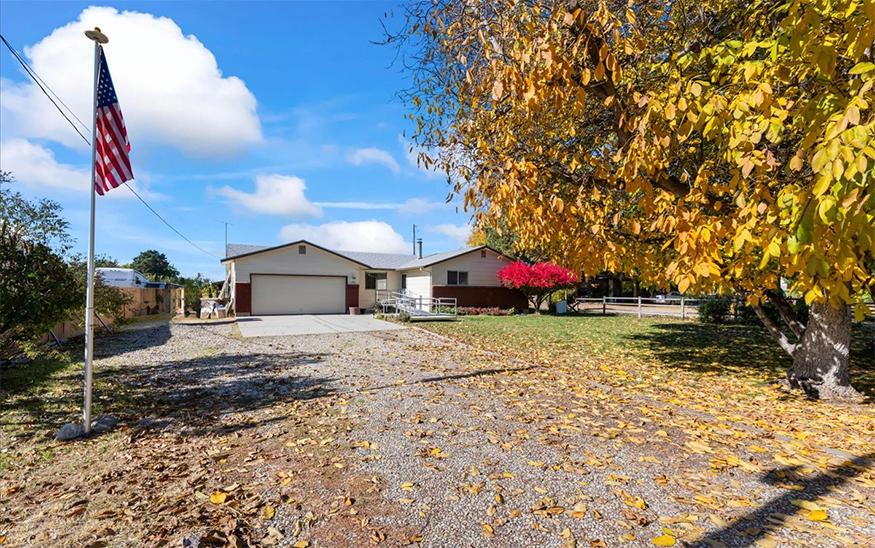
This property in Emmett sold earlier this year for $349,000. It is a three-bedroom, two-bathroom, two-car garage home that is 1,200 square feet and sits on almost a half acre of land. Some homebuyers are looking further out from the Treasure Valley to get more value for their home purchases. (PHOTO: COURTESY OF MICHELLE BAILEY)
As the Treasure Valley population increases, some homebuyers opt for further away
Marc Lutz//June 9, 2026//


Much to the chagrin of those who want a small-town feel in Idaho’s Treasure Valley, the state’s population continues to tick upward. Just about two years ago, the number passed the 2 million mark.
At a Glance:
- Idaho Realtors president Michelle Bailey discusses homebuyer challenges
- Ada County median home price at $545,000 in April
- COMPASS projects 500,000 new residents in next 25 years
One recent projection calls for 500,000 new residents in the state in the next 25 years, adding roughly 25,000 people every year. With that increase comes a demand for housing and more accommodating infrastructure. With Idaho home prices trending upward like the population, some people are looking for the best values, even accepting a longer commute if necessary.
A home on the range? Not so fast
Some who move into Idaho from out of state are looking for the great deals on homes and land, bucolic settings and an easier way of life. That’s not always going to be the case, said Michelle Bailey, the current president of Idaho Realtors and an associate broker running a team at Keller Williams Realty Boise.
“I think it’s always this idea that you can move here and you get your own private Idaho, right? You’re going to have this land, you’re going to build your dream house, and what happens 99% of the time is a reality check of what is involved in that process and how much it costs,” she said.
Bailey stated that in her two decades in the business, that has always been the case. “I think what’s changed a little bit is this idea of wanting a family compound, which is great in theory, not so great in execution. … [It’s] the idea of having this plot of land that then they can build multiple houses, so that all the family is close by. I mean, it’s not very realistic.”
Depending on where potential homebuyers look, prices (and what can be bought for those prices) can vary drastically.
In Ada County, the median sales price for a single-family home decreased slightly in April by 0.3% to $545,000, according to information from the Intermountain Multiple Listing Service (MLS). In Canyon County, the median sales price was up 3.6% to $430,000.
But what buyers will get for that price in Boise, Meridian or Nampa compared to Caldwell, Mountain Home or Emmett is vastly different.
“To get something for that [$300,000 price point] in the Boise area is not happening,” Bailey said. “Even an older townhome I have listed is listed at $380,000, and that’s three-bedrooms, one and a half bath. These are single-family homes, but they’re more like 1,000 or 1,100 square foot and they’re older.”
Bailey said her firm recently sold a 1,290-square-foot home with three-bedrooms, two-bathrooms and a one-care garage on a nearly quarter-acre lot in Mountain Home. The home was built in 1976 and sold for $300,000. A similar home built in Emmet in 1979 but on a nearly half-acre lot sold for $349,000.
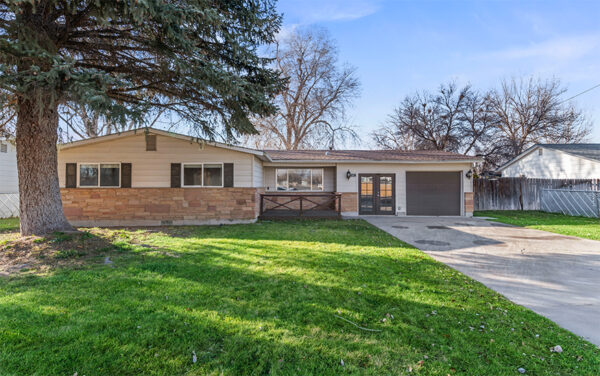
Similarly priced properties in Boise are closer to 1,000 square feet on much smaller lots and many are fixer-uppers.
When finding the house they want, the challenge for the buyers then becomes having the winning bid.
“We have one particular buyer right now that is in a lower price point, and it makes it more challenging, but every property that we’ve gone to put an offer in on has multiple offers because they’re at that $300,000 mark,” Bailey said. “It has been challenging to get something.”
Getting from point A to point B
At its April board meeting, the Community Planning Association of Southwest Idaho (COMPASS) accepted population estimates for 2026 covering Ada, Boise, Canyon and Elmore counties. The total combined population is 915,940, nearly half of the state’s residents. Ada and Canyon counties account for 876,760 of those.
Since 2020, the population of Ada and Canyon counties combined has increased by 150,000, COMPASS reported. The population of the four-county region has increased more than 20% since 2020. The City of Star saw the largest percentage increase in population since 2020 at 131%.
The report also stated Caldwell, Kuna and Meridian all had the largest year-over-year increase in population, gaining 5,160; 4,810; and 4,730 people, respectively.
COMPASS is also the organization behind the estimated growth of 500,000 people in the region over the next 25 years. The projected data comes from looking at energy use and the number of housing developments pulling permits, said Craig Raborn, executive director of COMPASS.
No matter where those new residents choose to live, that impacts area roadways, driving up commute times and to get around quickly and easily.
“What we’re trying to do is to make sure that we’re keeping up with the infrastructure needs for the region, and COMPASS focuses primarily on transportation, so every new resident is roughly 15 to 30 miles a day of vehicle travel of some type, bus, car, bike, walking, whatever that happens to be,” he said. “Because transportation projects take time to develop, by the time you’re feeling the impact on the roads of the new growth, the easiest ways to address that are already off the table. We’re left with sort of retroactive type fixes.”
Raborn pointed out that the growth of the Treasure Valley is not unique as any area facing growth has the same challenges, especially when it comes to investments in infrastructure.
“We’ve got a conservative estimate … that we’re falling behind every year about $200 million in necessary investments, and that’s just to keep up with the growth that we have,” he said. “That’s a conservative estimate based on my experience in other regions prior to coming here. I think that’s a very low estimate, frankly. I’d say it’s probably higher.”
About 25 years ago, COMPASS forecasted commute times by this year from downtown Caldwell to downtown Boise would take two and a half hours. But because of transportation investments and upgrades to Interstate 84, those times are typically 30 to 35 minutes, Raborn said.
“We’re already projecting that that’s going further as we look 20 years out from now,” he said. “[Commute times are] edging right back up because the resources are falling further and further behind. I think the growth is happening faster, and it’s putting more vehicles onto the roads now than we were anticipating, say 10 years ago, and so you know everyone is working hard to keep up with it.”
Different options for house hunters
A newly published COMPASS report, “2025 Development Monitoring Report For Ada and Canyon Counties,” showed that there were 9,327 new permits for residential developments across the two counties. With the completion of Highway 16 coming in early 2027 connecting I-84 north to Highway 20-26, the open areas around that corridor will likely be the hottest areas of development.
“The big trend we’re seeing, or we’re projecting right now, I’d say is kind of an infill that will be happening in the area between Meridian and Star and over into the Nampa and Caldwell area as 16 opens up. And the surface roads to serve and provide access to 16 continue to improve. As that area starts to fill in, it’s kind of the most notable area of growth.”
But new developments don’t always fit within the budgets as many can hover around the $600,000 and up price tag. And if it’s more affordable, people will choose to live closer to their workplace.
In a report from the Idaho Department of Labor, as of April 2026, the labor force was 298,028 in Ada County, more than half of the total population of the region. If every one of those people had to commute by car, that could cause more gridlock and delays. However, it is estimated that 17% of Ada County’s workforce, or about 50,600 people work remotely.
“I think if people are able to work from home, then they’re willing to be a little bit outside of the restaurants and stuff,” Bailey said about those who choose to look further afield for a housing. “But for people that have to work close to or within Boise, for example, I’m not seeing a ton of flexibility in moving further out in order to get what they want.”






 Loading ...