Sign In
Upcoming Event
 Free Newsletter

How sustainable construction is transforming Idaho
By Brooke Strickland, Special to IBR//July 13, 2026//
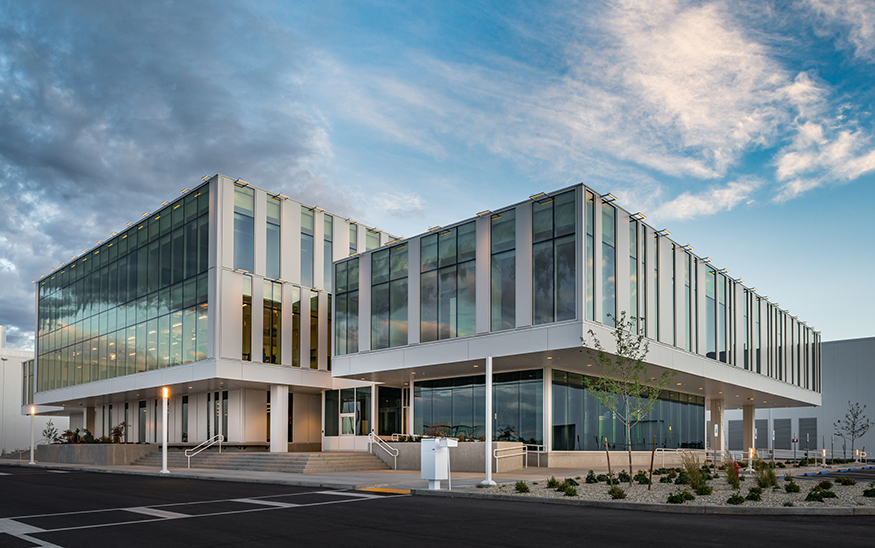
The Chobani headquarters building was designed and built with sustainable practices in mind. (PHOTO: MARC WALTERS PHOTOGRAPHY)
How sustainable construction is transforming Idaho
By Brooke Strickland, Special to IBR//July 13, 2026//


Sustainable construction is proving to no longer be an out-of-the-box concept or a last-minute consideration. Instead, it’s becoming a foundational piece of building development.
At a Glance:
- Sharon Grant leads integrative design process for sustainability
- Suzie Hall promotes wind power use near Snake River Plain
- Lindsey Love advocates low embodied carbon concrete options
From integrated design processes and unique solar strategies to utilizing low-carbon materials and implementing smart building technologies, architects and developers across Idaho are finding innovative ways to reduce their carbon footprint at all project stages.
Demand has grown in recent years for healthier, more resilient spaces, and sustainable design is evolving. Local industry leaders and business professionals say the key to success comes from thoughtful planning, collaboration and a holistic approach that considers a building’s entire lifecycle.
Incorporating eco-friendly design elements
Sharon Grant, founder and owner of Eco Edge and sustainability consultant for RE Tech Advisors said that the integrative design process starts with a design charette during the concept phase. This intensive, focused workshop can be several hours or several days long and brings together stakeholders and experts to communicate to the project team, building users and project management staff.
“A charette can be viewed as a creative burst of energy that builds momentum for a project and sets it on a course to meet project goals. Integrated design processes encourage early, cross-disciplinary collaboration to optimize building performance, cost and sustainability before major design decisions are locked in. Integrating sustainable measures at the front end of project conception through design processes and contractual agreements tends to cost less than utilizing change orders to add sustainability later in the process.”
Lindsey Love, past president of AIA Idaho and founder of Regenerative Building Solutions explained that nearly every choice in early building design has a cascade of consequences, so early iteration, integration and estimation are crucial.
“A collaborative design process is essential to successfully incorporating project priorities, so including eco-friendly strategies early on and making sure all team members, including the contractor, are aware and on board with the priorities is helpful,” she said. “In addition, approaching any design with options and ‘value engineering’ (lower cost) alternatives that maintain eco-friendly values is a win-win strategy.”

Innovative strategies to reduce carbon footprints
Suzie Hall, CEO of The Cornerstone Collective said that working alongside experts is the first step to minimizing negative environmental impact.
“Hiring an experienced LEED or sustainability project coordinator ensures that an expert is ‘steering the ship’ so to speak, and speaks the language of every stakeholder,” she shared.
She pointed out that one innovative strategy she’s seen lately is using one of Idaho’s greatest natural resources: wind.
“Wind power is highly beneficial for Idaho buildings because it provides access to low-cost, predictable electricity, and improves local energy independence,” Hall said. “Because Idaho features strong wind resources — especially near the Snake River Plain — incorporating wind helps buildings lower utility costs while supporting a sustainable grid.”
Grant said that while there are a variety of different products and techniques shaping the future of sustainable architecture, design and construction, passive solar is one fundamental approach to all designs that can be beneficial. This approach to building uses sunlight to heat, cool and light a home without mechanical systems like furnaces or air conditioners.
“Passive solar relies on the building itself; its windows, walls, floors and roof work together to naturally collect, store and distribute heat,” she explained. “These techniques can cut heating costs by 30% to 70% compared to conventional construction, depending on the climate. Integral to the success of passive design and overall building performance are a tight building envelope, one that is well insulated with minimal air leakage.”
The team at CSHQA, a Boise-based architecture, engineering, and interior design firm reiterated the benefits of solar saying, “Solar is a natural fit in this region because we have strong sun exposure. Even when a client does not install panels immediately, we are often thinking about roof layout, equipment placement, conduit pathways, and electrical capacity so the building can support solar in the future.”
Love shared that concrete is a major culprit of embodied carbon and while it’s required for nearly every project to build a strong foundation, there are new products and technologies emerging that can help reduce carbon emissions.
“In the future we’ll see bio-based, low embodied carbon and maybe even net-zero concrete more commonly,” she said. “There are lower embodied carbon concretes and aggregates, available now from some concrete suppliers, even in eastern Idaho. The most practical strategy is to reduce the amount of concrete a project requires, though. Requesting a low embodied carbon mix and discussing options w/ the architect or structural engineer is the best place to start.”
Common misconceptions
Love stated that the main misconception she sees is that it’s more expensive or must be considered an “add-on” to prioritize sustainability. There is also some confusion around different materials.
“Green design can cost the same or under 5% more than conventional,” she said. “When done poorly, or as an add-on at the wrong time, just like any design change, it will cost significantly more. Around specific materials and strategies like straw or hemp, there is a lot of fear around pests, moisture and fire. But enough testing and existing buildings even in Idaho have proven these to be false. In fact, we’ve seen the opposite: Straw and hemp buildings are more fire, pest and mold resistant than our typical cavity walls.”
Hall also spoke of the long-term savings that eco-friendly building provides. “While initial material costs may be slightly higher, long-term operational and maintenance savings yield higher property values, higher occupancy rates and significant utility reductions.”
She also said that thinking about sustainable building doesn’t have to be in brand-new builds.
“You don’t need to build from the ground up to practice sustainable construction,” Hall shared. “Retrofitting, upgrading and renovating existing structures is one of the most effective ways to be sustainable. Repurposing older buildings prevents demolition waste and significantly lowers a structure’s overall carbon footprint. Invest in a consultation with an expert to discuss your project and ideally perform a feasibility study. Many times, you’ll discover many opportunities for designing and building more efficiently, with better health benefits and a much longer life cycle.”
Additional benefits of eco-friendly environments and future outcomes
Love said that while there are obvious long-term benefits to the Earth with eco-friendly design and construction, it goes even further than that.
“Sustainable, biophilic, beautiful buildings typically see higher productivity in employees/users/occupants,” she said. “This is an obvious win for companies, but it is also a win for anyone living or working in any building — we would all be glad to feel better, livelier and more productive, no matter if working or at home.”
She also stated that an energy efficient building can also pay for itself in savings and lower-embodied carbon materials are often, by default, less toxic to produce.
“There are many opportunities that come with eco-logical, quality design that can be capitalized on,” Love explained.
Looking at the future, implementing good sustainability strategies not only helps people reap real rewards of energy savings and lower utility bills, but this can truly make a true positive impact in helping conserve the Earth’s most precious resources.
“The Treasure Valley is growing quickly,” CSHAQ stated. “The buildings we design today will shape our energy use, water demand, comfort and resilience for decades.”
This story originally appeared in the July 3, 2026, issue of Square Feet: Designing for Innovation, a publication of Idaho Business Review.

 Loading ...