Sign In
Upcoming Event
 Free Newsletter

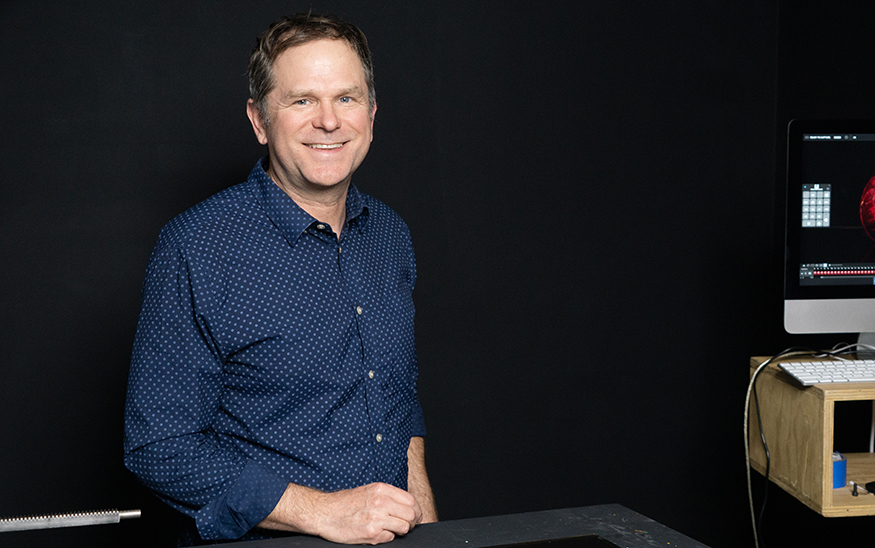
Lars C. Larsen is a Boise-based stop-motion animator who has won an Oscar for his work in film. His upbringing and education helps him blend his creative side with technical expertise when it comes to the craft of animation. (PHOTO: MARC LUTZ, IBR)
The IBR Interviews of Highly Effective People: Lars C. Larsen
Marc Lutz//June 22, 2026//


In only a few minutes of speaking with Lars C. Larsen, it’s clear that he is on a lifelong journey of learning, collaborating and teaching.
At a Glance:
- Lars C. Larsen won an Academy Award for stop-motion animation
- Larsen teaches stop-motion workshops at Boise School District
- Inducted into the 2025 Idaho Film Society Hall of Fame
The Boise-based Academy Award-winning stop-motion animator admits that he’s always had an artistic side and a technical side. Those two aspects of his personality combined to make stop-motion a natural fit. Even when animating, he finds pathways to other skillsets he learns from the art. He has worked on Guillermo del Toro‘s “Pinocchio,” “Kubo and the Two Strings,” “The Boxtrolls” and “Coraline” among others.
As the fourth child of Danish immigrants, he learned the value in creating with one’s own hands. “We built our own house growing up,” he said.
Embracing the spirit of education has led Larsen to his latest endeavor of teaching students the technical aspects of stop-motion animation at Boise Schol District and South Junior High School. One of his core philosophies is the idea of “thinking with your hands,” and getting kids to create. He has been told that children who previously showed no interest in anything are suddenly interested in using their minds and hands to make something after his workshops.
Most recently, he was inducted into the inaugural 2025 Idaho Film Society Hall of Fame with the Excellence in Education Award.
The following interview has been edited for length and clarity.
Idaho Business Review: Can you remember the first stop-motion that you ever watched?
Lars C. Larsen: It’s hard to remember exactly what was maybe the first, but I was always fascinated by the Rankin-Bass [production of] “Rudolph the Red-nosed Reindeer.”
I’m going to watch “Clash of the Titans” this week … and that will be at the Hollywood Theatre in Portland, and it’ll be on 35 millimeter. I remember having a very vivid experience … they had it set up in the parking lot of my elementary school. They had a screen set up and we watched it outside, and the animation just kind of left an impression on me.
I’ve seen Ray Harryhausen speak in Boulder, and he talked about how stop motion is inherently surreal. If you take the word surreal, it’s like “before reality,” and taking an inanimate object and giving it motion is a surreal experience that you have when you watch it.
(Editor’s note: Ray Harryhausen was considered a pioneer in stop-motion animation and special effects for films. He worked on several films such as “The 7th Voyage of Sinbad,” “Jason and the Argonauts,” “One Million Years B.C.” and the aforementioned “Clash of the Titans,” which was his final film.)
IBR: What inspired you to pursue the career you are in?
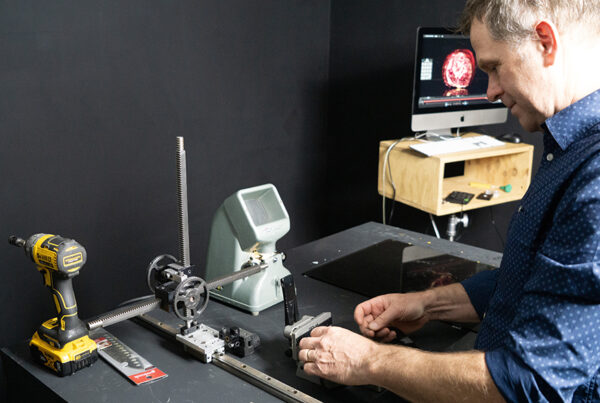
LL: When I was a kid I played with LEGO, and I was like, “Wow, that’d be cool to have this come to life.” And then we shot on Super 8 [film]. And those films were lost, I guess, but you know, just the process of filmmaking really resonates with me. I was in college, I was studying engineering, and found myself just editing all night, realizing this is what I love to do, and I think I could choose to do this and just dedicate my whole self to it.
IBR: What was your first job?
LL: I did a lot of freelance projects, and I was also working in theater, doing theater production, putting together sets for different theater companies in Portland. I was the technical director, and I would hire people for painting, or installing sets, and made really solid connections with a crew of people there. When you work with somebody that you really like, you wind up working with them more, they kind of bring you on to their projects, and it just kind of snowballed.
I came to Portland back in the late ’90s, knowing that [Laika and ShadowMachine were] producing animation, and there was a growing film industry there. I immersed myself in the scene, as far as experimental film, music videos and film production. I think I did a couple commercials … and then that just kind of snowballed into more projects, and then the big project was “Coraline.”
IBR: What did you learn from your experience on Coraline?
LL: My main thing in that feature production is I do practical effects, and it’s called stop-motion rigging, where you’re designing really specialized scenic setups, where the environment is moving, there are the puppets, but there are also elements that are doing complicated things. I kind of see it as slow-motion kinetic art, right? You’re designing and engineering a way to achieve an effect ― like one of the big things is Coraline’s portal from the two worlds. I worked on various versions of that for like two years; developing the look of it, how you would send a puppet through it, how you would send a camera through it, how you would send both a puppet and a camera through it, while the set itself is animating. That was really a magical moment for my career. You quickly learn a set of expertise, and it’s really fun because you’re working with animation, the scenic elements, the lighting, the motion control of the camera, so there’s a lot of elements that come together on the stage, and you’re navigating how they all work together to achieve a vision of production design and direction.
IBR: It seems that would teach you not just problem solving but patience.
LL: Yeah, long-term problem solving and patience. I’m doing a lot of workshops now. I do them here at [Idaho Film society], at JUMP, a variety of arts organizations, and with the Boise School District. Right now, I’m teaching a six-week workshop at South Junior High. … There’s not a huge [film] industry here, but what are the skills you develop when you [work in animation], and I think it’s very engaging for young minds that lead to other skill sets that you want to learn. 3D printing and advanced manufacturing techniques are pretty much the same technology as motion control for a camera, the way you would control a CNC router is the same technologies you would use to control a camera or a lighting system. … And those are skills that transfer out into to other disciplines.
IBR: What are some of the challenges you’ve experienced during your career and what have they taught you?
LL: When you are in an industry where there are a lot of visions and dreams ― we’re kind of working with imagery and dreams ― and as you get into bigger projects, there are a lot of different crafts. Some of them are about making something look good or making a great performance, but then there’s also another side of the organization that’s making the movie that needs it to be done quickly. Those aren’t always compatible goals, and everyone’s working on the same film, so you need to figure out how to communicate well with people. And no matter what you do, and it comes to a head in film production on set and learning how to navigate that, those situations where it’s collaborative, and you’re figuring out good solutions that you know it’s maybe not a compromise, but finding a place where everybody is like, “We’re getting this, and we’re doing the best we can.” That really comes into play when you’re working for exceptional directors, and the goals are really high.
IBR: When you encounter a roadblock on the path to reaching your goals, how do you circumvent it?
LL: I guess going right through it, right? You try not to avoid it, because that could result in kicking some issue down the road that’s going to come back to you, potentially. I guess it really depends on the situation, you know, but leaning into trying to find a solution, and I think there’s one sort of element of stop-motion animation where you have to kind of try it out with all the elements that you have. We have a process on features where you do a block, a rehearsal and a shoot. Built into the process to bring everything together, you know what might not work, and that’s OK. But you’re committing everything you have to it, and you try it out, and you refine it to the point that you can, and not to be a perfectionist, but you’re bringing a high level of problem solving. I had one of the students ask me “What’s the biggest mistake that’s ever been made?” I go back to that built-in process of bringing everything to the first block, and being able to leave space for lack of perfection. Sometimes, when you’re working on a TV show or something over budget, you don’t have the luxury of having blocks, rehearsals and shoots, but still just having the faith of, “We’re here, we’re going to bring the best we can.”
IBR: Talk about your most recent accomplishments, the significance of those accomplishments, and how you got there.
LL: Getting the Hall of Fame was a huge accomplishment, and it’s really amazing to be honored by your peers. Committing to that is satisfying, and it feels like an accomplishment and a challenge. It’s more entrepreneurial than going and doing production work, because you know you’re self-employed. Navigating the transition, there’s like a lot of small challenges and accomplishments. It’s like, “Hey, we filled up a workshop,” and you just kind of put it on the calendar. You’re like, “OK, is this anybody going to show up for it?” And it’s really exciting when everyone does. I guess it’s relishing in small accomplishments and the communal act of development of a new thing.
IBR: How would you define your leadership style?
LL: I think that good communication is key. Being clear is important, even in the hard parts, where you know you need to communicate about things that people don’t want to hear, but communicating that with clarity is better than kicking it down the road. Being a good listener is very important, and you learn about being curious. I think communication is key. It encourages a lot of other things like trust, and I feel like people that want to be on a team value that.
IBR: Do you mentor others? If so, what do you look for in a mentee?
LL: I have had, I think, three college student-level interns, and that’s kind of one of my goals for the coming year is to formalize a mentor program and looking for somebody who is dedicated to the [animation] art form and is kind of base level. Then also there’s the person who’s going to animate no matter what, like it’s in their blood, you know, and that’s something that has high value. We use the term “a high animation IQ” in the industry, and I think you learn by doing animation. [That person will also have] some developed skill set on their own that can be layered upon. I think those are key things. My most recent mentee, her name’s Shelby-Jeanne, she’s been studying film. She’s got a craft business. … There are no big animation studios here, and [she’s] a self-starter. She’s doing her own thing, and she wants to layer that as a way to promote another business.
IBR: How do you plan each day to be successful?
LL: My wife and I have been kind of doing a … routine that is based on core values. Starting the day, we’ve been doing a little understanding of where your core values are. It’s really how amazing how basic it can be, you know? I find that going on a walk with my wife and my dog, that’s family time. We get a good, dedicated time together, and get to talk. Then, getting some exercise after that is about health. And then I go right into doing some admin, [which] is about taking care of the things you need to take care of. And for me, just doing those three things hit those top values, and it’s a great way to start the day.






 Loading ...