Sign In
Upcoming Event
 Free Newsletter

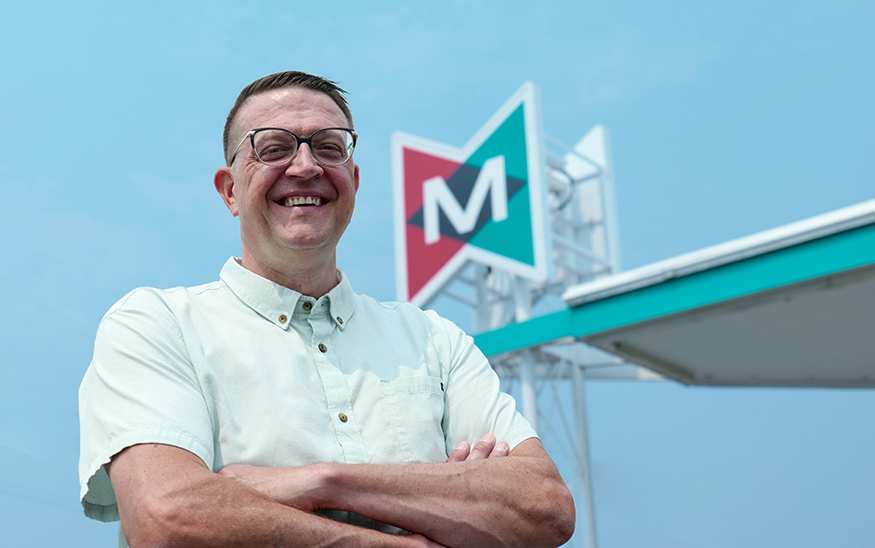
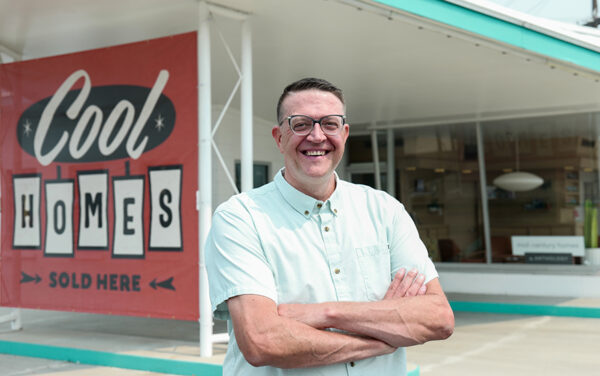
TJ Pierce stands outside the brick and mortar location of Mid-Century Homes by Anthology, the real estate company he founded in Boise. (PHOTO: MARC LUTZ, IBR)
The IBR Interviews of Highly Effective People: TJ Pierce
Marc Lutz//August 18, 2026//


Standing at six feet by six inches high, a person might be intimidated upon meeting TJ Pierce for the first time. But the founder, Realtor and specialist of Mid-Century Homes by Anthology won’t let that happen.
At a Glance:
- TJ Pierce founded Mid-Century Homes by Anthology in Boise
- Pierce focuses on mid-century modern architecture niche
- Pierce emphasizes patience and strategic yeses in real estate
Within less than a second, Pierce is asking questions, finding out more about the people he interacts with. The questions, along with a smile almost as wide as he is tall, puts a person at ease quickly, opening up an interchange.
And the questions aren’t just the techniques of a salesperson; they stem from a genuine love of people. That’s a trait Pierce fiercely believes in. So much so that he looks for that in the agents he brings aboard his real estate business. He also seeks out the creative people, those same personality types that share his love of mid-century modern home architecture.
Pierce is also incredibly thoughtful, taking his time to make a decision and weigh how those decisions will affect not only himself but his business, and more importantly, his wife and children.
The following interview has been edited for length and clarity.
Idaho Business Review: What inspired you to pursue the career you are in?
TJ Pierce: I think what started it was understanding what people were spending on advertising and marketing, and when my perspective was set on that area of business, my interest in business totally perked. In my previous industry, I was selling devices that were $10,000 to $15,000 that would last people five years, and then when I got into the C-suite conversations, leveraging more the technology side versus the equipment side — really in an effort to understand how we can help them gain more business — it put me into conversations where I heard the kind of money that people were spending to get people’s attention, and it blew my mind. I’m like, “Wait! I sell something that’s $10,000 that lasts for five years, and you’re telling me that you spend $10,000 a month on trying to get people’s attention?” I’m like, oh my gosh! I am in the wrong business, so that actually is what took me down this road of understanding marketing and advertising. And then once I went down that road, it was like I was addicted to the conversation, and I couldn’t let go of it. That’s really the turning point for me that got me thinking about doing something different.
Kind of my lead up to that, I had worked in church ministry, and learned from that perspective how to love people.
Then in my corporate sales experience, I learned sales, and then I took the combination of both of those and ventured out into an area of my own personal interest, which was [mid-century architecture]. And after hanging out with that architecture for two or three years, and this kind of growing disruption in me internally to create something different in business for myself, ended up just merging my past experience with my future interest, and realized that it was going to be through the avenue of real estate that helped me bring that to reality.
IBR: Other than your love of mid-century modern architecture, what made you decide on that niche market to focus on in real estate?
TP: We found a Realtor in Palm Springs that was specializing in it, and his name was Paul Kaplan. [He] had this business built around this era of architecture, easier to do in Palm Springs because there’s so much mid-century architecture. Not as easy to do in a place like Boise, Idaho, but that’s what probably got me percolating with the idea of real estate in mid-century. And if I was going to be in this industry, I was going to do it from a scheduling standpoint, the way that I wanted to do it. I didn’t want to work a bunch of nights and weekends, and the people that I knew who were in it had no boundaries in their life. And I had a wife and kids that want me to be around.
IBR: What are some of the challenges you’ve experienced during your career and what have they taught you?
TP: Early on, it was really important for me to be absolute in my noes and in my yeses, so that we could really become known for who we are and what we do. Because it’s easy to muddy the waters if you say you stand for something and then you do a bunch of other things, too. I’d say that that was a challenge in the beginning.
I knew that the business opportunity was there, and I knew if I hung in there long enough, that we would be able to get enough of it. And my year two was pretty amazing. But in years three and four, there were some times where I was like, “Man, are we too niched?” And it hurts the most in the middle of winter because the inventory shrinks so hard. When everybody else is transacting in the middle of winter because their net is wider, we feel it pretty heavily in the middle of winter, and there are times where we have the-grass-is-greener-on-the-other-side [mentality], but once spring rolls around, we’re so glad that this is what we do.
So, there are hard moments seasonally in the work that we do at saying no regularly at the cost of a paycheck.
IBR: So, patience is a keyword.
TP: Oh, my gosh! In this industry, you have to have it. That’s the only way you grow in this business. I mean, you can buy leads, you can be part of big machines where you’re constantly getting everybody and anybody, and you’re selling everything to everybody. But we’ve never wanted to build that model. When you’re niching down, and when you’re being really strategic with your yeses, it is slow. It is very slow. Having the patience to hang in there through that is definitely important.
IBR: When you encounter a roadblock on the path to reaching your goals, how do you circumvent it?
TP: I mentally noodle is what I do. I’m a mental noodler that then turns into a verbal processor, and then after I’ve verbally processed it enough with people who I think have insight or can help me solve the problem, hopefully, I’ve collected what I’ve needed to from those conversations to try to unearth a solution to the problem.
That’s typically how I do it. I think about it for a long time, and then I talk about it for a long time, and then I think maybe I’ve talked to the right person that gave me the right idea or gave me the right solution, and then I’ll usually take that and kind of play it out to see if that will be worth the investment of time or money or energy.
Even this building [Mid-Century Modern Homes by Anthology’s operating location at 3130 W. State Street in Boise] is a perfect example. We operated without our own brick and mortar for nine years. I was not convinced that we needed it, but the right opportunity presented itself in this building, and I would say that my wife [Ronda] actually played a huge role in convincing me to take the plunge and spend way more money than we were previously spending to have a space like this. My wife is probably a bigger risk taker than I am.
Both starting the business and getting into this space were risks that, on my own, I probably wouldn’t have taken. Because as a as a husband and a father of four at the time, and a wife who didn’t work, and being a husband that’s a provider for the entire family, taking a risk on all of it (and literally we risked losing everything to start the business), and without her encouraging me to do it or giving me permission to not live with regret because we needed to try it to see what would happen, I don’t know if I would have done it.
IBR: Talk about a time when you felt less than highly effective and what you did to overcome that feeling.
TP: I’ll give you one. The end of my time with Xerox, there was a business initiative that the company at the time had committed to in order to try to find larger business development opportunities. They had pulled in a gentleman by the name of Alan Gold to help lead that initiative. Alan was tasked with building a team around him to support what he was going to be working on, and I had expressed interest in wanting to be involved in what was going on.
They agreed to put me on the team with him, and the investment that that man made into my life to help me see things that I’d never seen before, and to help me believe things about myself that I’d never experienced before, that alone gave me what I needed to be willing to do what I’m currently doing. I think without Alan in my life, I don’t know that I would be doing this line of work. The idea of owning a business prior to spending time with Alan was beyond impossible to me. I would have never thought of myself as somebody willing to start, run, own or operate a business ever.
He put me in rooms with other business owners and reminded me regularly that I have the exact same makeup as a lot of those people, and that there’s no reason why I shouldn’t be willing to consider doing something greater than what I was doing. I fought him, too, regularly. The kind of friction and conflict that we had with me pushing back on many of the things that he would share with me, I actually can’t believe he hung in there with me as long as he did because, as a mentee, I’m sure I was really frustrating.
IBR: Do you mentor others? If so, what do you look for in a mentee?
TP: Two things that are absolutely essential in anybody that I’d be working with through this company: They have to have a unconditional love for people. I think everybody on the team has a different source for where that comes from. I don’t care what the source is, but it wherever it comes from, it needs to exist.
The other one that’s an absolute is mid-century architecture is king, and it is not like one of many that you love. That really doesn’t work because we have a target audience of people who are mid-century enthusiasts.
We invest so much time, money and energy into our passion because it’s what fuels us. So, unconditional love for mid-century architecture — I’ve never said it that way before. That’s kind of funny — and unconditional love for people. Those are the things that have to exist.
IBR: How would you define your leadership style?
TP: First and foremost, it’s a commitment. So, if we’re working together and you’re asking me to lead, I’m gaining confirmation that we’re actually in a partnership together. I’m confirming our commitment to one another, and then I’m trying to define what your expectations are. I lead through expectations. That’s what I do. So, who are you? How do you operate? What do you see in me or my company that you want? And this is who I am and how I operate, and are we all happy with that arrangement? … Then I’m going to tell you a little bit about me and how I operate, and then I’m going to ask if it makes sense for us to partner together. … And it’s honesty. It’s open communication. We don’t hide our feelings. We regularly talk about them.
My leadership style is through open communication and expectation setting, and caring enough for the people that I work with to regularly be communicating with them about where they’re at and how they’re getting there, and not hiding from hard conversations. So, if that’s a leadership style, that’s my leadership style, and all through the lens of being a challenger who loves people.
IBR: How do you plan each day to be successful?
TP: I wake up every day wondering who I can help. Whether that’s my family; whether that’s an agent on my team; whether that’s a friend who just needs support; whether that’s a client who I’m in the middle of a transaction with; whether that’s someone in the listening audience through our digital footprint that is engaged with us but not yet talking with us; what conversation starter can I put out there with a piece of content that I share that gets them to lean in and wonder if one home ownership is possible, or a better home is out there for them? If I don’t already have it scheduled on my calendar, what can I do in my day to get me to a place where I’m helping people from my area of knowledge or expertise?
IBR: What will you accomplish this year?
TP: I will hit my personal best in revenue. … [Mid-Century Homes] will hit over $225 million in sales by the end of the year. We’ll cross the 500 mark for clients serviced. So over 500 clients serviced in the almost 11 years that we’ve been doing business. Those are probably the biggest accomplishments for this year.
IBR: If you had to retire tomorrow, how would you describe the entirety of your career, and what would you do in retirement?
TP: I would absolutely still be doing this. I love what I do. I very much love what I do. But … if my company was operating without me having to show up and participate in it, I think Ronda and I would probably be trying to experience as much of the world that we haven’t seen yet, and the architecture that we have not been in yet. We would like to go to places in the world that we’ve never been and see places that have been built that we’ve never experienced before. We would definitely be doing that, and probably somewhere near water and a beach because she loves water.



 Loading ...