Sign In
Upcoming Event
 Free Newsletter

Mountain Home area prepares for higher density projects
Sharon Fisher//January 31, 2023//


Mountain Home and Elmore County are together looking at developments that could as much as double the population in the area.
The area is seeing more housing demand due to its lower prices, as well as a planned increase in hiring at Micron, just over the border in Ada County. And while both areas today are typically dominated by single-family homes, both see that as changing in the future to accommodate the expected growth.

Mountain Home
“When we use ‘density,’ the general public has the fear of ‘Oh no, there’s going to be 20-story skyscrapers next to my tiny, single-family home,’” said Brock Cherry, community development director for the city of Mountain Home. Instead, he sees the city’s goal as dramatically improving its housing diversity.
“For us, ‘multifamily housing’ is anything that isn’t single-family,” Cherry said. That could include duplexes, triplexes, fourplexes or apartment complexes, he said. “Housing diversity can even be a single-family home on a smaller lot.”
Housing diversity has been requested by city residents, many of whom are lifelong, Cherry said. While the 2017 average home price was $138,000, by 2022 it had reached $372,000, when average household earnings were just $50,000.
“If we continue to build only single-family homes, it’s not going to get any cheaper,” Cherry said. “Housing diversity is having enough options so you’re not forced to do one singular thing.”

Over the past two-and-a-half years, the city has amassed 16 projects comprising more than 1,600 multifamily dwelling units, from essentially zero previously, Cherry said, noting that the city hadn’t seen much multifamily development since 2008. Those 16 projects include duplexes, fourplexes, townhomes, row houses, three-story townhomes, patio-style apartments, live-work units and a manufactured home park, as well as single-family homes on lots of 3,000 to 4,000 square feet, he said. “It’s a lot more home, but a smaller lot,” he said.
That said, not many of the projects have broken ground yet. “Mountain Home is very good at getting projects passed,” Cherry said, noting that the city has passed 100% of proposed projects in the past two years. “To get people to come here — we’re not terribly far away, but we’re farther — we have to provide exceptional service and exceptional partnerships. The approvals speak to our willingness to work with developers.”
But the city’s current lack of multifamily housing makes funding the projects more challenging. “Funding actual projects is difficult, because we don’t have comps,” Cherry said.
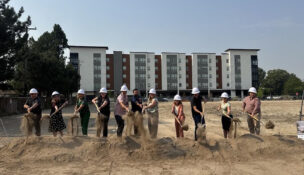
One project underway is the Village, a 192-unit patio-style apartment complex with amenities such as a pool and a clubhouse. “It’s the first of that caliber that Mountain Home has seen,” Cherry said, noting that it’s privately funded. Another 40-unit project of attached townhomes, Colthorp Commons, has also broken ground, he said.
While the Village is more luxury units, Mountain Home is also partnering with Leap Charities out of Boise on Falcons Landing, a 120-unit project that uses government funding to subsidize rents, mostly for people making 30%-60% of Mountain Home earnings, Cherry said.
To get all those projects, Mountain Home got support from the development community by holding a virtual housing summit in 2020. Cherry had worked for Twin Falls and Meridian in the past, and invited all the developers he knew to learn about opportunities in Mountain Home, where the city had tasked the mayor to spur housing development.
In addition, Mountain Home made some significant changes to its zoning ordinances, Cherry said. For example, it eliminated additional hearings for duplexes, townhomes and multifamily projects; no longer required applicants to build roadways for specific infill projects; eliminated minimum yard requirements for some zones and eliminated minimum dwelling sizes for its R-4 zoning, he said.
Moreover, the city streamlined its requirements for planned unit developments (PUDs). “It used to be five pages,” Cherry said. “We took it down to one.” The previous version of the ordinance had what he called excessive design and property development requirements that limited developers.
“A PUD is supposed to allow a developer to come forward with something creative and innovative,” Cherry said. “The requirements took the decision power away from the City Council to explore new housing options.”
The response? 75% of the 16 new projects are PUDs, Cherry said.
Part of that flexibility includes parking. “The PUD ordinance does allow developers to request deviations from parking requirements,” Cherry said. The downtown area now has a parking overlay with no parking requirements, which he said was appropriate for the area.
For residential areas, however, Cherry isn’t seeing a lot of difference in parking availability. “People want that standard ‘two-parking-spaces-per-dwelling-unit,’” he said. “We’re not seeing huge changes there.”
Part of the reason is that Mountain Home doesn’t have much in the way of public transit other than a shuttle service on call for the elderly and disabled. But as with changes to increase multifamily development, Mountain Home is planning for the future. Developments on major roadways are required to include a bus stop — currently for schoolchildren, but looking toward a future when Mountain Home has a more traditional public transit system. “It’s probably a ways out,” he said. “It may not happen in my time. But having the infrastructure built right now is extremely important.”
Elmore County

In unincorporated Elmore County, the county is looking at doubling the county’s population with two developments near the Ada County border, close to the historic townsite of Mayfield — which will essentially create a third city in the county, after Mountain Home and Glenns Ferry.
The Mayfield Townsite planned community, approved in 2011 but not yet built, consists of 15,000 units, while a second planned community, approved in October, has 2,300-2,500 units and is called Mayfield Springs, said Mitra Mehta-Cooper, director of the land use and building department for the county.
If you take the 17,000 new units with an average count of 2.5 people per home, that’s more than the current population of the county, Mehta-Cooper said. Mayfield Springs is expected to build out over the next decade, while Mayfield Townsite isn’t expected to see buildout until 2048, she said.
Elmore County sees an advantage with Micron’s planned expansion. “That area is only 15 minutes’ drive from the exit for Micron,” Mehta-Cooper said. “The Mayfield exit is 12 minutes’ drive. The commute is a lot easier than from Eagle to Micron.”
Planned communities in Elmore County are required to have a mixture of housing types, including eventually 25% multifamily units, for a dwelling range of from eight to 25 dwelling units per acre, Mehta-Cooper said. In addition, Mayfield Springs is also required to build a joint-use emergency response substation, including fire, emergency medical services and a sheriff, before first occupancy, she added.
Currently, Elmore County is determining what road expansion will be necessary to support the new city, and is conducting a traffic study — at the Idaho Transportation Department level to avoid one project from skewing the results — and both projects will be contributing to interchange improvements, Mehta-Cooper said. Thus far, indications are that about 70% of the traffic will be to Boise, with 30% to Mountain Home, she said.
The new city will require other types of infrastructure as well, Mehta-Cooper said. For example, while Mayfield Springs has dedicated water rights, Mayfield Townsite has water rights only for 8,000 units at present, she said; more will need to be obtained. In addition, Mayfield Springs will be required to build a wastewater treatment plant, she said.
Mayfield Springs is also working with the Mountain Home school district — the Boise district is already overcrowded, Mehta-Cooper said — with a goal to start having occupied homes by late summer, though she expects that spring 2024 is more realistic. The district will get an agreement for busing the children, with a K-12 school facility to be built by the time there are 750 dwelling units, she said. As the region grows, that school will become an elementary and middle school, with a high school planned to be located in Mayfield Townsite, she said.
 Elmore County is also looking at ways to preserve the cultural and historic resources of the old town of Mayfield, located along the Oregon Trail and is now within the Mayfield Townsite PUD, Mehta-Cooper said. They include several old buildings, as well as a cemetery, and one of the conditions for approval is kiosks in the PUD, she said. Mayfield Springs doesn’t have much in the way of cultural resources but is near old Highway 30, and there is heritage associated with that, she said.
Residents are concerned about growth, and the county is doing what it can to reassure them, including expanding the notification radius from 1,000 feet to 10 miles, Mehta-Cooper said. “Everybody should know that it’s happening,” she said. Thus far, the applicant has held four meetings to talk about how it is trying to mitigate the impact on Elmore County taxpayers.
“What’s very much on my mind is, ‘What is the contribution to Elmore County?’” Mehta-Cooper said.
— Editor’s note: This article was originally published in the Jan. 20, 2023 edition of Square Feet.




 Loading ...