
 Sign In
Idaho beef rancher, others weigh in on new food pyramid

Fruit and vegetables are among the choices for students eating hot lunch at Verona's Sugar Creek Elementary School. Dietary guidelines are influential in determining what is served in federal nutrition programs including meals served to nearly 30 million school children across the U.S. (PHOTO: VIA REUTERS CONNECT)
The most significant reset of federal nutrition policy in decades is now in place after U.S. Department of Health and Human Services Secretary Robert F. Kennedy Jr. and U.S. Department of Agriculture Secretary Brooke Rollins released the Dietary Guidelines for Americans (DGA) 2025–2030.
At a Glance:
- 2025–2030 Dietary Guidelines reset federal nutrition policy toward whole foods
- Guidelines prioritize protein, healthy fats, and full-fat dairy
- Sugar and highly processed foods are sharply discouraged
- Changes will shape school lunches, military meals, and federal nutrition programs
The new guidelines emphasize the consumption of more protein and healthy fats, and warn consumers to avoid sugar and highly processed foods in order to achieve a healthier diet.
Kennedy says the new guidelines deliver a clear, common-sense message to the American people: eat real food.
As part of the Trump administration’s “Make America Healthy Again” agenda, Kennedy says the guidelines are basic, promoting whole, nutrient-dense foods such as protein, dairy, vegetables, fruits, healthy fats and whole grains. Conversely, highly processed foods and sugar must be dramatically reduced in American diets.
While consumers were advised on the 1992 Healthy Eating Pyramid to consume red meats and butter sparingly and help themselves to only one to two servings a day of dairy products, which included low-fat milk, the new guidelines feature an inverted pyramid, encouraging the consumption of full-fat dairy along with red meat.
“New guidelines recognize that whole nutrient-dense food is the most effective path to better health and lower health care costs,” Kennedy said.
According to the USDA, 90% of health care spending goes toward treating chronic disease, much of it linked to diet and lifestyle. More than 70% of American adults are overweight or obese, and nearly 1 in 3 teens has prediabetes.
In the United States, more than half of the calories consumed at home by both adults and children come from ultra-processed foods, according to a 2025 analysis from the National Center for Health Statistics.
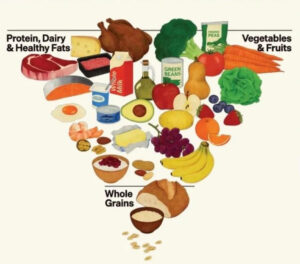
New guidelines emphasize simple, flexible guidance rooted in modern nutrition science
The guidelines, according to the USDA, “emphasize simple, flexible guidance rooted in modern nutrition science”:
- Prioritize protein at every meal
- Consume full-fat dairy with no added sugars
- Eat vegetables and fruits throughout the day, focusing on whole forms
- Incorporate healthy fats from whole foods such as meats, seafood, eggs, nuts, seeds, olives and avocados
- Focus on whole grains, while sharply reducing refined carbohydrates
- Limit highly processed foods, added sugars and artificial additives
- Eat the right amount for you, based on age, sex, size and activity level
- Choose water and unsweetened beverages to support hydration
- Limit alcohol consumption for better overall health
Farm groups applaud the inclusion of full-fat dairy products, meats and oils
Ag Secretary Rollins said the federal government is realigning the food system to support American farmers, ranchers and companies that grow and produce more real food.
“Farmers and ranchers are at the forefront of the solutions, and that means more protein, dairy, vegetables, fruits, healthy fats and whole grains on American dinner plates,” she said.
American Farm Bureau President Zippy Duvall is pleased that the Trump administration has recognized the importance of farmers and ranchers.
“The new dietary guidelines acknowledge the value of prioritizing high-quality protein, dairy, and fresh fruits and vegetables,” he said. “We plan to continue working with the administration to ensure food policy decisions are grounded in science and easily understood so America’s families have confidence when stocking their pantries.”
The federal government’s recognition of dairy’s benefits is a boost for dairy producers across the country.
The DGA report affirms dairy products’ central role in federal nutrition recommendations, encouraging Americans to consume three servings of dairy each day, specifically whole and full-fat dairy products such as whole milk, yogurt, cheese and other dairy products.
“This is a significant watershed moment,” Matt Herrick of the International Dairy Foods Association told AgWeb.
As consumer tastes change and demand for dairy products and protein rises, Wisconsin dairy processors are investing billions in new and expanded manufacturing capacity. According to IDFA, U.S. dairy processors are investing a record $11 billion across 19 states to expand capacity and meet demand for dairy nutrition.
Michael Dykes, president and CEO of IDFA, cautioned the DGA’s reference to “highly processed foods” could create unnecessary confusion among consumers and policymakers because no official or scientific consensus exists on what that term means.
“Many nutritious, safe, and essential foods – including milk, yogurt, and cheese – undergo processing to ensure quality, safety, and accessibility,” he said. “Establishing dietary guidance around an undefined or inconsistently applied term risks discouraging consumption of nutrient-rich foods that are vital to public health. … Any move toward defining or classifying foods by processing level is premature and should be informed by rigorous, consensus-based science.”
Soybean officials say the government needs to be educated on oil extraction
Oils and soy-based products also play a critical role in the health and nutrition of Americans, says American Soybean Association President and Ohio soybean farmer Scott Metzger.
“The new Guidelines highlight the importance of increased protein consumption, including plant-based proteins such as soy-based foods. They also emphasize prioritizing healthy fats, including oils rich in essential fatty acids like soybean oil. However, the report’s addenda continue to call into question the process of soybean oil extraction, which is scientifically proven to be safe for human health,” Metzger said. “We appreciate that the DGA acknowledges the importance of soy as part of a well-balanced diet, but we remain deeply concerned by the rhetoric and selectively cited studies regarding the health and safety of soybean oil in DGA supporting material. We look forward to continuing our work with the administration as we educate MAHA Commission leadership on the health benefits of soy-based foods and soybean oil.”
The updated DGAs nearly double the recommended daily amount for protein intake, increasing it to 1.2-1.6 grams per kilogram body weight, depending on specific age group and individual caloric needs. The document focuses on building a healthy diet around whole foods, limiting highly processed foods and added sugars, and prioritizing protein at every meal like nutrient-dense beef.
Health officials say red meat consumption comes with health risks
Kennedy says proteins and healthy fats are essential and were previously discouraged in earlier dietary guidelines. However, the American Heart Association points out not all meats are equally nutritious, noting red meats come with health risks, reported USA TODAY.
Although the American Heart Association applauded the guide’s emphasis on increasing the intake of vegetables, fruits and whole grains, it also shared some concerns about red meat, stating that “the report could lead some consumers to exceed recommended limits for sodium and saturated fats, which as primary drivers of cardiovascular disease.”
Idaho beef rancher and National Cattlemen’s Beef Association Vice President Kim Brackett noted that “several clinical studies have consistently shown that it is easy to incorporate beef into a balanced, heart-healthy diet.”
“As a mom, I understand the importance of eating nutritious, wholesome protein,” Brackett said. “The updated and simplified DGA will help more families like mine learn the facts about beef’s nutritional value and make the best decisions while shopping for a nutrient-rich, whole and delicious protein.”
The daily intake for saturated fat remains at 10% of the daily calories, according to the new guidelines.
“On a per-gram basis, beef offers more nutrient value than many other animal and plant options,” said registered dietitian and nutrition scientist Shalene McNeill, executive director of nutrition science for NCBA.
The guidelines also specifically recommend consuming a variety of protein foods from animal sources, including poultry.
“It’s abundantly clear that chicken is a lean and affordable protein that can help all Americans across all stages of life meet the new dietary guidelines,” said Ashley Peterson, National Chicken Council senior vice president of scientific and regulatory affairs. “Combined with its nutritional value, positive health benefits, popularity, versatility, affordability, and environmental sustainability, chicken is a pillar of the protein subgroup.”
The National Pork Producers Council has long advocated for sound science, including how the Dietary Guidelines are developed. The “upside down” pyramid encourages consumers to feel good about eating and enjoying their protein as part of a healthy, balanced diet.
“They took note of producer concerns and rightly gave pork and other high-protein, nutrient-dense, and delicious meats their due when it comes to Americans’ health and dietary habits,” said Rob Brenneman, NPPC president-elect and pork producer from Washington, Iowa.
Guidelines will impact school lunchrooms
The guidelines are published every five years by the Department of Health and Human Services and the Department of Agriculture, and are the basis of federal nutrition programs for meals served to both school children and on military bases, what’s included in federal food aid for mothers and infants, and inform medical advice and national disease prevention efforts, according to Reuters.
“We welcome the potential these guidelines hold for expanding upon dairy’s critical role in the diet,” said National Milk Producers Federation President & CEO Gregg Doud. “Now that the guidelines are out, the federal government will begin applying them across federal programs. We look forward to working with the entire nutrition community to ensure that dairy is best used to generate positive health outcomes for families across America.”
This article originally appeared on Wisconsin State Farmer. Reporting by Colleen Kottke, Wisconsin State Farmer
USA TODAY Network via Reuters Connect







 Loading ...