Sign In
Upcoming Event
 Free Newsletter

An official state sport, visitation restrictions and hundreds of other new laws in effect in Idaho
Steve Lombard//August 28, 2026//
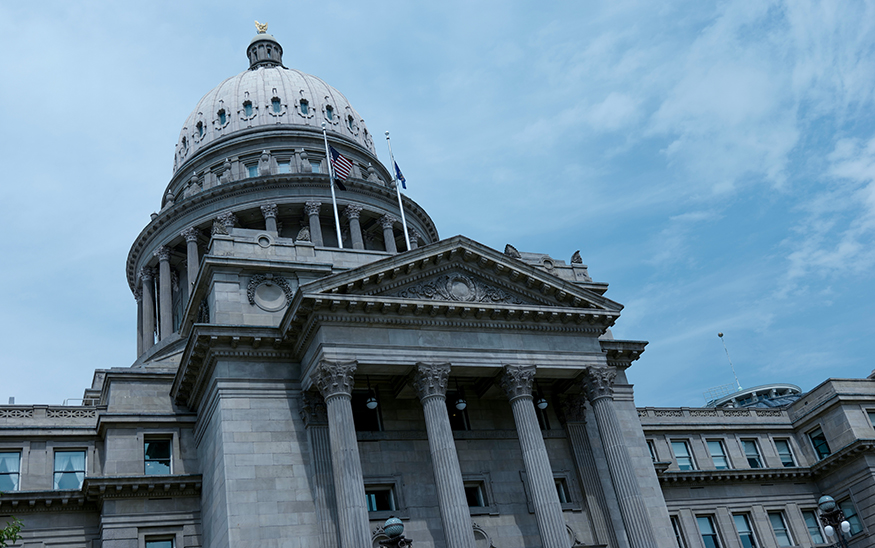
The Idaho State Capitol Building is seen in downtown Boise in July 2026. (PHOTO: MARC LUTZ, IBR)
An official state sport, visitation restrictions and hundreds of other new laws in effect in Idaho
Steve Lombard//August 28, 2026//


Flying a drone over a prison property in Idaho won’t fly legally. And for those hoping to avoid jury duty, a potential new option is now on the docket.
At a Glance:
- Idaho passes HB 522 restricting drone flights over correctional facilities
- HB 560 allows jury duty substitution with poll worker service
- Sen. Tammy Nichols sponsors child visitation and foster care laws
House Bill 522 outlines regulations for drone operators, while Houe Bill 560 provides another duty for potential jurists, two of the 350 new statutes that took effect in the Gem State July 1.
The collection of new legislation brought forth by state lawmakers during the 2026 legislative session represents the most laws enacted in one year during the past five years, according to the yearly Sine Die report. Latin for “without a day,” the report serves as a comprehensive recap or summary of legislative session activity.
Legislative activity was rampant in 2026, despite the session wrapping up eight days sooner than last year. State lawmakers reviewed 2,665 pieces of draft legislation, along with 178 individual rulemaking dockets spanning 1,488 pages to produce the wide-spanning collection of new laws signed by Gov. Brad Little.
Wide enough to include the skies above any Idaho Department of Correction (IDC) facility. Anyone thinking of using technology in the form of a drone as a creative measure to provide assistance to an incarcerated individual should reconsider.
HB 522 grounds such action. The law considers drone flights of this nature illegal when operating within 400 feet above ground level within the perimeter of an IDC structure.
Rep. Ted Hill (R-Eagle), a retired U.S. Navy combat fighter pilot, told the House Judiciary Committee earlier this year that drones used for such purposes — delivering what can be construed as contraband — operate in a “nefarious manner” and are “tremendously threatening,” while adding that detection is “difficult” and stopping them is “extremely difficult.”
Those who violate the statute, classified a misdemeanor, can face a fine of up to $1,000, six months in county jail or both, plus potential court costs.
When it comes to performing civic duty, potential Idaho jurists can use HB 560 to render a verdict in their own favor. The law now allows a county clerk to solicit a local jury commissioner to offer a trade; those summoned to the courts can instead choose to serve as a poll worker for a short-staffed county election rather than sitting through a trial.
“If a potential juror decides, instead of serving on a jury, he would rather work on a county election, that would relieve the potential jury member of his jury duty service for two years, said Sen. Phil Hart (R-Kellog), who sponsored the bill.
However, it should be noted that HB 560 does not apply to any federal juries or federal elections.
With numerous new laws covering an array of topics, several aim to protect Idaho children within the social services arena. This includes Senate Bill 1257, which grants courts the authority to pause or terminate visitation rights in cases where a parent has been found to have committed abuse against a child.

“The bill clarifies Idaho law when a child is already in state custody,” said Sen. Tammy Nichols (R-Middleton), who serves as the co-chair of the Child Custody and Domestic Relations Task Force.
“It makes clear that in-person visitation is not required when physical or sexual abuse by a parent has been substantiated.”
Nichols called the new law an “important change” when considering the welfare of a child in those types of situations.
“The safety of a child has to come first, while still protecting due process and allowing the court to look at each case individually,” she said.
SB 1257 also clarifies existing law regarding when a court may consider termination of parental rights after the Department of Health and Welfare begins such proceedings.
“I would describe that a little differently than saying it simply accelerates termination,” Nichols said.
Similarly, SB 1292 also intends to strengthen foster care guidelines, establishing new training requirements for those who may consider taking on the role of a foster parent, especially on behalf of children who have experienced abuse, trauma or instability.
“Through the task force, we continue to hear bout the need for child safety, consistency, accountability and due process,” she said. “These bills are part of that larger effort to improve how Idaho serves children and families.”
On the education front, SB 1288 was drafted specifically for supporting children with special needs. The legislation establishes a one-time $5 million fund for students with “particularly high needs” attending Idaho public schools.
Idaho Superintendent of Public Instruction Debbie Critchfield says the new law will help alleviate “financial pressures” for serving our “most vulnerable students.”
SB 1288, she added, is intended to assist local districts and charters serving students who require or are entitled to “extra-ordinary” support as part of their academic career.
“We’ve pursued this fund with the understanding that there is a growing need and data to support the ask,” Critchfield said. “The impacts of this legislation should assist our schools in offsetting current gaps in funding, where federal and state funding streams haven’t caught up to the need.
“This fund will not satisfy the larger challenge — a $100 million special education gap — but it is a step in the right direction.”
Another new law in the education arena but outside the classroom is HB 516, which places restrictions on teachers unions when it comes to utilizing taxpayer monies. The law prohibits unions from using a district payroll system to pay dues and prevents union meetings from being held on district property.
According to Critchfield, HB 516 did not come into play until after this past spring’s bargaining session, thus, allowing school leaders to “work through required changes” before any penalties could be levied.
“While the negotiations themselves proceeded as expected, school leaders had to work through new logistical and administrative requirements regarding where and when certain activities could take place,” she said.
However, the superintendent conceded these initial changes may come across as “hurried” and “confusing” for some school leaders.

“For some it was less challenging, although everyone had to adjust to the new law,” Critchfield said. “I think the effects of the changes will be understood this coming school year, and we will have more to report.
“Whereas this is a function of the contractual elements of adults in the system, we would hope that it would not impact the day-to-day instruction of students in the classroom.”
HB 623 now requires all Idaho public schools to implement 60 seconds of silence at or near the beginning of each school day. The law aims to provide students an opportunity to spend quiet time in thought, reflection, mediation or prayer, while prohibiting teachers and other school personnel from directing, suggesting or instructing students on how to use the one-minute of silence.
“The biggest concern I hear from school leaders is the ability to control an actual timeframe of silence in some circumstances,” Critchfield said. “Because school is starting, we don’t have information or data to support a correlation to student achievement. We have asked our schools to share their implementation and experience with us.”
And leave it to a child to help establish a first-in-the-nation new law with numerous Idahoans in its sight. Hunting is now classified as the official Idaho state sport, thanks in part to Betty Grandy, a 9-year-old from Twin Falls who helped spearhead the passage of HB 652, sponsored by Rep. Don Hall (R-Twin Falls) and his alternate, Grayson Stone.
In a presentation before the Senate State Affairs Committee earlier this year, Grandy shared how the sport would “celebrate Idaho’s history” and how “native people and European settlers hunted to survive,” lessons she learned as a home-schooled fourth-grader.
“While learning about Idaho history, I discovered Idaho doesn’t have an official state sport,” Grandy told the committee. “We have a state bird, a state gem and even a state dinosaur. I think Idaho is such a great state that we deserve a state sport.”
Stating that hunting is “historically” and “culturally” representative to the state, Idaho lawmakers unanimously agreed. As did the Congressional Sportsmen’s Foundation, a nonprofit considered the nation’s “leading authority” on sportsmen’s policy.
“The bill also declares that the ‘State of Idaho values the rights to hunt, fish and trap and has enshrined such rights in the Constitution of the State of Idaho,’” the group posted on its website in support of the new law.






 Loading ...