Sign In
Upcoming Event
 Free Newsletter

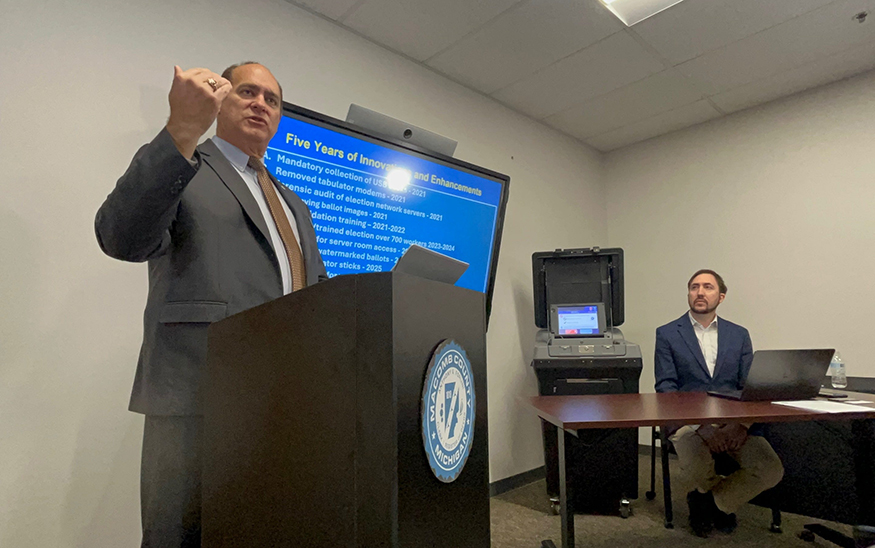
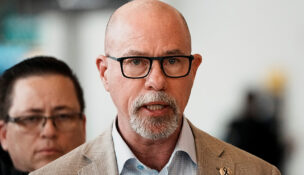
Macomb County Clerk Anthony Forlini, standing, and Adam Friedman, founder and CEO of Civera, discuss new information called Ballot Verifier appearing on the county's elections website Feb. 23, 2026 in Mount Clemens. (PHOTO: DETROIT FREE PRESS, VIA REUTERS CONNECT)
Ada County among others to post ballots using software
reuters//March 10, 2026//


Want to see scanned ballots from voters in the November 2025 election? Curious how the tabulators counted the votes on Election Day?
Wonder no more.
At a Glance:
- Ada County, Idaho, launched Ballot Verifier software in April 2024 to post scanned ballots online.
- Macomb County, Michigan, is the first in the state to use Ballot Verifier for public election transparency.
- Ballot Verifier allows voters to view scanned ballots, contest results, and cast vote records while protecting voter privacy.
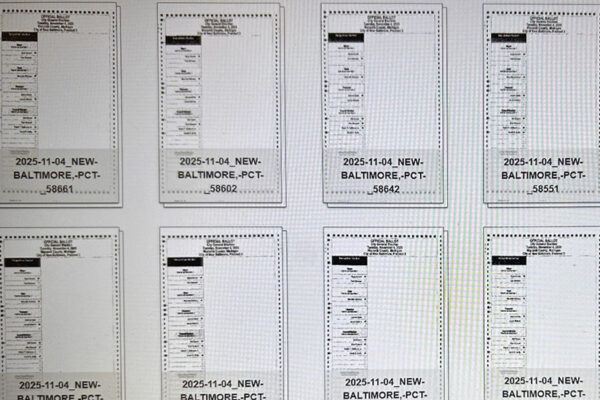
Macomb County Clerk Anthony Forlini says the county is the first in Michigan to use Ballot Verifier from Civera, a software company in Massachusetts, on its elections website, which will allow the public to see contest results, scanned images of ballots and cast vote records that show the marks voters made to indicate choices. In Idaho, Ada County was the first to launch Ballot Verifier in April 2024.
“This is good stuff. There’s a lot of people that question everything that we’re doing, as they should,” Forlini said Feb. 23 when introducing the software to local clerks or their representatives from about eight communities who were able to see a demonstration, ask questions and make recommendations. They seemed favorable to the new technology.
“To me, this is really a great way of being able to provide for our citizens a method of accountability, transparency and that’s what we’re all about in Macomb,” Forlini said.
Available for view are 80,337 ballots from the Nov. 4 election through the present, according to the website.
Forlini, a Republican running for Michigan Secretary of State, said the effort is to promote integrity and accuracy of election results without someone needing to ask for the information under the state Freedom of Information Act (FOIA). People can go online, browse ballot images and view, compare and check the count of ballots and other voting records, narrowing by ballot type and down to precinct level, while protecting voters’ privacy and confidentiality.
Forlini said this may reduce the number of FOIAs filed with clerks, making the $30,000 annual cost of the program worthwhile. He said ballot images eventually will go back to the November 2024 election. Historical data, without ballot images, also goes back to 1998 on the website.
Adam Friedman, Civera’s founder and CEO, said more than 20 counties in six other states − California, Colorado, Florida, Idaho, New Mexico and Texas − use Ballot Verifier. He said Georgia is using it through a project with Yale University to analyze and map more than 4 million ballots statewide from the 2020 presidential general election.
He said Civera has historical election results searches for Kent, Washtenaw and Marquette counties in Michigan. He said the information provided by Macomb County for Ballot Verifier is sent after an election is certified.
“Anybody from the comfort of their living room, from their bedroom, even on their phone or on their desktop can go through this and actually do their own citizen count of the results. That’s a profound level of accountability that did not exist before this technology was rolled out,” Friedman said.
Cheri Hardmon, spokeswoman for the Secretary of State’s Office, said clerks can decide on their own whether to use such technology.
In a statement, she said Michigan election law “neither requires nor prohibits proactively sharing these images publicly. …
“Sharing ballot images can help with transparency but can sometimes cause voter privacy concerns. While rare, sometimes voters mistakenly write their name on their ballot, and the concern about their selections becoming public in this situation is amplified if the ballot image is shared online,” Hardmon said.
She said with more transparency, there may be more burden as clerks may have to explain details of election procedure to the public. That could include how machines might interpret a stray mark on a ballot differently than a human or how bipartisan election inspectors duplicate military ballots so they can be tabulated, with the same handwriting appearing on multiple ballots when write-in selections are duplicated.
David Becker, executive director and founder of the Center for Election Innovation & Research, a nonpartisan, nonprofit in Washington, D.C., said election officials across the political spectrum embrace transparency and are doing their best to deal with doubts that people have “even if they’re baseless.”
Some, he said, have posted ballot images online, but he wouldn’t call it a trend.
“I think, in general, anything that embraces transparency and that also takes into account the secret ballot is generally positive,” Becker said. “But I also think those who think this is going to magically change the perception and security around our system are probably going to be disappointed, unfortunately.
“I suspect if losing candidates seek to spread lies about future elections, I think it’s unfortunate, but I think many of these transparency efforts, as noble as they might be, won’t prevent that.”
‘The best transparency is truth’
Ada County spends a little over $30,000 a year for it, with some additional add-ons, Clerk Trent Tripple said. Ada County had about 535,800 residents in 2024 and includes Boise, the capital, and six other cities.

Tripple, a Republican elected in 2022, said the effort “has been a great success for us.” Election officials went from spending hundreds of hours a week fulfilling public records requests to zero, he said, and there have been no recounts, which can be costly and time-consuming for the county, which runs elections.
Tripple, a former chief deputy during the 2020 election, said he sought a solution after people constantly raised conspiracy theories and questioned how things were done during that election as well as the integrity of that election. He said: “We thought why don’t we post everything online? This is the public’s information. It’s not our information.”
Tripple said Friedman, of Civera, already had software to get information, such as turnout and percentages, and election officials wondered whether they could add on ballot images and other voting records.
Now, Tripple said, people can analyze the ballots for themselves, see that official results the county posts match what the ballots say and that elections officials “are not trying to hide anything.”
Regarding voter privacy, he said, some ballots are masked, or hidden from view, when the voting numbers are small enough to where it would be easy to narrow down who voted for whom.
There will be some ballots masked in Macomb County, too, if there are 20 or fewer ballots in a reporting precinct or ballot style, Forlini said. There is a voter privacy masking note at the top of the page indicating the race contains precincts where the number of ballots was small enough that a voter could possibly be identified.
Tripple said some voters want to know their ballot was counted correctly, and they will put a mark on it they would recognize ― not a name or signature ― so they can find it online. Some have left “love notes” on ballots, especially absentee ballots, about how they feel about a certain candidate, even profane writing or images. Tripple said officials put a warning on ballots there that anything written on them will be publicly available.
The Center for Election Innovation & Research said in a 2024 update that elections, in general, are so decentralized and have so many safeguards, transparency and verification systems “that any fraud that does occur is either detected and reversed or on a scale too small to make a difference.”
Tripple said while not many people may go looking at the ballots and other voting information on the system “the fact that it exists is what calms people’s minds” and builds trust in the community. He said it also offers a window to voter behavior and has toned down some of the rhetoric, even changing how some candidates campaign, as they can see from the ballots that some people vote for Republicans and Democrats on the same ballot.
“The best transparency is truth. And if people have access to the truth, right, it’s gonna help us get past our differences,” Tripple said. “We don’t want to hide anything. I want people to trust elections. I don’t want the conversation around the dinner table focused on if the election was run properly. I want the conversation around the dinner table to be is the person that got elected doing job we elected them to do, and if they’re not, let’s vote for somebody else.”
Erik Berg, chair of the Ada County Democrats from 2020-25, said the feedback he’s received about Ballot Verifier has been positive, and he hasn’t heard any concerns.
He said early in the development, Tripple told him what he was doing, emphasizing the goal was to increase people’s faith in elections, short-circuiting some of the conspiracies and letting people know they were accurate. He said Tripple walked through how to use this and why he thought it was important with the central committees of Republicans and Democrats there.
“It does cost money. But I think as a proactive manner, if it helps stop some of the crazy ideas of stolen elections and all that stuff, I think it’s a very valid investment,” Berg said. “And it comes from a really excellent place of what can we do to make it so that this is more accessible; people don’t have questions, and they understand exactly what we’re trying to accomplish.”
Berg said he’s looked at some of the information and it’s interesting to view split ballots and where people leave ballots blank.
“I think that’s helpful. I think that’s good information for people to know, that it’s OK to cross party lines when you have good candidates on the other side, and you’re not the only one,” he said.
Local clerks: Another tool to illustrate accurate elections
Mount Clemens City Clerk Cathleen Martin checked out the new software, in particular for the city, which showed last November election results for mayor and city commission. Her initial impression was that the effort is a good thing, especially for people who have questions.
“Anything that promotes transparency, I’m a fan of, definitely. Michigan’s always … had secure, accurate elections, and I think this is just another tool to which we can illustrate that,” said Martin, a deputy clerk for six years prior to being appointed clerk five years ago.
She said people may question masked ballots thinking “that’s where all the secrets are, and we’re hiding things, which we’re not.”
Martin said the city had some FOIA requests in the past where people or groups wanted to see every ballot. She said “that’s kind of a tall order” and would be in the thousands of dollars as the work is time intensive, with copies costing more.
Clinton Township Clerk Kim Meltzer was aware of Ballot Verifier, learning about it while attending a conference in Ada County in 2024. She thinks having it in Macomb County is a smart move given the public scrutiny of elections.
“I think the public more and more is asking election administrators to come to where the people are, as opposed to us saying, ‘Well, we have all this information, you can always access it, you just FOIA us.’ We can do that and the public has access to all the information elections related. But the public seems to want us to come to them,” said Meltzer, a Republican elected township clerk in 2012.
“If they have to go get it under this heavily redacted, heavily processed system, that’s what breeds doubt. They don’t understand that,” she said. “So now, it’s all out in the open. And it’s transparent. And they’re looking at it, like what’s the big deal. And there isn’t a big deal. It’s just they don’t know that yet.”
Meltzer said tax dollars are being used for this, something that previously was paid for by the people or groups interested in obtaining the information through FOIA. She said she’s received FOIAs occasionally to see ballots, generally for races at the top of the ticket in presidential or gubernatorial elections.
Alysa Diebolt, chairwoman of the Macomb County Democratic Committee, had not heard about the new software, but after an initial glance, she said she didn’t think the county should spend tax dollars on it. She said ballots can be seen through FOIA, with the person requesting them paying for the records.
She said she thought this was “appeasing election deniers with this guise of transparency” and could invite more dissent.
“The work on local clerks is tremendous and it has increased with any access ballot initiative that’s happened in Michigan, but I don’t believe this is the accurate reaction to that,” said Diebolt, who also is chair of the county’s bipartisan Board of Canvassers, which certifies election results. “An election denier is still gonna deny election results to a clerk … whether or not there are PDFs on the website.”
Becker, of the Center for Election Innovation & Research, said much of what has occupied discussions about election policy across the country during the last five to 10 years “has been driven by disinformation and outright lies about the trustworthiness of our election system.”
He said election officials, in general, have seen an “incredible increase” in public records requests in all aspects of their work, which he said are often duplicative, frivolous and sometimes intended to be a burden. Clerks are doing more with less, he said, and “are still succeeding.”
Becker said the election system in Michigan and across the country is “as trustworthy and secure as it has literally ever been.” He said people can observe the counting and machine testing processes and volunteer to be poll workers and “what that means is our election system is verifiably accurate, despite what losing candidates might claim, despite what we might hear from politicians.”
This article originally appeared on Detroit Free Press: Ballot images from November election on “Macomb clerk’s website.” Reporting by Christina Hall, Detroit Free Press, via USA TODAY Network via Reuters Connect.