Sign In
Upcoming Event
 Free Newsletter

Inside Milt Sparks Holsters, a 55-year legacy depends on a craft that takes months to learn and a lifetime to master
Heide Brandes//April 24, 2026//
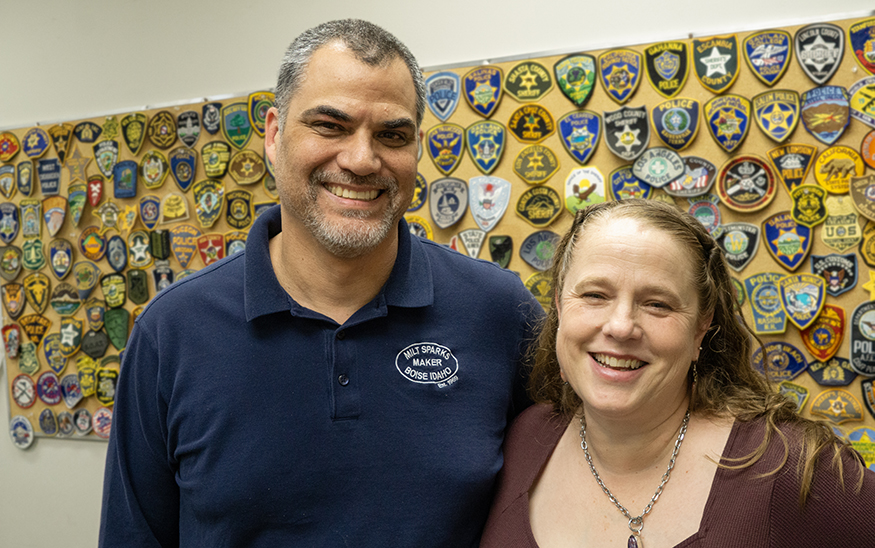
Nick Harvey and Leslie Frederiksen, co-owners of Milt Sparks Holsters in Garden City, purchased the business from its second owner in 2017, along with partners Jim Wall and Scott Kubik. (PHOTO: MARC LUTZ, IBR)
Inside Milt Sparks Holsters, a 55-year legacy depends on a craft that takes months to learn and a lifetime to master
Heide Brandes//April 24, 2026//


Nick Harvey picks up a finished holster and turns it over in his hands. Pressed into the smooth, vegetable-tanned leather near the seam, almost hidden from casual view, are two small initials. They belong to the craftsman who built it — start to finish — without handing it off to anyone.
At a Glance:
- Milt Sparks Holsters maintains 10-month backlog for custom orders
- Nick Harvey and partners own company since 2017
- Leather sourced from Herman Oak and Horween Leather
“It’s our way of signing the holster,” Harvey said. “Someone made this and was willing to put their name on it.”
That small stamp of accountability is the philosophy of Milt Sparks Holsters distilled to its simplest form. In a market flooded with polymer holsters cranked out on assembly lines and delivered overnight, the Garden City company has spent more than five decades doing almost everything differently.
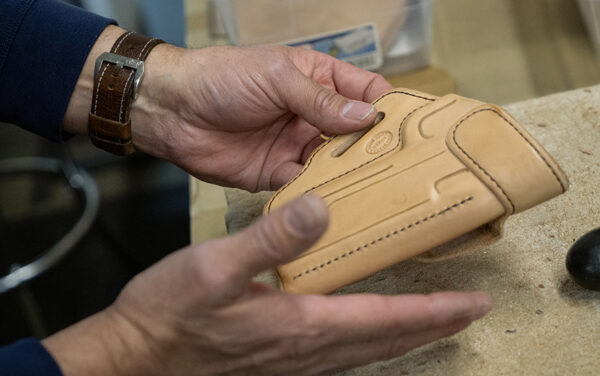
The wait time for a custom order currently runs 10 months. Every piece of leather comes from American tanneries, and every holster that leaves the building was built by one person, whose initials will follow that holster for the rest of its life.
Harvey has spotted his own work on eBay, years later, tagged as vintage. It still had his initials on it.
From a purse kit to a legend
The story of Milt Sparks Holsters begins, improbably, with a woman waiting for her husband to come home from the war.
During World War II, Bonnie Sparks bought a handicraft kit to make a leather purse while her husband, Milt, was flying Navy planes. When he returned, he picked up the hobby himself, eventually making flight bags for fellow pilots. One thing led to another, as it often does in Idaho. By the late 1960s, Milt Sparks had turned that quiet hobby into a business, starting in Star before eventually settling in Idaho City.
The company’s real launching pad came in 1976, when Sparks became involved with Col. Jeff Cooper, the legendary firearms instructor who shaped modern pistol technique and helped found what would become IPSC competition shooting. Sparks holster designs were used in those early competitions, and the company’s reputation spread fast among serious shooters.
In the 1980s, a craftsman named Tony Kanaley started working for Sparks and eventually became shop manager. When Milt stepped back, Kanaley bought the company in 1990. Milt Sparks died in 1995, but the business he built from a purse kit and a pilot’s patience kept going.
Harvey came on board in 2000. When Kanaley was ready to retire, Harvey and two longtime colleagues, Jim Wall and Scott Kubik, bought the company in 2017. Wall has been with Milt Sparks since the mid-1990s, and Kubik has been there nearly 28 years.
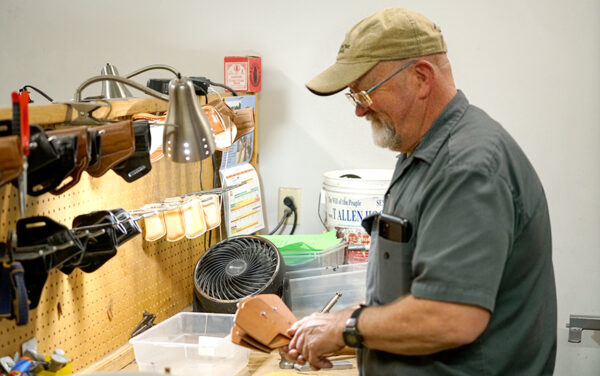
“We all have quite a bit of institutional knowledge in that regard,” Harvey said.
The business of slowness
Milt Sparks operates out of a working leather shop in Garden City, the city-within-a-city that sits tucked inside the greater Boise metro. The team is small, the process entirely hands-on.
Cowhide comes primarily from Herman Oak in St. Louis, known for producing some of the finest vegetable-tanned leather in the country.
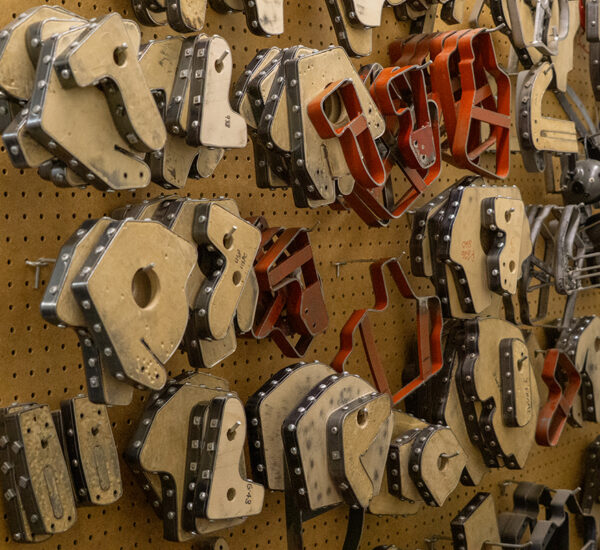
Horsehide arrives from Horween Leather in Chicago. Thread, dyes and adhesives are all American-sourced.
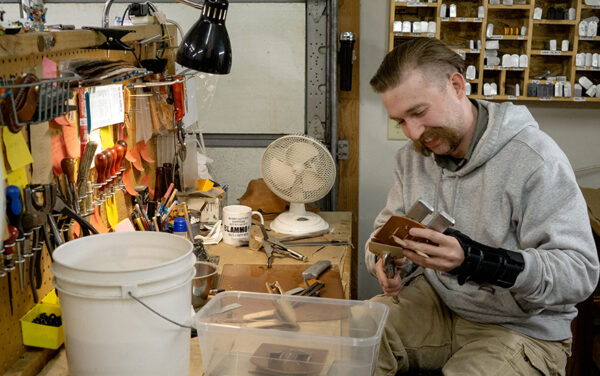
Each holster gets cut, stitched, wet-molded to the exact shape of a specific firearm, pressed at high pressure, hand-detailed and burnished before it ships. The whole process, done by one craftsman who will put their initials on the finished piece, takes time that no algorithm can compress.
The 10-month backlog does not appear to be hurting business.
“People are willing to wait,” Harvey said. “They’ll say, ‘I’ve heard about your product and I’m willing to wait.’ That’s worked out really well for us.”
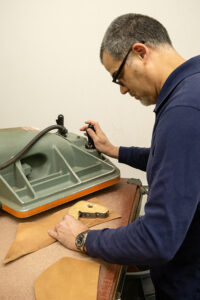
Harvey is candid that there is room to grow the company faster. The demand is there. The path to scaling up is visible. He has simply chosen not to take it. For him, the math is different than it might be for a conventional manufacturer.
“You see where a lot of companies really expand really quickly, and that expansion outstrips the quality,” he said. “I would rather make less money but have tremendous pride in the product we produce.”
That restraint appears to be a sound strategy. A Milt Sparks holster sells because it is not mass-produced, and the moment it becomes mass-produced, it is no longer a Milt Sparks holster. The reputation and the production model are inseparable.
Keeping the shop small, the leather American-sourced, the craftsmen few and experienced, and the initials on every piece is not a limitation to be overcome. It is the product.
The shift from competition holsters to concealed carry has broadened the customer base considerably. When states began loosening concealed carry restrictions in the mid-1990s, Milt Sparks found a new market in everyday carriers who needed a holster built for all-day wear, not weekend competition. Leather, Harvey argues, still wins that comparison.
“Even with a quality Kydex holster, over time they will break,” he said. “Leather tends to be more forgiving. It conforms to the body. We get a lot of converts from Kydex who say, ‘I didn’t realize carrying a gun can be this comfortable.’”
The hard part
Harvey will say the supply chain is manageable. Marketing largely takes care of itself. The part that keeps him up at night is simpler and harder to solve than either of those.
He needs the next generation of craftsmen, and he is not sure he will find them.
“It’s an old-school, apprenticeship-type learning experience,” he said. “It takes several months to get up to speed on making quality product.”
The process is humbling by design. A new maker will put tremendous effort into a piece, feel proud of it, and then watch a master craftsman point out a stitch line that is off by a millimeter. The holster gets cut up. The maker has to decide whether to try again or walk away.
“It takes that right mindset,” Harvey said. “You know what? I’m going to do it better next time.”
Idaho’s post-pandemic population growth has made skilled labor harder to find across all industries, and convincing someone to spend months learning a craft that will not make them rich is its own sales pitch. Harvey is honest about the ceiling.
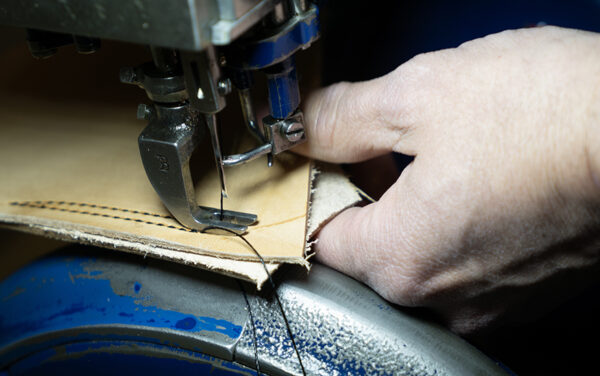
“It’ll provide a good life for you,” he said, “but you’re not going to be living that jet set lifestyle.”
Five years from now, Harvey hopes to have a couple more employees working their way up through that apprenticeship. He would like to shave the backlog down a bit. But the vision stops well short of expansion for its own sake.
In a world where you can order something on Amazon in the morning and have it on your doorstep by afternoon, he has made peace with building things the other way.
“It’s not about big growth,” Harvey said. “It’s about having that pride. I made something that very few other people in the world are doing.”
What he can offer is something rarer than a high salary. He can offer the chance to make something with your hands that will outlast you, stamped with your initials, that someone will someday call vintage and still use.