Sign In
Upcoming Event
 Free Newsletter

Budget cuts, education funding and issues highlight panel discussion on 2026 legislative session
Steve Lombard//April 24, 2026//
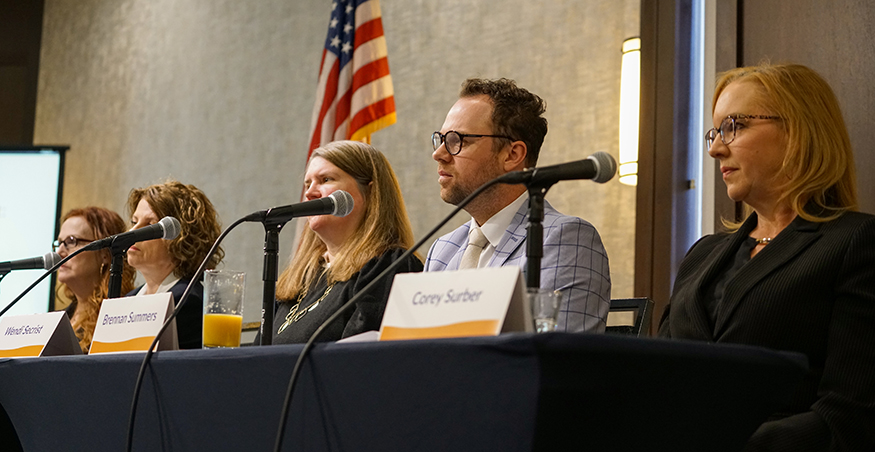
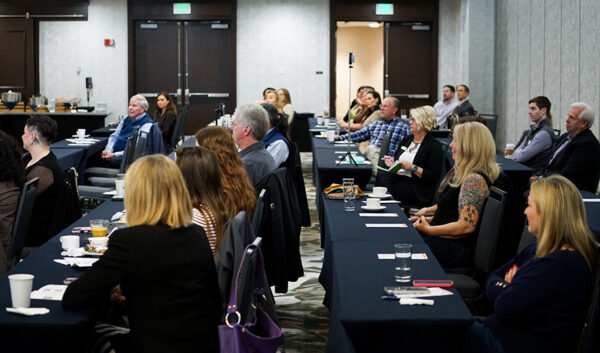
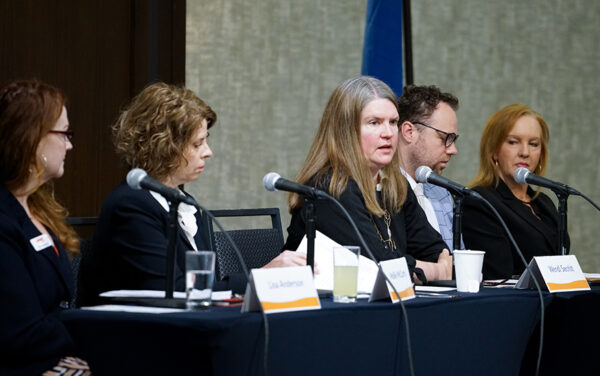
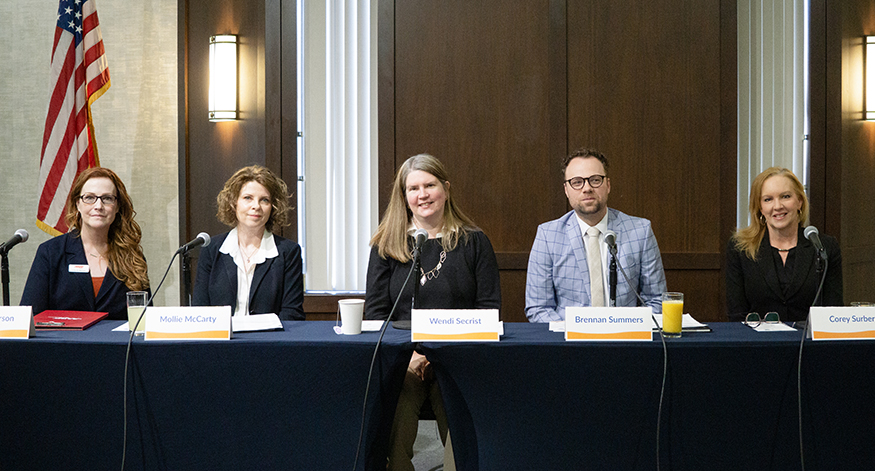
From right: The panelists, Corey Surber, Brennan Summers, Wendi Secrist, Mollie McCarty and Lisa Raye Anderson, listen as an audience member asks a question during the question-and-answer portion of the Breakfast Series event on April 9, 2026, at The Grove Hotel in downtown Boise. (PHOTO: MARC LUTZ, IBR)
Budget cuts, education funding and issues highlight panel discussion on 2026 legislative session
Steve Lombard//April 24, 2026//


Solid education, accessible health care, lasting infrastructure and the ability to produce a qualified future workforce all play big roles in the economic development of quickly growing states such as Idaho.
At a Glance:
- Corey Surber details Medicaid coverage cuts and consequences
- Lisa Raye Anderson highlights Medicaid application complexity for seniors
- Mollie McCarty outlines reduced transportation funding since 2021
To help address these key topics and how decisions enacted by the state Legislature during the 2026 session impact these areas, Idaho Business Review (IBR) recently sought the perspectives of a group of local business and community leaders for a panel discussion: “Policy Meets Profit: Business View on Legislation.” The session, held April 9, was the second in a five-part Breakfast Series IBR is slated to present this year.
A host of impacts
From changes in Medicaid requirements, to transpiration issues, maintaining funding for Idaho LAUNCH, and producing and sustaining a viable future workforce, panelists shared their expertise and thoughts as the Gem State rapidly evolves socially and economically.
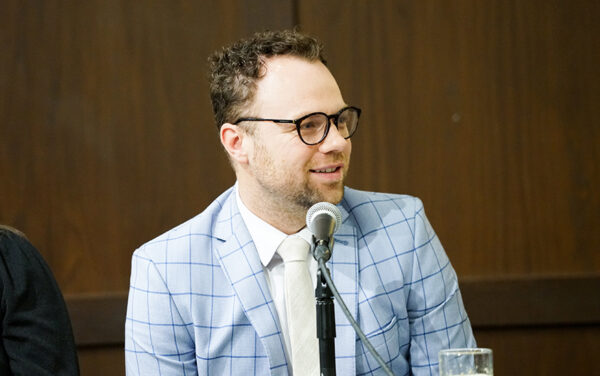
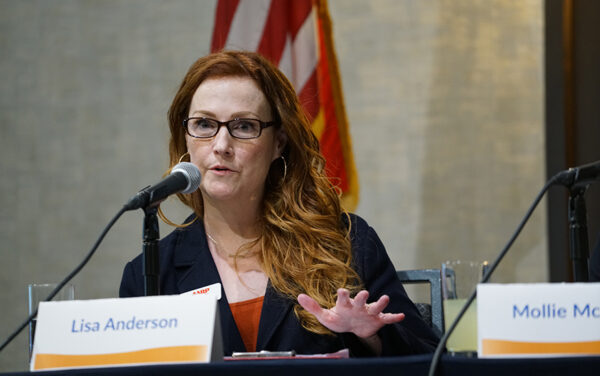
“We have a lot of multi-generational families, so what affects education also affects the older population,” said panelist Lisa Raye Anderson, director of advocacy for AARP Idaho.
“People aging want to stay in their homes as long as possible, so any legislation that helps the elderly age in place is a good thing.”
State changes in obtaining Medicaid was a topic that stands out for Anderson. “Anything that makes the process for applying for these types of benefits more complex we consider a negative,” she said. “We look into anything that can impact our age 50-plus population.”
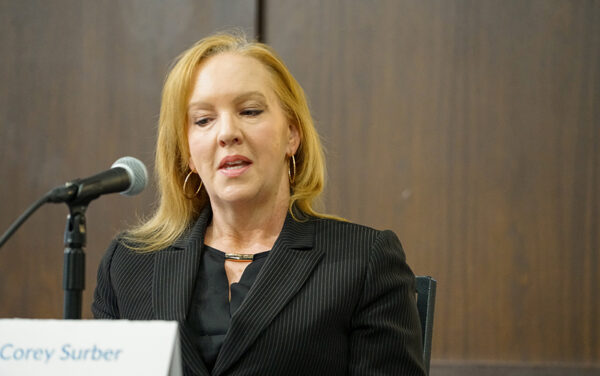
Corey Surber, regional vice president of Advocacy and Government Relations for Saint Alphonsus, detailed changes some Idahoans will experience regarding Medicaid coverage.
“Coming into this session, the governor had already taken action because revenues were short,” Surber said. “This past September he had instructed agencies to do holdbacks.”
A “flush” balance sheet is how she described previous funding available during the past five years.
“This created an environment where policymakers could pass tax cuts, a very politically popular thing to do,” she said. “And you don’t want to be sitting on revenues you don’t have a use for. We have now cut to the point where we wound up in a revenue shortfall coming into this legislative session.”
A 4% provider rate cut to the state’s behavioral managed care contract, she said, means the contractor had to eliminate entire services from coverage, including assertive community treatment teams that are trained to respond to people in crisis.
Service reductions also hit adult peer support, partial hospitalization programs and transportation reimbursement for those who need to get to appointments.
Cuts she believes result in “real consequences” in the behavioral health arena.
“By the time the legislature came in this January, there was word of deaths that occurred due to these teams no longer being funded to help those in crisis,” she said. “By the end of the session, we had heard of at least four deaths that could be concretely attributed to that.”
Along with the state’s revenue shortfall and state tax cuts, she noted, was the federal passage of HR1 last summer. The combination of factors, and with Idaho being a “conformity state” all contributed to the Medicaid reductions.
“As for conformity to HR1, the estimate I believe the JFAC, Joint Finance-Appropriations Committee, went with was a $155 million impact to the state’s bottom line in [fiscal year] 26, and $175 million in FY 27,” Surber said. “So we’re facing even more budget shortfall.
“By looking at the spending side and not the narrative side, it becomes ‘Medicaid got us into this position. Medicaid drove us into this budget hole.’ Whereas both education and transportation are viewed as investments for the state, Medicaid is viewed as a blackhole by many of our legislators.”
In 2018, Idaho voters approved a ballot initiative for Medicaid expansion by a 62% margin. However, Suber feels the state has been “trying to find a way to repeal it or scale it back ever since.”
Brakes on the budget
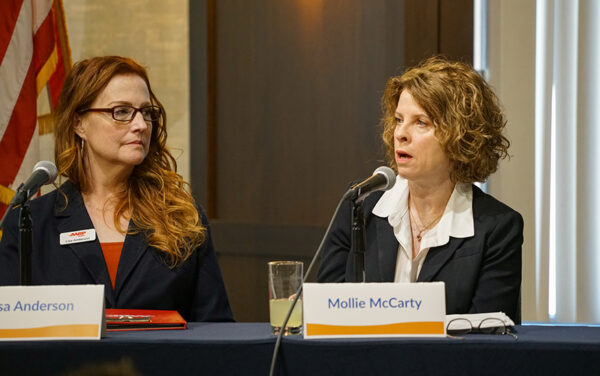
Scaling back funding is a scenario not unfamiliar to Mollie McCarty, chief external affairs officer for the Idaho Transportation Department (ITD), an agency she has served for the past 27 years.
“It’s been a long and interesting road, no pun intended,” McCarty said. “For many, many years the message to our legislators, with a lot of support from the business community, was that solid infrastructure is fundamental to the state’s vitality.”
While the message remains the same, funding since 2021 has changed dramatically.
Transportation Expansion and Congestion Mitigation (TECM) monies provided by the state for large-scale infrastructure projects is now significantly lower.
The process previously involved a transfer of $300 million from the state’s general fund, with 60% going to the state and 40% directed to local systems.
“A significant challenge for the Legislature has been user fees versus asking whether it is appropriate from a policy perspective to use general funds or sales tax revenue to fund transportation,” she said. “For several years we could combine that with the congestion mitigation funding and between the two, we were on our way to doing some significant infrastructure projects throughout the state.”
A “vulnerable” place to be is how McCarty describes the current funding mechanism.
In 2025, that $300 million figure was cut to $275 million. Due to reduced revenues this past year, and by the end of this session, the total put in by the state legislator dropped to $32 million utilizing the same 60/40 split.
“When you are a transportation agency, you need to know what your funding is,” she said. “It needs to be consistent. We have a seven-year plan and that takes time to work through these projects. We planned for the monies to be ongoing and we structured our programs assuming such funding would continue.”
Learning curve
Representing K-12 education, panelist Brennan Summers, chief governmental affairs officer for the Idaho Department of Education, sat in for State Superintendent Debbie Critchfield, who was unable to attend.
He called this year’s legislative session “interesting” for educators.
“Our biggest priority this year was SB 1288 which is a high-needs bill for special education funding,” Summers said. “Any student who shows up for school, you have to educate them and provide them the resources that they need.”
Federal law requires states to cover the costs.
“We have legislators who openly say such students should just be institutionalized and not be in our schools,” he said. “We’re sorry they feel this way.”
Looking at the big picture, Summers was grateful that K-12 education did not sustain similar cuts as other agencies did.
“In the grand scheme of things, it could have been a lot worse,” he said. “There is an argument that public education should have been cut because all of these other agencies received cuts. That it is only fair. So we got lucky in that space.”
For Wendi Secrist, executive director of the Idaho Workforce Development Council (WFDC), she was pleased that this year’s legislative session did not include any bills to limit the state’s LAUNCH program.
Described by many in the business community as a “gamechanger,” and labeled as a “hostage” bill politically since its inception, the program has experienced great success with 6,500 grants awarded for the first class in 2024.
This year the expectation is that more than 13,000 graduating seniors will apply for program assistance.
“We use a very data-driven approach to determine what is an in-demand job and what programs support preparation for these careers,” she said. “But I do believe we will be able to offer all 2026 graduates a LAUNCH award.”
And research shows more Idaho students now pursuing post-secondary education are staying in the Gem State
“We’ve even had calls from neighboring colleges in Utah asking why their enrollment of Idaho students is declining,” she said.
Connecting a culture of learning to careers also helped bring the WFDC and the Idaho STEM Action Center together during the legislative session.
“By proposing this integration, we really are able to look at the whole continuum and work with our partners in the Department of Education and the State Board of Education,” Secrist said.
The eventual merger was a slow process getting through the session, but the integration is a “huge win” for both groups.
“I anticipated it would be the first bill introduced,” she said. “It took a little longer, but it passed almost unanimously through both the House and Senate education committees and on the floor.”
Summers applauded those he believes are using education as a tool to help foster a future workforce.
“We deeply appreciate those who don’t let education operate in a vacuum, and who are able to make the connection between education and industry,” he said.
Combating fraud, embracing tech
And while artificial intelligence serves as a hot topic for all panelists, Anderson stressed how AARP is particularly aware of its use and what it means for seniors who might not be up to speed with the technology.
“We try to talk to our members a lot about how AI is used in fraud, but also about how AI can help them age in place,” she said. “From monitoring their medications, managing health, using communication tools offered by AI, these types of things can help make it so they don’t feel so isolated in their lives.”
Anderson also noted SB 1359 which was meant to regulate cryptocurrency kiosk scams, which led to more than $48 million lost by Idahoans in 2025. The bill, which had bipartisan support, would have created consumer protections.
The bill was vetoed by Gov. Brad Little on April 10.


 Loading ...