Sign In
Upcoming Event
 Free Newsletter

The Search for a Cure
Health care experts discuss immediate and long-term solutions for medical staffing in Idaho
Marc Lutz//June 19, 2026//
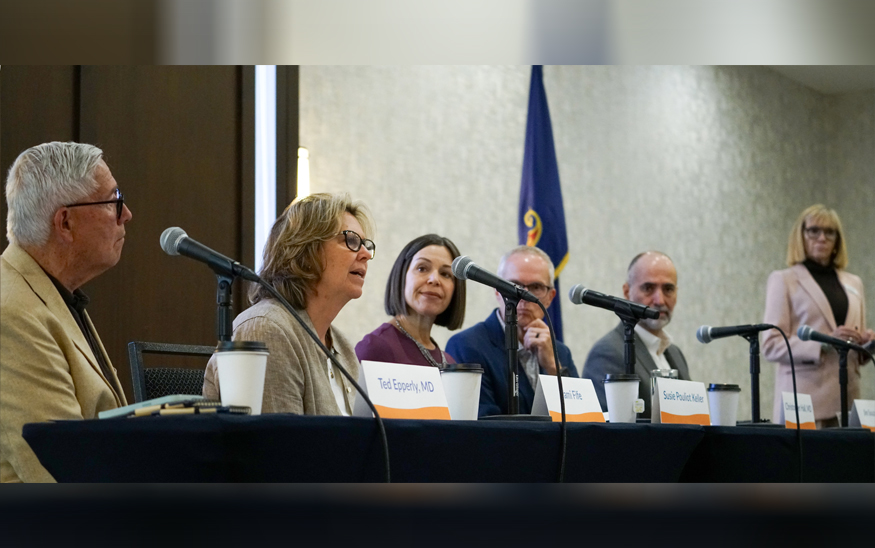
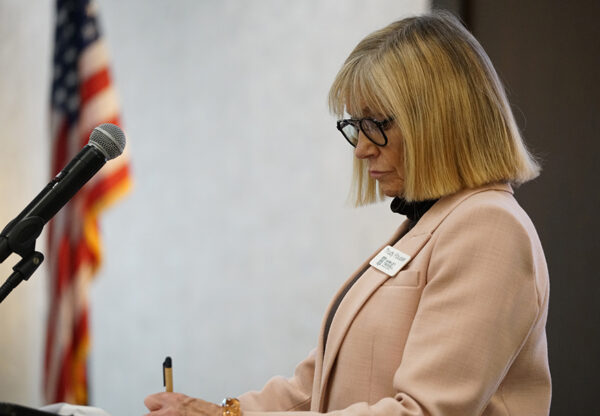
Tami FIfe, COO and CIO of Terry Reilly Health Services, addresses the audience at the third installment of the 2026 Breakfast Series panel discussion events on June 4 at The Grove Hotel in downtown Boise. The panel was talking about the need for health care staff in Idaho and the challenges systems face in meeting the growing need. (PHOTO: MARC LUTZ, IBR)
The Search for a Cure
Health care experts discuss immediate and long-term solutions for medical staffing in Idaho
Marc Lutz//June 19, 2026//


There isn’t a magic pill to cure a chronic illness plaguing Idaho’s health care workforce. But there are cures, nonetheless, and they will take time and effort, experts say.
At a Glance:
- Idaho ranks 50th in physicians per capita with 1,700 shortage
- Panel includes Dr. Ted Epperly, Susie Keller, Dr. Jim Souza
- Health care contributes more than $10 billion to Idaho economy
Such was the conversation on June 4 as Idaho Business Review held the third installment of five in its annual Breakfast Series panel discussion titled “The Doctor Is Not In: Solving Idaho’s Medical Crisis.” Five leaders from across the state’s health care systems and organizations talked about what needs to happen to have enough health care workers to adequately care for Idaho’s fast-growing population.
Over the course of an hour and 15 minutes, Trudy Hanson Fouser, a partner and litigation and health care attorney at Hawley Troxell, moderated the panel, which was comprised of Dr. Ted Epperly, president and CEO of Full Circle Health; Tami Fife, DHA, chief operating officer and chief information officer of Terry Reilly Health Services; Dr. Christopher Hall, chief clinical officer of Saint Alphonsus Medical System and president of Saint Alphonsus Medical Group; Susie Keller, CEO of Idaho Medical Association; and Dr. Jim Souza, senior vice president, chief physician executive of St. Luke’s Health System.
From looking at Idaho’s challenges in recruiting and retaining qualified health care staff and taking on physician burnout to educational pipelines and utilizing artificial intelligence to cut down on time away from patients, the panel covered as many topics as time would allow.
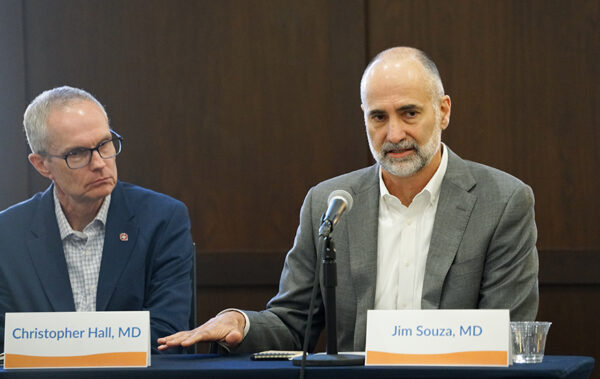
(PHOTO: MARC LUTZ, IBR)
How Idaho got here
For a few years, Idaho has ranked 50th in the nation for adequate health care staffing. Before the panel examined how the state could fix the issue, it looked at how landed on the bottom.
“We’re 50th out of 50 in terms of physicians per capita. We have about 3,500 physicians in the state of Idaho, but that leaves us about 1,700 physicians short,” Epperly said in giving the packed room a brief history lesson. “We’re 1,400 physicians short of the national average, and every one of our counties is a mental health shortage area and 43 of 44 is a physician shortage area. It’s taken decades for us to get here.”
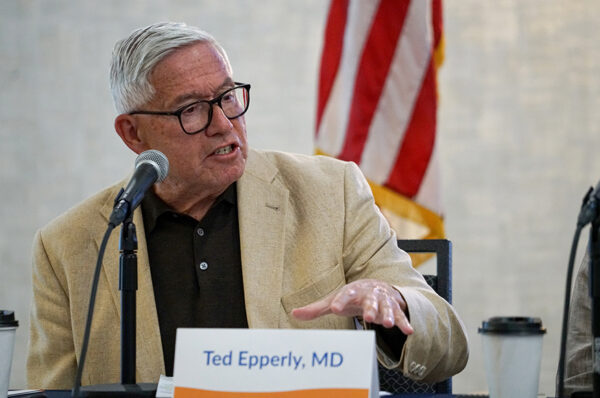
In what he called a “bit of a perfect storm,” Epperly outlined five reasons why the state has come up short on doctors.
The first reason is that Idaho has had an underinvestment in health care workforce training, he said. Data reveals that 75% of people will remain within a 100- to 20-mile radius of where they were trained. But, he pointed out, the issue isn’t about medical schools, it’s about residency programs, for which there aren’t enough.
Secondly, the state faces geographical challenges with about 40% of the population in rural or “frontier” areas, making it difficult to recruit to those areas since many lack features physicians and their families are looking for in a place to settle down. Getting to patients in remote areas is also a challenge for health care.
Third among the reasons are demographic shifts with a large influx of people, many of which are retirees that require extra and specialized health care which puts more stress on the medical system, Epperly said.
Fourth, he said, “Idaho is a flyover state, so if you don’t know about the graphic, scenic beauty of Idaho, it’s hard to have that on your list if you’re from the East Coast.”
Lastly, he said, population growth is a major factor. “If you at data from this year’s U.S. Census Bureau report, Idaho is the second fastest state growing in the United States next only to South Carolina. Over the past five years, it’s the first and largest growing state in the United States,” he said.
“You put all of this together … we have more patients, more chronic disease, increase demand for health care, not enough providers. … You would think that because of this, our health care outcomes would also be last.”
That isn’t the case, Epperly said. According to a report from the Commonwealth Fund, Idaho ranks 19th in the country for health care outcomes. He believes that has to do with the state’s penchant for outdoor living, less smoking, more family support systems, a better quality of life and less chronic diseases.
“All of that is good, but if we don’t get on top of this problem now … the next five, 10, 15, 20 years will make us the next Appalachia in regards to our health care system and the health of our people.”

The business concern
Many in attendance, coming from business backgrounds, wanted to know how these shortages would affect their own workforce and operations.
“It’s an economic challenge to the entire state. … Health care contributes more than $10 billion to the Idaho economy,” Souza said. “If you’re a business leader, your people need health care, they need access, and when they need it, they need it to be good.”
As the leader of the IMA, Keller was able to explore those business impacts a little deeper, pointing out just how big of an impact health care has on Idaho’s economy.
“Physicians do have a tremendous economic impact and benefit to our communities to the tune of $1.34 million per physician,” she said. “In addition, Idaho physicians support 12 and a quarter jobs per physician in the community, so that’s directly and indirectly throughout the health care sector. They also contribute to our tax base to the tune of about $46,000 per physician in local and state tax revenue that’s generated.”

A bigger concern than the economic factor, Keller stated, was that Idaho has lost more than one-third of its OB-GYN physicians over the past few years due to its laws on abortion. “When companies are trying to recruit workers and retain their workers in Idaho, I don’t think it’s unreasonable to want to secure health care access for half the population in our state. … Our state laws do have an impact on our workforce.”
Fife said that access should be a major concern for employers. “If your employees don’t have access to primary care, then they’re going to lose more time from work. It’s going to impact your bottom line as business leaders.”
She added that it’s even more important in rural areas since employees might have to travel further for appointments or forgo seeing a doctor altogether to avoid missing work.

More than doctors
It’s not just a lack of physicians that should be concerning, the panel pointed out. Support staff is also needed throughout the state’s health care industry.
“It’s amazing how one, single physician directly can work with three to five people [in a primary care office],” Hall said. “In a lot of our highly complex teams, like our trauma team, at Saint Alphonsus, the team that really takes care of you is probably a dozen people. And they have to be experts in every single thing they do.”
Those positions can be anything from pharmacy technicians to lab technicians and many other jobs that comprise what Hall said was “one one-thousandth of our team, so every single person is really, really import.”
Fife said that the need is also in other areas such as behavioral health, dental practices, administrative services, allied health professionals and others. “There’s a difference in hard to fill roles … and hard to keep roles. … It really is a balance of recruitment and retention.”
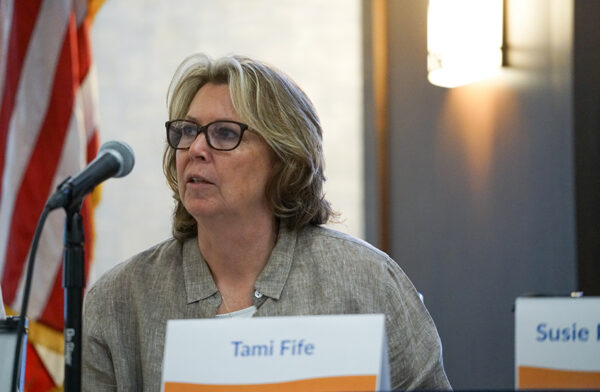
When it comes to the rural areas, she added that health care systems want experienced health care providers who want to live and work in those areas rather than commute. And in places like McCall and Sandpoint, there is a housing issue, making it more difficult for support staff to relocate to those areas. “There are health systems that I know that either have to provide housing or some sort of stipend, so when you think about what [positions] are hardest to fill, it really depends on the need of the community.”
What’s the best medicine?
One option that health systems have used is importing physicians from other countries. Highly skilled individuals with years of experience who want to come practice in the U.S. are available, however, Souza pointed out, those people come with increased financial risks for systems.
“The investment in a single human individual, highly trained, competent, ready to jump in, runs you right around $130,000 to $150,000 with unclear outcome at the end of it,” he said.
Much of the risk comes from not only the physicians securing visas, but from having to go through additional certification and residency training for U.S. requirements. Once that happens, they have to return home for two years before being able to return and work in the States. Yet there is no guarantee that a person will return.
There is a type of “apprenticeship” program, Souza said, that would allow foreign-trained physicians to work under a licensed and board-certified doctor, in essence earning a pathway to being able to practice here. It’s an option that is gaining support but will require more of a national effort.
For the educational pipeline, Keller said that in Idaho close to 300 medical students are being trained per year. “The next phase to determine where physicians are going to practice in their specialty is residency training. Right now, we have about 90 residency slots. This part of the medical education pipeline is very robust, and we have a little bit of a challenge here with the residency training.”

She added that the Idaho Medical Association and other organizations have been working to get state funding for residency opportunities. “This is one area where we have been very quite successful with the Idaho Legislature. We’ve been able to double the number of residents and programs that we have.”
Keller also said that physicians who train in Idaho tend to stay in Idaho. “We may rank last in the number of physicians to population ratio but we rank in the top five states in the country for retaining the residents that train here. … That’s something we should be really proud of and something we should continue to grow on.”
The fourth installment of Idaho Business Review’s Breakfast Series will be held on Aug. 4, 2026, and will focus on the construction workforce in the state.



 Loading ...