Sign In
Upcoming Event
 Free Newsletter

Panelists discuss employee, community health at Idaho Business Review Breakfast Series event
Alx Stevens//August 16, 2022//
Panelists discuss employee, community health at Idaho Business Review Breakfast Series event
Alx Stevens//August 16, 2022//


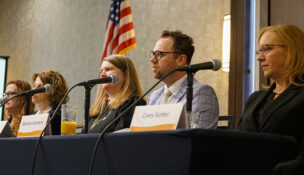
Employee health, community resources and almost everything in-between came together as panelists discussed what it means to keep Idaho healthy at Idaho Business Review’s Aug. 4 Breakfast Series event.

Five health care stakeholders — Mary Biddle-Newberry, Patrick Fithen, Rex Force, Jill Murphy and Elke Shaw-Tulloch — shared their perspectives on individual health and what that could mean for company leaders. Of almost immediate consensus was the point that employee health extends to life outside the workplace. Panelists also highlighted the opportunity for company leaders to partner with local and statewide health care resources, as a support network for the individual can be helpful.
The discussion was moderated by Susan Olson, chief financial and operations officer for presenting sponsor Hawley Troxell. Breakfast was sponsored by The Grove Hotel, where the event was held. The College of Western Idaho, Gallagher, Optum and Unite Us also supported the event. A Q&A session followed the moderated discussion.
Guidance for employers: Promote wellness
What practices and approaches are becoming more widely used, and why?
“I believe it is just so important to look at the employee as a whole,” Murphy said, explaining that, typically in the past, companies “used to just provide a job,” where employees come in, get paid, and the company “really didn’t worry about what was happening outside of work.”
“Now we really want to focus on, ‘How do we make sure that their mental well-being is strong; their physical well-being is strong; emotional well-being is strong,’” said Murphy, senior HR business partner at Agri Beef and president of HRATV, adding that the goal is to provide a supportive environment including through partnering with other agencies. “We’re seeing everybody battle, and there’s so much going on outside of the workplace. We need (and want) our employees to be healthy; we want them to be able to come into work and if they’re not able…that shuts down operations for us.”
Shaw-Tulloch said she appreciated hearing that the whole person’s well-being is being considered by employers in and outside of work, because part of her role as the Division of Public Health administrator for the Idaho Department of Health and Welfare is helping with intervention for every Idahoan at every stage of life.
“Because of course you need healthy employees to come into your businesses and your businesses can’t be healthy unless you have healthy employees,” Shaw-Tulloch said. “So, one of the things that I’m encouraging businesses and communities to do is start looking at root causes of poor health in their communities and how can they make investments.” These do not necessarily need to monetary, rather “How can we collectively come together in communities to address those things that influence people?”

Tuning into the entire span of health issues resonated with Force, who is the vice president for health sciences and senior vice provost for Idaho State University (ISU).
“One of the things that we’re really working on now is, ‘How do we address, from a workforce perspective, the needs of the state of Idaho?’” Force said. “We have the fastest-growing state. Everybody knows the demographics of the United States in terms of people getting older and needing more health care. We have a shortage in the state of literally thousands of nurses, and many other health disciplines.”
One of the next steps, he added, is looking at how to ramp up addressing those challenges in an efficient and effective way.
What Idaho health trends are you seeing in your work that the business community should be aware of?
Murphy responded, “We are seeing a higher utilization of health care but at a higher level of care. Some of that is over the last couple of years not able to get some preventive checks and things like that, but people haven’t gotten around to doing those. We are a self-funded organization for our health care, so we want to see people do preventive medicine; do their wellness checks; do those types of things, because when they’re not going in, they are at these things (such as stage four cancer) that they didn’t check on.”
She added, “That’s where our wellness initiatives are coming out — looking at doing wellness fairs, biometric screenings on site, things that we can do for people to bring medical care to them if they’re not willing to go and get it.”
Shaw-Tulloch said, “We’re seeing a lot of our health going in the wrong direction. We’re seeing diseases due to heart disease, unintentional injury, drug overdose and suicide death increasing as well as obesity rates increasing across the state. Those are bottom-line indicators for us, and employers, to think about.”
This is where looking at root causes comes into play.
“It’s been mentioned multiple times, the importance of looking at not just wellness for employees, but well-being and how we make sure that our businesses and our communities have both a pandemic- and recession-proof well-being and wellness measures in place,” she continued. “Those days of just handing somebody a pedometer and saying ‘good luck and go get some exercise’ are over. We really need to think about that whole person, their behavioral health needs, the community connectedness, that belongingness they need in their environment, all those social measures too that are super important for helping people have opportunities.”

“We’ve seen a lot of people leave health care (in Idaho and nationwide),” Force responded. “One of the other things that we need to be thinking about, especially in Idaho, as it’s a rapidly growing state, is health care is infrastructure. We are not going to be able to move forward as a state as our communities grow without that health care infrastructure, just like you need to build roads and bridges and everything else. We’ve got to build that infrastructure. If we don’t think about investing in health care at a business level, but also at the wider infrastructure level, I think that we’re going to be falling even further behind and we’re playing catch-up already.”
What is one thing you wish business managers or supervisors considered as they think about health care for their workforce?
“Support is incredibly important,” Force said. “I’ve been at ISU for 29 years; I’ve had a few different roles, but I’ve had one employer for that time, and that’s not common. And we’re seeing that not only in academics but also across the workforce, people moving from one job to the next. And frequently, that’s related to health, whether it’s mental health or physical health. Support for some of the mindfulness activities and being able to access health care during the workday, for example, those are really important things, particularly when we’re dealing with a scarce resource. Making sure that we have the right policies in place to allow flexibility for people to take care of themselves is a really big part of retaining a healthy and happy workforce.”
Fithen, CEO of A Body & Mind Health Services, expanded on those comments: “Everyone really needs to invest in their employees’ well-being. I want to know about what’s going on with all the employees. I don’t just do a strict, ‘You have two weeks off and your set number of holidays during the year; I have this kind of open policy, ‘Cover your work, make sure that it gets done and let’s help each other out.’”
He added: “Talk to your employees about mental health. Maybe your employees can access free counseling, but how many of them actually access it and use it? It’s really good to have meetings to promote using those resources. A lot of your life insurance companies will actually cover a gym membership or reimbursement…This has to be a culture about taking care of family (and) ourselves so that we do our best job.”
Biddle-Newberry, director of the YMCA Healthy Living Center for the Treasure Valley Family YMCA, said, “As an employer, really do your very best to learn and understand” about diseases affecting employees. “How does that disease affect the body? What type of treatments and surgeries are required? What are the limitations that come with that? And what accommodations — to your very best ability, of course — might you be able to make for this individual so that they can continue to be productive?”
“Get to know your employees as people so they’re comfortable coming to you and saying, ‘Hey, I’m fighting this battle right now…This is the accommodation I need,’” Murphy said. “Have those regular meetings just to say, ‘Hey, what’s going on in life? What did you do this weekend?’”
This includes the team as a whole, she added, while encouraging that employees get to know each other.
“Because the cohesiveness that you can build together is huge,” Murphy said. “And if they don’t have that trust in you, they’re not going to come talk to you when things are not going well. Just say ‘hi’ in the morning…Everyone wants to be acknowledged and feel appreciated and as a business leader, as a supervisor, you have so much impact on that.”
Shaw-Tulloch said, “As a manager and a supervisor…you need to model some behaviors, like help-seeking behaviors, and taking time off for yourself and showing up and getting the wellness activities in for yourself as well. Just like being a parent, you can’t really support your kids if you’re not taking care of yourself.”
Health care industry insights
What practices and approaches are becoming more widely used, and why?
“I’m really excited to see that we’re finally kind of taking a more proactive versus a reactive approach,” said Biddle-Newberry. “How do we either try to prevent somebody getting to that point of having that diagnosis or if they do have that diagnosis, ‘How can we really help individuals well with that?’”
She added that quality of life — defined at the individual level — always needs to be at the forefront of mind and program delivery.
“Maybe for a 27-year-old mom who has breast cancer, she wants to be able to pick up her 2-year-old again…Maybe it’s the 55-year-old gentleman who wants to go back to playing tennis, or it’s my 87-year-old grandmother who wants to go back to knitting club. (Give) people the skills and the tools to get back to that,” Biddle-Newberry said. “When you think of a chronic disease, how would an individual — unless they are in the field of health — have the knowledge and the skillset to be able to return to normal health without having a team to do that?”
“Coming from the behavioral health field, it’s kind of not known, but in a lot of our practices, we don’t take care of our own behavioral health practitioners. And why I kind of went into business for myself is a lot of places didn’t offer benefits or employee perks and I wanted to change that,” said Fithen.
After three years in business, Fithen said he feels the practice has been successful because, “We implemented health care for our employees. We do a paid mental health day; we partnered with Axiom to get paid gym memberships for our employees, because a lot of our employees worked with caseloads with 30,40, 50 people…and a lot of people don’t know about all the notes, the treatment plans, all the paperwork and I wanted them to be able to turn it off so (that) we have that high employee retention, which there’s always a high turnover in the behavioral health field.”
Fithen added, “I’m really happy to see that more mental health agencies are kind of taking that approach and it’s important to take care of your body and mind and be able to be whole and do your best job when you’re working with behavioral health.”
What Idaho health trends are you seeing in your work that the business community should be aware of?
“We’re trying to educate people about taking care of their body and how that impacts their mental health,” Fithen said. “And so, when we have somebody come in for an intake (we) provide them a packet of information with some great tools and resources on how you can eat healthy; a way that you can get a gym reimbursement even if you have Medicaid and just a lot of community involvement and getting outdoors. A lot of people forget why we live in Idaho and that’s not to be in a city, that’s the outside.”
Biddle-Newberry highlighted focus on continuum of care while adding that there are so many facets that fall in that.
“The reality is, there’s not one entity that can really address every single one of those (facets) and do it well. That’s an unrealistic expectation,” she said, while also providing an example of someone being diagnosed with Parkinson’s: that individual may be referred to programs at her organization, but they are no longer able to drive.
“That’s where we have to look at those (facets),” she added.
Biddle-Newberry also highlighted one of the benefits of having an individual come into a community setting: sometimes a patient will come in several times a week; those in the community setting are likely to notice developing limitations for that patient and they could potentially make referrals back to other members of the patient’s health care team that may see the patient only a couple times a year.
What is something that you are seeing more commonly?
Shaw-Tulloch said, “We’re seeing more initiations of community investments…It’s important for businesses to be involved. So, it’s not just health care entities or local public health agencies that are involved in those, but it’s also that whole spectrum of who represents the community.”
She also expanded on Biddle-Newberry’s patient example: while that patient might have great support, such as getting transportation to and from the clinic, that individual might face a challenge, for example, of getting around in their neighborhood if they are wheelchair bound and the sidewalks are not connected well.
“It’s raised an for opportunity for businesses to get involved and do those things across the state,” Shaw-Tulloch said.
Force said, “More health professionals are really practicing at the top of their license; that’s out of necessity when we’re dealing with shortages in certain areas. Practicing at the top of the license and being able to do the full breadth of care that our health care that our professionals are trained to do is going to be very important moving forward.”
Additionally, he said, “As we move forward, we’re going to see more integration of technology, (such as) artificial intelligence and telehealth, and how we utilize technology in a way to really impact people’s health…it’s here.”
Expanding on telehealth, Fithen said, “That’s really just opened doors to people in our state for receiving services. 52% of (our clients) wanted to stay (on) telehealth…That’s now a door that’s open; we can better serve Idaho with more behavioral health services.”
Biddle-Newberry said, “We used to think that a diagnosis came with age…but really what we’re seeing is this uptick of early onset of Parkinson’s, of dementia, just disease at a much earlier age in general…This is not going away. We’re starting to see it earlier and we really need to be aware of that.”
“From the employee side, (we are seeing) increasing expectations,” Murphy said. “We are in a global workforce now. As HR practitioners, we’re fighting to get employees…just trying to keep up with those expectations, making sure that we have these opportunities for employees, that will continue to be a struggle for us…There’s just so many more opportunities out there for people and you just have to keep those top of mind…but then (also) supporting (employees) and saying, ‘What can we do to help you get to where you want to be?’ And just looking at the overall picture rather than just being focused within your own company.”
MODERATOR
 Susan Olson, COO/CFO, Hawley Troxell
As the Chief Operating/Chief Financial Officer, Susan Olson provides leadership on firm finances, operations, growth and business initiatives. She joined the firm in 2001 after spending time in the health care and finance industries. Guided by the firm’s objectives, culture and the ethical requirements of the legal profession, Olson is responsible for all financial and operational functions of the 75+ attorney law firm. She is at the forefront of the firm’s mergers and acquisitions strategies. It is her duty to ensure the firm meets its financial goals and objectives and has the proper operational controls and people systems in place to achieve the firm’s business objective — exceptional client service. She provides constant attention to the improvement of the organization to ensure financial strength and operating efficiencies of the business of law. Olson is a Certified Legal Manager.
PANELISTS
 Mary Biddle-Newberry, Director, YMCA Healthy Living Center
Serving as the director of the YMCA Healthy Living Center (Y-HLC) for the Treasure Valley Family YMCA in Boise, Mary Biddle-Newberry oversees disease prevention and management programs that focus on promoting well-being, reducing the risk of disease and reclaiming health by helping individuals adopt healthier lifestyles and make a significant and positive impact on quality of life, reducing incidence of chronic disease and the cost of health care. Working alongside community partners, Biddle-Newberry focuses on delivering accessible, evidence-based programs that demonstrate both an improvement in Treasure Valley residents’ health and a savings in health care costs. She has created and implemented a variety of programs, supporting and addressing the many diverse needs of chronic disease in the pursuit of an individual’s better health and well-being. She holds a bachelor’s and Master of Science degree, is a certified medical exercise specialist and holds multiple nationally recognized certifications in numerous modalities of exercise.
 Patrick Fithen, CEO, A Body & Mind Health Services
Growing up, Patrick Fithen knew he wanted a career where he could help people. Fithen graduated from Boise State University in 2008 with a degree in social science and criminal justice, and after 15 years in the mental health sector, he saw a void that needed to be filled. So in 2019, along with his best friend from high school, Fithen decided to launch A Body & Mind Health Services with a mission of helping both clients and employees. Fithen’s company combines mental health care with physical fitness, nutrition and healthy social circles. Fithen also strives to bring awareness to mental health, and to remove the stigma that’s often attached to discussing mental health with others. He’s also an advocate for getting people to be more active and enjoy the outdoors.
 Rex Force, Vice President for Health Sciences & Senior Vice Provost, Idaho State University
As vice president for health sciences — named to the role in 2016 — and senior vice provost, Rex Force, PharmD, has been praised for his contributions in leading the health care education mission of the Kasiska Division of Health Sciences at ISU and in response to the COVID-19 pandemic. He joined the university in 1993 as a faculty member and later directed the Family Medicine Clinical Research Center before serving as the associate dean for clinical research in the Kasiska Division of Health Sciences. He has authored multiple publications and conducted extensive clinical research. His contributions include work in trials that have helped to define the current treatment of high blood pressure, diabetes and high cholesterol. In addition, his work at ISU has involved solving rural health issues.
 Jill Murphy, Senior HR Business Partner, Agri Beef & President, HRATV
In addition to her human resources role with Agri Beef, Jill Murphy is serving as the 2022 president for the Human Resources Association of Treasure Valley (HRATV). Her love of HR unknowingly began when she owned and operated a Pita Pit franchise shortly after graduating from college. Hiring, training, leading and developing incredible people is her passion. She is a proud Vandal with degrees in marketing and Spanish from the University of Idaho, and she received her master’s in HR management from Webster University.
 Elke Shaw-Tulloch, Division of Public Health Administrator, Idaho Department of Health & Welfare
As the administrator of the Idaho Department of Health and Welfare’s Division of Public Health, Elke Shaw-Tulloch is also the state’s public health officer. She has worked for the Department of Health and Welfare since 1996 and was promoted to division administrator in 2012. Since February 2020, she has focused a majority of her time on responding to the coronavirus pandemic.



 Loading ...