Sign In
Upcoming Event
 Free Newsletter

Former CEO seeks to raise business standards around the world
Benton Alexander Smith//May 3, 2016//


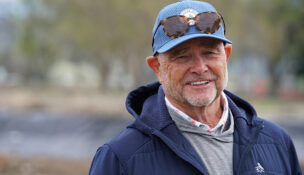
Pete Gombert had served as the CEO of Balihoo for a decade when he stepped down in 2014 to take on a reduced role as chairman.
Then, he set out to become a better corporate citizen. He took a 10-month trip around the world with his family in 2014 and 2015. While he didn’t set out to learn about poverty in the developing world, Gombert encountered examples of child labor, forced labor, poverty-level wages and unsafe working conditions.
When he returned, Gombert founded GoodWell, a coalition set up to make companies more accountable for the labor practices they support in other countries.
Gombert said much of the poverty, child labor, and other problems he saw on his trip could be traced to companies that operate in the United States and other Western countries. Many claim the goods are sourced responsibly, Gombert said. But the several supply chains involved mean the companies are too far from the labor conditions to be connected to them.
He described a Cambodian slum where the only housing structures were tin shacks and the poorest residents lived in crawl spaces between the shack and the ground.
“I asked what they had done to end up there. I asked if it was because of drugs, but it turned out that everyone living there worked at least 40-hour weeks at a nearby factory,” he said. “At that moment I realized I was going to spend the rest of my life trying to eradicate that.”
Gombert was already intrigued with corporate responsibility while at Balihoo. Before his trip, he read books by the owners of companies such as Patagonia and Whole Foods about being a better corporate citizen. Those principles accompanied him on his 10 month travels in Europe, Africa, Australia and southeast Asia, where he knew he would see the impact of western companies.

But “I didn’t leave with the intent to start GoodWell,” Gombert said.
Gombert plans to get one million members to join his coalition for a one-time membership fee of $35. The $35 million will create an endowment fund that will finance the coalition, now financed by Gombert, in perpetuity.
There are other nonprofits that certify businesses in this area. Gombert said most of Goodwell’s 13 metrics will ensure that employees are treated fairly, including that the business does not employ children under the age of 14 for more than 15 hours a week, has less than 10 work-related injuries per 200,000 hours, and ensures that wages are paid equally between genders and races. GoodWell asks companies not to use forced labor, destroy the environment, and to give at least 1 percent of profits back to the community.
About 220 people in six countries have joined the coalition since it was announced in December.
“So many of us live in blissful ignorance,” Gombert said. “I think the average person does care, but when you walk into H&M and buy a pack of T-shirts for $7 you don’t add up that you can’t stitch the shirt together, transport it all the way to Boise Town Square Mall and sell it for that price while paying decent wages.”
Kallen Hayes, a business attraction specialist who in December became Goodwell’s 23rd member, said it’s hard for consumers to know which companies produce their wares responsibly.
“In my personal life I want to make sure that my purchasing habits are supporting products made in a socially conscious manner,” Hayes said. “It’s really hard to do that unless you are committed to shopping at a few stores that have their industry-specific information listed and to do the research required to know if your favorite brand is operating responsibly or not. It is really burdensome.”
The most important metric that GoodWell uses monitors supply chains. In order for a company to become GoodWell-certified, it has to strive to work with only GoodWell-certified companies. The first year a company is certified, 20 percent of the companies it works with have to be certified as well, and each year that standard becomes more stringent. A company is expected to only work with other GoodWell-certified companies by year 10.
With this metric in mind, Gombert is targeting Wal-Mart and its 3,000 direct suppliers as one of the coalition’s first big marks. He has talked with representatives of Wal-Mart and hopes to meet with the company in the coming months.
“Most of those shipping chains are three to 12 layers deep so you will have this cascading effect,” Gombert said. “If we were to get Wal-Mart it will affect 2 million businesses.”
Nobody gets paid for their part in GoodWell, but 14 volunteers help Gombert spread his message.
Aiming for the worst offenders makes sense, said Leif Elgethun, founder of the Boise-based startup Retrolux who signed up as a member of GoodWell while watching Gombert discuss the company March 30 at Trailhead.
“There is nothing going on at the bottom in order to raise standards above the level of deplorable,” Elgethun said. “It’s like construction. You have good construction companies out there and you have some that do just enough to keep from breaking the law.”
A night in Thailand
Gombert said he encountered poor business practices all over the world. One was the island of Ko Lanta in Thailand, where on the beach at night, he noticed green lights on the horizon.
“I have always been a curious person so I went online to see what they were and it turned out they were shrimping boats,” Gombert said. ” I also found information about the Thai fishing industry and it turns out it is mostly comprised of forced labor.”
Four Associated Press reporters have since won the Pulitzer prize for Public Service for their investigatory piece detailing the conditions that fishermen in southeast Asia work in and how much of the fish sold in the United States is caught by slaves.
“Everywhere you turned there was another example of business exploitation,” Gombert said. “The stories about the Thai fishermen were horrific.”
How to become GoodWell-certified
There are three parts to becoming GoodWell-certified.
All GoodWell-certified companies must measure the 13 metrics that GoodWell monitors. Each metric has a pass/fail threshold and companies must pass all 13.

The companies have to have their metrics audited by an independent third party on an annual basis to ensure that the results of the company’s measurements are valid.
The companies also must purchase supplies from other GoodWell-certified companies. This practice forces other companies to raise their standards to ensure that businesses aren’t hiding unethical practices beneath a supply chain.
If enough large supply chains change their business practices, GoodWell might be able to improve the world, Gombert said. He’d like to see businesses sign on and push each other to become certified.
“Implementing these standards with thousands of companies would make GoodWell successful, but would not really enact systematic change,” Gombert said. “You have to get enough people to buy in to change the economics of it all.”
Jennifer Isenhart, principal at Wide Eye Productions, was one of GoodWell’s first members. Her Boise-based production company works with large firms such as Apple, Sony and Adobe, over which it has little influence. Therefore, Wide Eye can’t be certified with GoodWell.
“My goal is to influence others in my industry to join together and then together we might be able to have influence,” Isenhart, said. “As seven employees in Boise, Idaho, we aren’t going to be able to tell Apple how to be corporately responsible. I think our only hope to become GoodWell-certified is to join with others in the industry.”